

Research notes

Mazdutide vs Retatrutide: How the Dual and Triple Agonists Compare

Mazdutide is a once-weekly GLP-1 and glucagon receptor dual agonist; retatrutide is a triple agonist that adds the GIP receptor. Mazdutide was approved in China in 2025 for weight management and then type 2 diabetes, and its phase 3 GLORY-1 trial reported a mean weight change of −14.01% at 48 weeks with 6 mg. Retatrutide remains investigational, with a phase 2 obesity result of up to −24.2% at 48 weeks and one published phase 3 trial. The trials differ in population and design, so neither can be ranked above the other, and neither has EMA authorisation.

9 min readUpdated 22 Sept 2026Reviewed by Independent EU laboratory (ISO/IEC 17025)
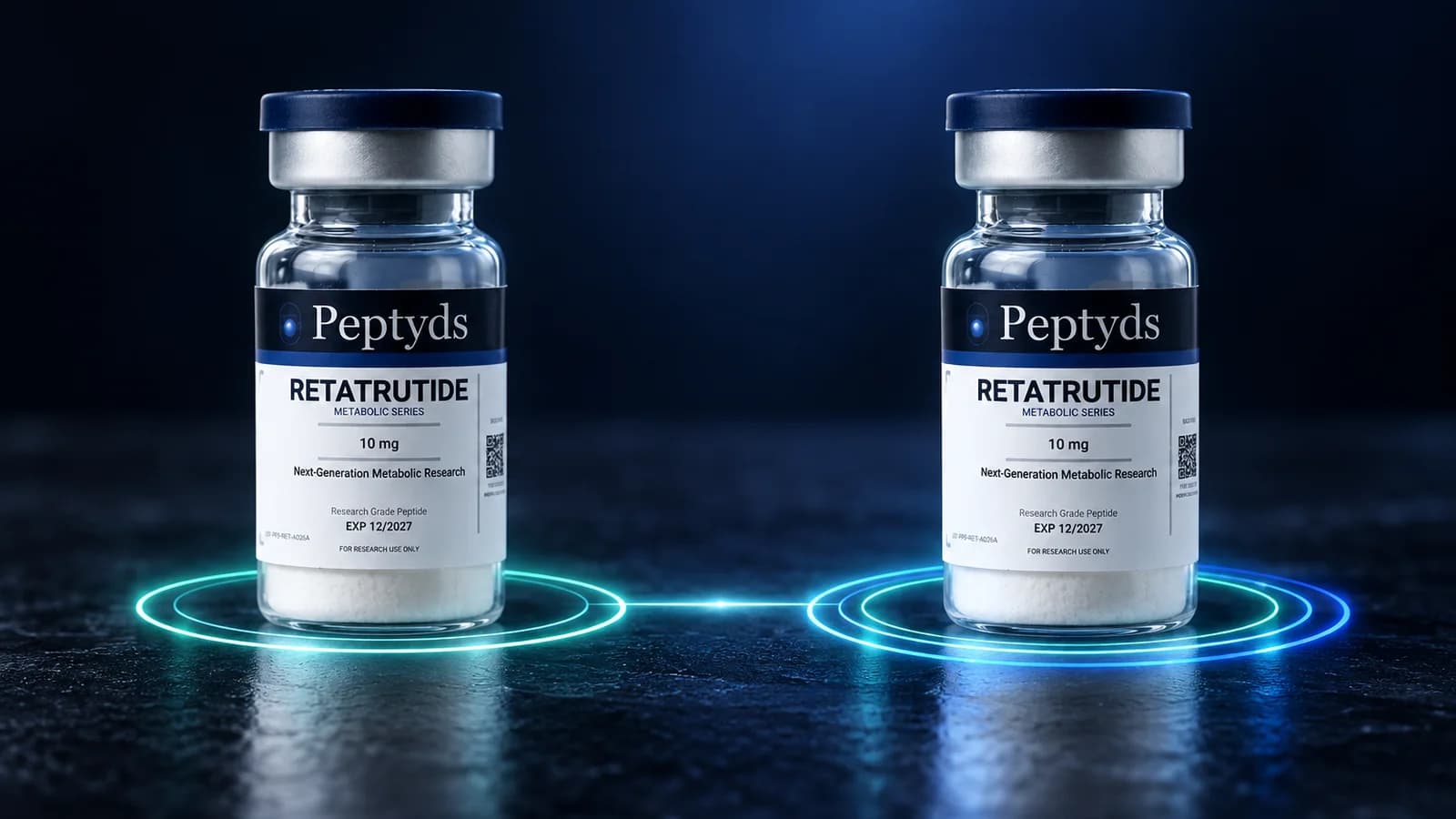
Two sealed Peptyds retatrutide research vials on separate rings of blue light, joined by a thin beam across a dark surface.
Jump to section
  1. 01What is mazdutide?
  2. 02Mazdutide vs retatrutide: what is the receptor difference?
  3. 03What have the mazdutide trials shown?
  4. 04How does the retatrutide evidence compare with mazdutide?
  5. 05Where does survodutide fit among GLP-1/glucagon dual agonists?
  6. 06What side effects do the dual and triple agonists share?
  7. 07Are mazdutide, survodutide or retatrutide approved in Europe?
  • Mazdutide activates the GLP-1 and glucagon receptors; retatrutide adds the GIP receptor, which makes it a triple agonist.
  • Mazdutide received its first approvals in China in 2025, for weight management and type 2 diabetes; retatrutide is still in clinical development.
  • GLORY-1 reported mean weight changes of −11.00% and −14.01% at 48 weeks in Chinese adults; retatrutide's phase 2 trial reported up to −24.2% at 48 weeks in a different population.
  • Cross-trial comparisons are unreliable: a 2026 network meta-analysis rated the certainty of the evidence for both as very low to low.
  • Survodutide is the other GLP-1/glucagon dual agonist with phase 3 data, and none of the three has EMA authorisation.

Discussed in this guide

  • SemaglutideA GLP-1 receptor agonist studied for its effects on appetite regulation and metabolic signalling — investigated in weight and metabolic support contexts.5 mg · 10 mg€5.00 / mg
  • RetatrutideA triple agonist peptide targeting GIP, GLP-1, and glucagon receptors — studied in advanced metabolic and weight-regulation contexts.10 mg · 60 mg€4.32 / mg
  • TirzepatideA dual GIP/GLP-1 receptor agonist studied for its effects on appetite regulation, metabolic balance, and body composition — framed for clinician-guided routines.10 mg€6.50 / mgOut of stock

What is mazdutide?

Mazdutide (development codes LY3305677 and IBI362) is a once-weekly peptide that activates two receptors: the glucagon receptor and the GLP-1 receptor. It was developed by Eli Lilly together with Innovent Biologics. In June 2025 it received its first approval, in China, for long-term weight management in adults with a BMI of at least 28, or at least 24 with a weight-related condition, and a second Chinese approval, for glycaemic control in type 2 diabetes, followed in September 2025.[1]

Mazdutide is also under clinical evaluation for metabolic dysfunction-associated fatty liver disease, obstructive sleep apnoea and alcohol use disorder. Its phase 3 obesity trials, GLORY-1 and GLORY-2, were run in China, and a US phase 2 dose-ranging trial was published in 2026.[1][2][3][6]

Continue reading:Read the complete retatrutide guide

Mazdutide vs retatrutide: what is the receptor difference?

The two molecules share the GLP-1 and glucagon receptor arms. Retatrutide adds a third, the GIP receptor, at which its discovery paper reported stronger activity than at the other two. Mazdutide is therefore a dual agonist and retatrutide a triple agonist, and the GIP arm is the structural difference between them.[1][7]

The glucagon arm is what both compounds have in common. Reviews describe glucagon as stimulating lipolysis and fat oxidation in the liver, reducing calorie intake and raising energy expenditure, the last shown at least in animal models. Because glucagon also raises blood glucose, glucagon-based compounds pair it with GLP-1 receptor activity; mazdutide, survodutide and retatrutide all follow that logic, and how chronic glucagon-receptor activation behaves in humans is still being worked out.[13]

What the GIP arm adds on top is a question the available comparisons cannot settle, because they are indirect. A 2026 BMJ network meta-analysis placed mazdutide and retatrutide among emerging agents that may produce weight reductions similar to or greater than established drugs, and rated the certainty of that evidence as very low to low.[15]

What have the mazdutide trials shown?

In GLORY-1, published in the New England Journal of Medicine in 2025, 610 Chinese adults with a BMI of at least 28, or 24 to 28 with a weight-related condition, received weekly mazdutide at 4 or 6 mg or placebo for 48 weeks. Mean body weight changed by −11.00% and −14.01% at week 48, against +0.30% with placebo, and 35.7% and 49.5% of participants reached a reduction of at least 15%, against 2.0%.[2]

GLORY-2 (JAMA, 2026) tested a higher 9 mg dose in 461 Chinese adults with a BMI of at least 30 for 60 weeks. Body weight fell by 16.65%, against 1.50% with placebo. Gastrointestinal effects were frequent: vomiting was reported in 53.1% of the mazdutide group, nausea in 46.9% and diarrhoea in 39.4%, mostly mild to moderate.[3]

In type 2 diabetes, two phase 3 trials published in Nature in 2026 reported HbA1c reductions against placebo at 24 weeks (DREAMS-1) and superiority over dulaglutide 1.5 mg at 28 weeks, with greater weight loss than dulaglutide (DREAMS-2). Outside China, a 179-person US phase 2 trial reported 32-week weight changes of −7.3%, −15.6% and −18.1% in its 3–6 mg, 10 mg and 16 mg groups, against −0.9% with placebo; 20% of the 16 mg group stopped treatment because of adverse events.[4][5][6]

How does the retatrutide evidence compare with mazdutide?

Retatrutide's obesity data come from a 48-week phase 2 trial of 338 adults without diabetes, in which mean body weight fell by up to 24.2% against 2.1% with placebo. Its first peer-reviewed phase 3 trial, TRANSCEND-T2D-1, reported weight reductions of up to 15.3% at 40 weeks in people with type 2 diabetes.[8][9]

Setting those numbers beside mazdutide's is tempting and mostly misleading. The trials differ in population (GLORY-1 enrolled Chinese adults from a BMI of 28, or 24 with a weight-related condition; the retatrutide phase 2 trial started at 30, or 27 with a condition), in duration (48 to 60 weeks) and in phase. The network meta-analysis that compared them indirectly rated the certainty of the evidence for both as very low to low.[2][3][8][15]

The fair summary is about evidence shape rather than size. Mazdutide has regulatory approval in China and several published phase 3 trials; retatrutide has the three-receptor design and, so far, one published phase 3 trial. Neither record answers which molecule does more in the same population.[1][9]

Continue reading:Read Retatrutide vs Tirzepatide

Where does survodutide fit among GLP-1/glucagon dual agonists?

Survodutide (BI 456906) is the other GLP-1/glucagon dual agonist with published phase 3 data. In a 46-week phase 2 dose-finding trial of 387 adults without diabetes, body weight fell by 6.2% to 14.9% across the four doses, against 2.8% with placebo, and gastrointestinal adverse events occurred in 75% of participants on survodutide against 42% on placebo.[10]

In the phase 3 SYNCHRONIZE-1 trial (New England Journal of Medicine, 2026), 725 adults with obesity and without diabetes lost 12.2% and 13.0% of body weight at 76 weeks on the two doses, against 5.4% with placebo; gastrointestinal events occurred in 80.9% and 89.7% of participants, against 47.9%. A separate phase 2 trial in biopsy-confirmed MASH with fibrosis reported improvement in MASH without worsening of fibrosis in 43% to 62% of participants on survodutide, against 14% on placebo.[12][11]

What side effects do the dual and triple agonists share?

Across the mazdutide, survodutide and retatrutide trials, gastrointestinal effects were the most common adverse events, mostly mild to moderate and more frequent at higher doses. Discontinuation because of adverse events ranged widely, from 0.5–1.5% across the arms of GLORY-1 to 20% in the 16 mg group of the US mazdutide phase 2 trial.[2][6][12][8]

Heart rate is the signal reviewers watch most closely with glucagon co-agonism. A 2026 review found that mazdutide and survodutide generally raised heart rate to a similar extent as GLP-1 receptor agonists, but noted that at least one other dual agonist was discontinued partly because of large heart-rate increases and QT prolongation. In the retatrutide phase 2 trial, heart rate rose in a dose-dependent way and peaked at 24 weeks. The review concluded that cardiovascular effects must be clarified compound by compound in ongoing trials, including a cardiovascular-outcome trial of survodutide.[14][8]

Are mazdutide, survodutide or retatrutide approved in Europe?

No. As of September 2026, the European Medicines Agency's database of authorised medicines lists no product containing mazdutide, survodutide or retatrutide. Mazdutide's first approvals came in China in 2025, for weight management and then for type 2 diabetes; retatrutide is still described in the 2026 literature as under clinical development.[16][1][9]

Peptyds supplies retatrutide, tirzepatide and semaglutide as lyophilised research peptides for in-vitro laboratory work only, with batch documentation described on the quality page. It does not supply mazdutide or survodutide. None of these research products is a medicine, and none is intended for human use.

Continue reading:View RetatrutideRead the GLP-1 peptides overview

Sources

  1. [01]
  2. [02]
  3. [03]
  4. [04]
  5. [05]
  6. [06]
  7. [07]
  8. [08]
  9. [09]
  10. [10]
  11. [11]
  12. [12]
  13. [13]
  14. [14]
  15. [15]
  16. [16]

Questions

What is mazdutide?

Mazdutide (LY3305677, IBI362) is a once-weekly peptide that activates the glucagon and GLP-1 receptors. It was first approved in China in 2025 for long-term weight management and later for glycaemic control in type 2 diabetes.[1]

Is mazdutide the same as retatrutide?

No. Mazdutide is a dual agonist of the GLP-1 and glucagon receptors; retatrutide is a triple agonist that also activates the GIP receptor. They are different molecules with separate trial programmes.[1][7]

Is mazdutide approved in the EU?

No. As of September 2026 the European Medicines Agency's database of authorised medicines lists no mazdutide product. Its approvals so far are in China, for weight management and for type 2 diabetes.[16][1]

What is survodutide?

Survodutide (BI 456906) is another GLP-1/glucagon dual agonist. In the phase 3 SYNCHRONIZE-1 trial, adults with obesity lost 12.2% and 13.0% of body weight at 76 weeks on two doses, against 5.4% with placebo, and a phase 2 trial studied it in MASH with fibrosis.[12][11]

Which leads to more weight loss, mazdutide or retatrutide?

That cannot be answered from current data. The trials differ in population, BMI thresholds, duration and phase, and a 2026 network meta-analysis that compared the agents indirectly rated the certainty of the evidence as very low to low.[15][2][8]

Why does the glucagon receptor matter in these compounds?

Glucagon-receptor activation is linked to hepatic fat oxidation, lower calorie intake and higher energy expenditure, the last shown at least in animals. Because glucagon also raises blood glucose, it is combined with GLP-1 receptor activity, and its long-term effects in humans, including on heart rate, are still being characterised.[13][14]

Educational content. Not medical advice.

Next step

Choose the route that matches how you read.