

Shop by goal

Peptides for Weight Loss: What the Metabolic Research Actually Shows

The peptides with real evidence for weight loss are incretin-based: semaglutide and tirzepatide, which produced mean weight reductions of about 15% to 21% in large 68- to 72-week trials and are EU-authorised for weight management, and newer multi-receptor agonists such as retatrutide, which remain investigational. Weight is largely regained after these treatments stop. Tesamorelin reduced visceral fat in people with HIV, and MOTS-c has only animal data on obesity so far. Research peptides are not the same as authorised medicines.

8 min readUpdated 22 Sept 2026Reviewed by Independent EU laboratory (ISO/IEC 17025)
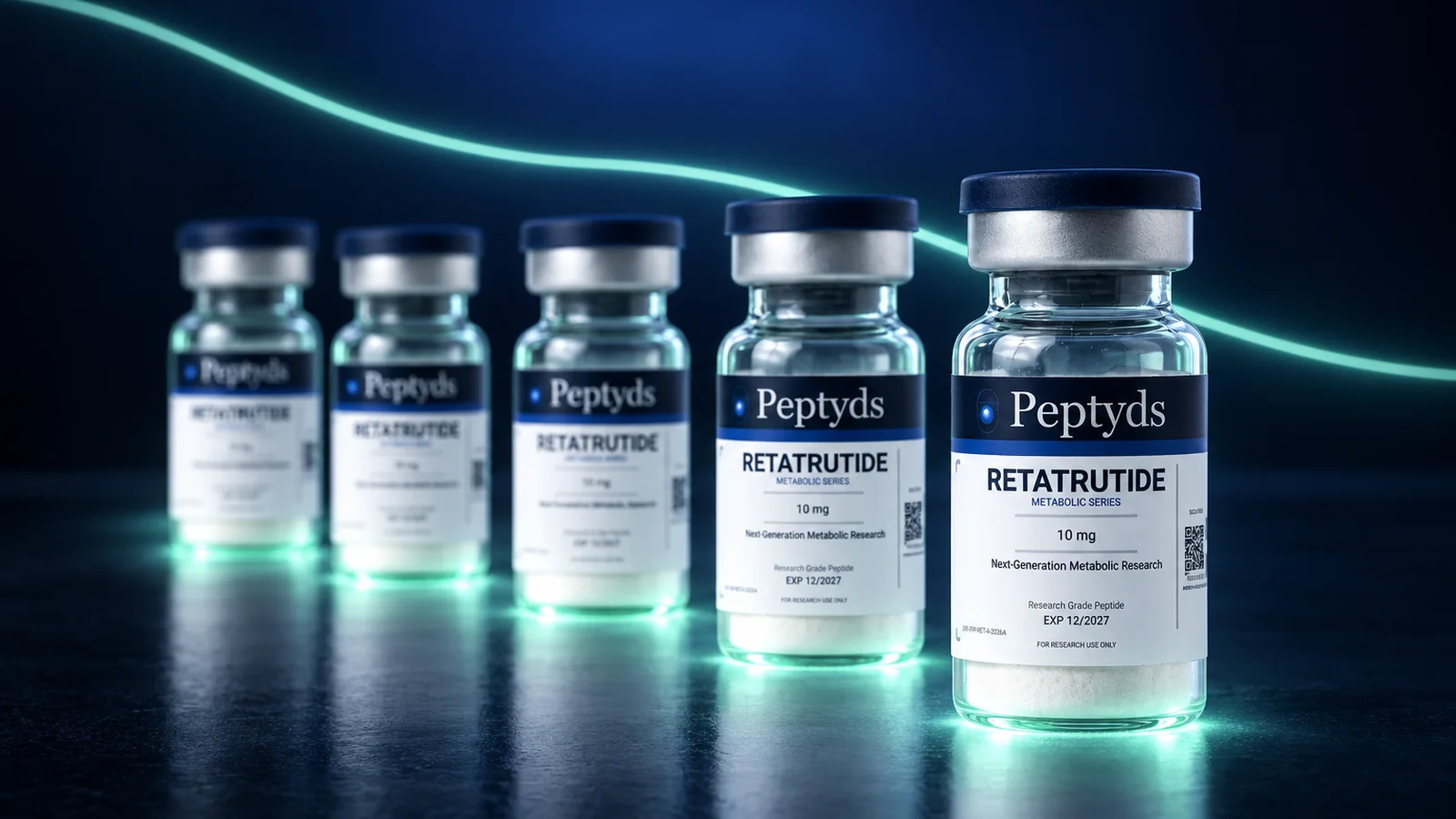
A row of five sealed Peptyds retatrutide research vials, growing in size from left to right, beneath a curving line of mint light.
Jump to section
  1. 01Which peptides are studied for weight loss?
  2. 02Why do GLP-1-based peptides dominate the weight-loss evidence?
  3. 03What side effects do GLP-1-based peptides have in trials?
  4. 04What happens to weight when GLP-1 treatment stops?
  5. 05What about newer multi-receptor peptides such as retatrutide?
  6. 06What does the research show for tesamorelin and MOTS-c?
  7. 07How should claims about weight-loss peptides be read?
  • The weight-loss evidence is dominated by incretin-based peptides acting on the GLP-1 receptor, alone or with the GIP and glucagon receptors.
  • STEP 1 (semaglutide) and SURMOUNT-1 (tirzepatide) reported mean weight reductions of 14.9% and up to 20.9% over 68 and 72 weeks.
  • Withdrawal trials show most of the lost weight returns after treatment stops.
  • Retatrutide, mazdutide and survodutide show large effects in trials, but a 2026 network meta-analysis rated the certainty for the newest agents as very low to low.
  • Tesamorelin's data concern visceral fat in HIV; MOTS-c has mouse data and a phase 2a trial that is still recruiting.

Discussed in this guide

  • SemaglutideA GLP-1 receptor agonist studied for its effects on appetite regulation and metabolic signalling — investigated in weight and metabolic support contexts.5 mg · 10 mg€5.00 / mg
  • RetatrutideA triple agonist peptide targeting GIP, GLP-1, and glucagon receptors — studied in advanced metabolic and weight-regulation contexts.10 mg · 60 mg€4.32 / mg
  • TesamorelinA GHRH analogue studied for visceral fat reduction and body-composition support — used in clinician-supervised metabolic and growth hormone contexts.5 mg · 10 mg€6.90 / mg
  • MOTS-cA mitochondria-derived peptide studied for its role in metabolic regulation, insulin sensitivity, and cellular energy homeostasis — an emerging longevity-pathway molecule.10 mg€5.00 / mgOut of stock
  • TirzepatideA dual GIP/GLP-1 receptor agonist studied for its effects on appetite regulation, metabolic balance, and body composition — framed for clinician-guided routines.10 mg€6.50 / mgOut of stock

Which peptides are studied for weight loss?

When people search for peptides for weight loss, they are mostly asking about one family: incretin-based peptides that act on the GLP-1 receptor, alone or together with the GIP and glucagon receptors. Semaglutide (GLP-1), tirzepatide (GIP and GLP-1) and the investigational retatrutide (GIP, GLP-1 and glucagon) carry by far the largest body of human trial evidence.[1][2][7]

Two other names appear in the same conversations with very different evidence behind them. Tesamorelin, a growth-hormone-releasing factor analogue, reduced visceral fat in a randomised trial in people with HIV and abdominal fat accumulation. MOTS-c, a mitochondrial-derived peptide, prevented diet-induced obesity and insulin resistance in mice; its first placebo-controlled phase 2a trial in people with prediabetes was still recruiting in 2026.[10][11][12]

This page maps that evidence by type and strength. The molecule-by-molecule comparison of the incretin peptides lives in our GLP-1 overview.

Continue reading:Read the GLP-1 peptides overview

Why do GLP-1-based peptides dominate the weight-loss evidence?

GLP-1 is a gut hormone that stimulates insulin secretion, inhibits glucagon secretion, slows gastrointestinal motility and appears to be a physiological regulator of appetite and food intake. Native GLP-1 is inactivated very rapidly by the enzyme DPP-IV, so the peptides used in weight-management trials are modified analogues given once weekly.[6][1]

The trial programmes are large. In STEP 1, 1,961 adults without diabetes lost a mean 14.9% of body weight over 68 weeks on weekly semaglutide, against 2.4% with placebo. In SURMOUNT-1, 2,539 adults lost 15.0% to 20.9% over 72 weeks on tirzepatide, against 3.1%. SELECT, with 17,604 participants who had cardiovascular disease and overweight or obesity, found a lower risk of major cardiovascular events with semaglutide (hazard ratio 0.80).[1][2][3]

That depth is why both molecules are authorised medicines in the EU for weight management, as Wegovy and Mounjaro, used alongside diet and physical activity. Those authorisations cover specific pharmaceutical products with approved labels, not research compounds that share the same name.[15][16]

Continue reading:Compare semaglutide, tirzepatide and retatrutide

What side effects do GLP-1-based peptides have in trials?

Gastrointestinal effects dominate. In STEP 1, nausea and diarrhoea were the most common adverse events with semaglutide, typically transient and mild to moderate, and 4.5% of participants stopped treatment because of gastrointestinal events, against 0.8% on placebo. In SURMOUNT-1, gastrointestinal events were also the most common, occurring mainly during dose escalation, and 4.3% to 7.1% of participants on tirzepatide discontinued because of adverse events, against 2.6% on placebo.[1][2]

Longer exposure changes the picture. In SELECT, where the mean exposure was about 34 months, adverse events led to permanent discontinuation in 16.6% of participants on semaglutide, against 8.2% on placebo. Discontinuation figures from shorter trials should be read with their duration in mind.[3]

What happens to weight when GLP-1 treatment stops?

The withdrawal data are among the most important and least quoted results in this field. In the STEP 1 extension, participants who stopped semaglutide and the lifestyle programme regained two-thirds of their prior weight loss within a year, and most cardiometabolic improvements reverted towards baseline.[4]

SURMOUNT-4 tested the same question as a randomised withdrawal trial. After a 36-week tirzepatide lead-in, participants switched to placebo regained 14.0% of body weight over the next 52 weeks, while those who continued treatment lost a further 5.5%.[5]

Both trial teams reached the same conclusion: in these studies the effect lasted only as long as the treatment, which is consistent with obesity behaving as a chronic condition rather than one that a fixed course resolves.[4][5]

What about newer multi-receptor peptides such as retatrutide?

Retatrutide adds a glucagon-receptor arm to GIP and GLP-1 agonism. Its 48-week phase 2 obesity trial in 338 adults reported mean weight reductions of up to 24.2%, against 2.1% with placebo, with dose-related gastrointestinal effects and a dose-dependent rise in heart rate.[7]

Mazdutide and survodutide pair GLP-1 with glucagon agonism. In GLORY-1, Chinese adults lost 11.00% and 14.01% of body weight at 48 weeks on two mazdutide doses; in SYNCHRONIZE-1, adults with obesity lost 12.2% and 13.0% at 76 weeks on survodutide, against 5.4% with placebo.[8][9]

A 2026 BMJ network meta-analysis of 262 trials puts these figures in proportion. It found that emerging agents such as mazdutide and retatrutide may produce weight reductions similar to or greater than established drugs, but with very low to low certainty, and that larger benefits generally came with more harms and discontinuations.[13]

Continue reading:Read the complete retatrutide guide

What does the research show for tesamorelin and MOTS-c?

Tesamorelin is a growth-hormone-releasing factor analogue. In a 26-week randomised trial of 412 people with HIV and abdominal fat accumulation, visceral adipose tissue fell by 15.2% on daily tesamorelin and rose by 5.0% on placebo, while IGF-1 levels rose by 81%. The finding concerns visceral fat in that population, not general weight loss.[10]

MOTS-c is a 16-amino-acid peptide encoded in mitochondrial DNA. In mice it acted mainly on skeletal muscle, activated the energy sensor AMPK and prevented diet-induced obesity and insulin resistance. A placebo-controlled phase 2a trial in adults with prediabetes and overweight or obesity began recruiting in 2026, with insulin sensitivity as its primary outcome; until trials like it report, the metabolic case for MOTS-c rests largely on animal data.[11][12]

Continue reading:Read the complete MOTS-c guide

How should claims about weight-loss peptides be read?

Three questions separate evidence from marketing. What phase and size is the trial behind the claim? Which population was studied? And what happened to lean mass, side effects and weight after stopping? In the 2026 BMJ network meta-analysis, tirzepatide reduced fat mass the most (by 25.7%) but also lean mass the most (by 8.3%), and most agents did not improve quality of life meaningfully.[13]

Products sold outside medical channels add another layer of uncertainty. A 2026 review warned that unregulated injectable peptides, including investigational agents such as retatrutide, lack established human safety profiles and carry risks of contamination, manufacturing impurities and inaccurate dosing.[14]

Peptyds supplies research peptides for in-vitro laboratory work only, with batch documentation described on the quality page. None is a weight-loss product, and nothing on this page is a recommendation for personal use.

Continue reading:How to choose a peptide by goalExplore weight & metabolic support

Sources

  1. [01]
  2. [02]
  3. [03]
  4. [04]
  5. [05]
  6. [06]
  7. [07]
  8. [08]
  9. [09]
  10. [10]
  11. [11]
  12. [12]
  13. [13]
  14. [14]
  15. [15]
  16. [16]
  17. [17]

Questions

Which peptides are researched for weight loss?

Mainly incretin-based peptides: semaglutide (GLP-1), tirzepatide (GIP and GLP-1) and newer multi-receptor agonists such as retatrutide, mazdutide and survodutide. Tesamorelin has trial data on visceral fat in people with HIV, and MOTS-c has mouse data on diet-induced obesity.[1][2][7][10][11]

Are weight loss peptides approved medicines?

Some specific products are. Semaglutide (Wegovy) and tirzepatide (Mounjaro) are authorised in the EU for weight management alongside diet and physical activity. Retatrutide, mazdutide and survodutide have no EMA authorisation as of September 2026.[15][16][17]

Is MOTS-c a weight loss peptide?

Not on current evidence. MOTS-c prevented diet-induced obesity and insulin resistance in mice, but its first placebo-controlled phase 2a trial in people, focused on insulin sensitivity, was still recruiting in 2026.[11][12]

Do weight loss peptides cause muscle loss?

Part of the weight lost is lean mass. A 2026 BMJ network meta-analysis found that tirzepatide reduced fat mass by 25.7% and lean mass by 8.3%, the largest reductions of both among the drugs analysed.[13]

What happens after stopping GLP-1 treatment?

In the trials that tested it, most of the lost weight returned. One year after stopping semaglutide, STEP 1 participants had regained two-thirds of their prior weight loss, and in SURMOUNT-4 people switched from tirzepatide to placebo regained 14.0% of body weight over 52 weeks.[4][5]

Are research peptides the same as prescription GLP-1 medicines?

No. An authorised medicine is a specific product with an approved label and indication. Research peptides are supplied for laboratory work, and a 2026 review warned that unregulated peptide products carry risks of contamination, impurities and inaccurate dosing.[15][14]

Educational content. Not medical advice.