

Research notes

Retatrutide: Complete Guide to the Triple-Agonist Research

Retatrutide (LY3437943) is an investigational peptide that activates three receptors, GIP, GLP-1 and glucagon, in a single once-weekly molecule with a half-life of about six days. In a 48-week phase 2 trial of 338 adults with obesity, mean body weight fell by up to 24.2% against 2.1% with placebo, and the first peer-reviewed phase 3 trial (TRANSCEND-T2D-1, 2026) reported lower HbA1c and body weight in type 2 diabetes. Gastrointestinal effects were the most common adverse events, and dose-dependent heart-rate increases and dysaesthesia have been reported. Retatrutide is not an approved medicine and has no EMA authorisation.

11 min readUpdated 22 Sept 2026Reviewed by Independent EU laboratory (ISO/IEC 17025)
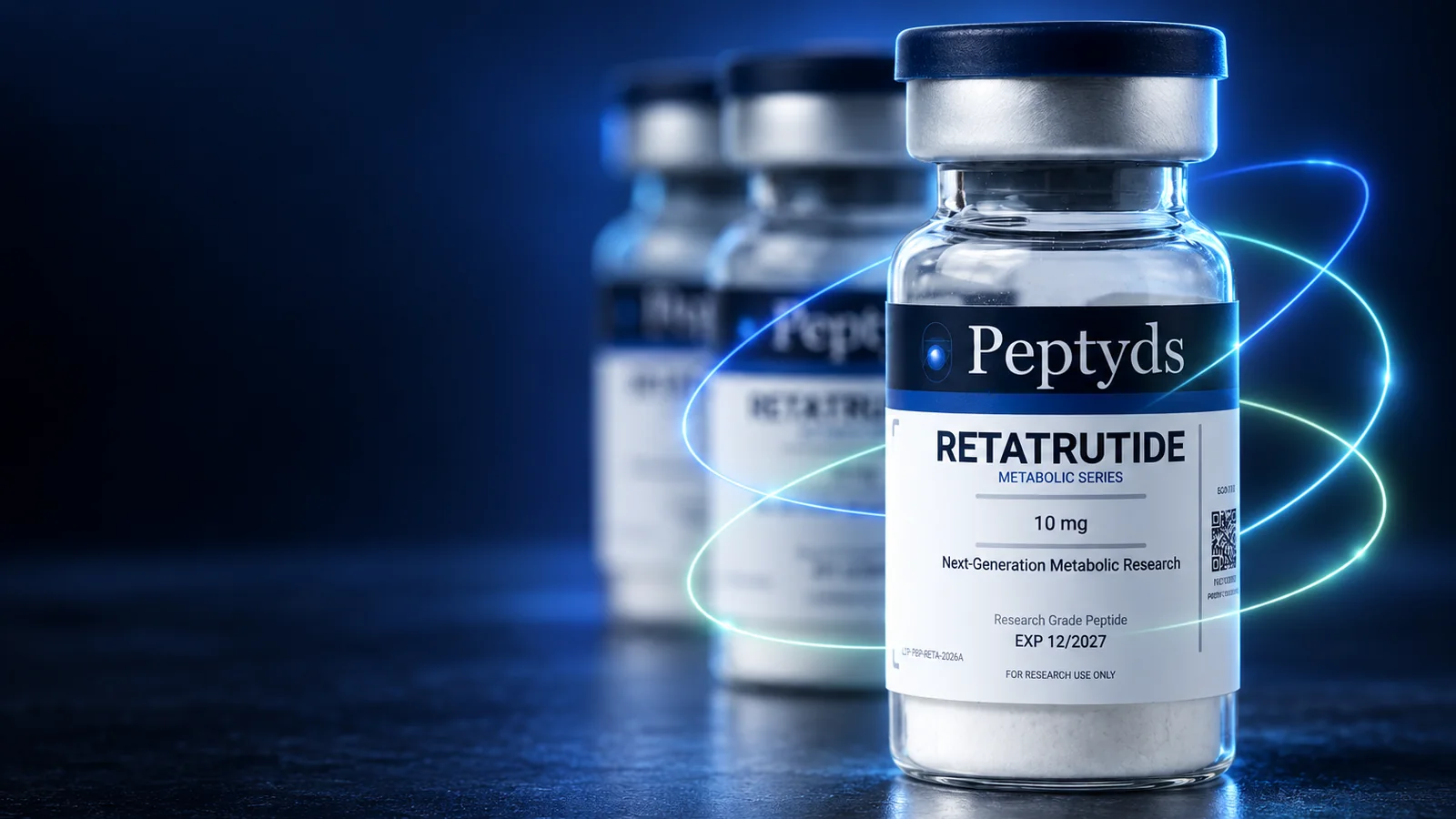
A sealed Peptyds retatrutide research vial encircled by tilted orbits of mint and blue light, with two more vials out of focus behind it.
Jump to section
  1. 01What is retatrutide?
  2. 02How does retatrutide work on three receptors?
  3. 03What did the retatrutide phase 2 obesity trial show?
  4. 04What do the diabetes, liver-fat and body-composition studies add?
  5. 05Where does the retatrutide phase 3 programme stand in 2026?
  6. 06Is retatrutide safe? What the trials report and what is unknown
  7. 07Is retatrutide approved in the EU or the US?
  8. 08How Peptyds frames retatrutide: research context, not consumer medicine
  • Retatrutide is a single investigational peptide that activates the GIP, GLP-1 and glucagon receptors; 'GLP-3' is an informal nickname, not a hormone.
  • In the 48-week phase 2 obesity trial of 338 adults, mean body weight fell by up to 24.2% against 2.1% with placebo.
  • TRANSCEND-T2D-1 (2026) is the first peer-reviewed phase 3 result: HbA1c fell by up to 1.94 points and body weight by up to 15.3% at 40 weeks.
  • Reported adverse events are mainly dose-related gastrointestinal effects, with dose-dependent heart-rate rises and dysaesthesia also documented.
  • Retatrutide has no EMA authorisation, and the published trials lasted under a year without cardiovascular-outcome endpoints.

Discussed in this guide

  • RetatrutideA triple agonist peptide targeting GIP, GLP-1, and glucagon receptors — studied in advanced metabolic and weight-regulation contexts.10 mg · 60 mg€4.32 / mg

What is retatrutide?

Retatrutide (development code LY3437943) is an investigational peptide built as a single molecule that activates three hormone receptors: the glucose-dependent insulinotropic polypeptide (GIP) receptor, the glucagon-like peptide-1 (GLP-1) receptor and the glucagon receptor. The discovery paper described balanced activity at the glucagon and GLP-1 receptors, with stronger activity at the GIP receptor. The phase 2 obesity trial published in 2023 is what brought the compound to wide attention.[1][3]

Online, retatrutide is often shortened to 'reta' or called a 'GLP-3'. The second nickname is informal and misleading. The proglucagon gene gives rise to glucagon, GLP-1, GLP-2, oxyntomodulin and glicentin; there is no hormone called GLP-3. The label is shorthand for the third receptor retatrutide engages, the glucagon receptor, not evidence of a new hormone class.[11][1]

The molecule was engineered for once-weekly exposure. In a 12-week phase 1b study in 72 people with type 2 diabetes, its half-life was approximately six days and exposure rose in proportion to dose. In the first-in-human single-dose study, the reduction in body weight persisted up to day 43.[2][1]

Continue reading:Retatrutide research vials and batch documentation

How does retatrutide work on three receptors?

Each receptor adds a different lever. GLP-1 receptor agonism stimulates nutrient-induced insulin release, lowers glucagon secretion and acts on central and peripheral pathways that regulate energy balance. GIP is the other incretin hormone, and the discovery work attributed the drop in calorie intake to the GIP- and GLP-1-receptor arms of the molecule.[11][1]

The glucagon receptor is the new element. Glucagon is best known for raising blood glucose, but reviews of the field describe further roles: stimulating lipolysis and fat oxidation in the liver, reducing calorie intake and increasing energy expenditure, the last shown at least in animal models. In obese mice, adding glucagon-receptor activity to the incretin arms augmented weight loss through higher energy expenditure.[12][1]

Two cautions follow. The energy-expenditure mechanism is established in animals; how chronic glucagon-receptor activation behaves in humans, including its risks, is still being worked out, and the review literature says so directly. And because glucagon raises glucose, glucagon-based compounds are paired with GLP-1 activity to offset that effect. The balance between the arms is a design choice, not a given.[12]

Continue reading:Read Retatrutide vs Tirzepatide

What did the retatrutide phase 2 obesity trial show?

The pivotal phase 2 trial, published in the New England Journal of Medicine in 2023, randomised 338 adults with obesity, or overweight plus a weight-related condition, to weekly retatrutide at 1, 4, 8 or 12 mg or to placebo for 48 weeks. Participants did not have diabetes. The primary endpoint was the percentage change in body weight at 24 weeks.[3]

At 24 weeks, the least-squares mean change in body weight was −7.2% in the 1 mg group, −12.9% at 4 mg, −17.3% at 8 mg and −17.5% at 12 mg, against −1.6% with placebo. At 48 weeks the figures were −8.7%, −17.1%, −22.8% and −24.2%, against −2.1%. In the 12 mg group, 83% of participants had reached a reduction of at least 15% by week 48, compared with 2% on placebo.[3]

Two details shape how those numbers should be read. Gastrointestinal adverse events were dose-related and were partially mitigated by a lower starting dose in the escalation arms, and heart rate rose in a dose-dependent way, peaking at 24 weeks before declining. It was also a phase 2 trial: modest group sizes, 48 weeks of follow-up and no hard clinical outcomes such as cardiovascular events.[3]

Continue reading:Read Semaglutide vs Retatrutide

What do the diabetes, liver-fat and body-composition studies add?

A separate phase 2 trial randomised 281 people with type 2 diabetes in the USA to retatrutide, placebo or dulaglutide, an established GLP-1 receptor agonist. At 24 weeks, HbA1c fell by up to 2.02 percentage points in the 12 mg escalation group, against 0.01 with placebo and 1.41 with dulaglutide. At 36 weeks, body weight had fallen by up to 16.94%. No severe hypoglycaemia and no deaths were reported.[4]

A substudy of the obesity trial followed 98 participants with metabolic dysfunction-associated steatotic liver disease (MASLD) and at least 10% liver fat. At 24 weeks, liver fat fell by a mean of 42.9% relative to baseline at 1 mg and by 81.4% and 82.4% at 8 and 12 mg, against a 0.3% rise with placebo; 86% of the 12 mg group reached normal liver fat, below 5%. Liver-fat content is a surrogate measure, not evidence on fibrosis or long-term liver outcomes.[5]

A body-composition substudy of the diabetes trial measured fat mass by DXA scan at 36 weeks. Total fat mass fell by 26.1% in the pooled 8 mg groups and by 23.2% at 12 mg, against 4.5% with placebo, and the authors reported that the share of weight lost as lean mass was similar to other obesity treatments. Only 103 participants completed both scans, which limits precision.[6]

Where does the retatrutide phase 3 programme stand in 2026?

The first peer-reviewed phase 3 result is TRANSCEND-T2D-1, published in The Lancet in 2026. It randomised 537 adults with type 2 diabetes managed by diet and exercise alone, at sites in the USA, Mexico and India, to weekly retatrutide at 4, 9 or 12 mg or to placebo for 40 weeks. HbA1c fell by 1.69, 1.86 and 1.94 percentage points, against 0.81 with placebo, and body weight fell by 11.5%, 13.9% and 15.3%, against 2.6%.[7]

In that trial, discontinuations due to adverse events were 2–5% with retatrutide and 0% with placebo. The most frequent events were mild-to-moderate gastrointestinal effects that subsided over time, and no severe hypoglycaemia was reported. Two deaths occurred in the 4 mg group; both were judged unrelated to the study drug.[7]

The obesity programme, TRIUMPH, comprises four phase 3 trials in more than 5,800 participants: basket trials that nest obstructive sleep apnoea and knee osteoarthritis studies inside weight-management trials, a trial in people with cardiovascular disease, and a stand-alone osteoarthritis trial. TRIUMPH-1 is listed as completed on ClinicalTrials.gov, and a kidney trial, TRANSCEND-CKD, has published its design. This guide adds phase 3 obesity results once they appear in a peer-reviewed journal.[8][9][10]

Continue reading:Read the GLP-1 peptides overview

Is retatrutide safe? What the trials report and what is unknown

Across the published trials, the dominant adverse events were gastrointestinal (nausea, diarrhoea, vomiting and constipation), mostly mild to moderate and dose-related. In the diabetes phase 2 trial they were reported by 35% of participants on retatrutide, ranging from 13% at the lowest dose to 50% in one fast-escalation group, against 13% on placebo. In the obesity trial, heart rate rose in a dose-dependent way before declining after week 24.[4][3]

Dysaesthesia, meaning abnormal skin sensations such as burning or tingling, has been observed in clinical trials of retatrutide as well as semaglutide and tirzepatide. A 2026 pharmacovigilance analysis strengthened the evidence for this class-wide signal and found it more frequent at higher doses and with more potent GLP-1 receptor agonists.[13]

What is unknown matters as much. The published phase 2 and 3 trials ran for 36 to 48 weeks and none was designed to measure cardiovascular events or long-term safety, and a 2026 BMJ network meta-analysis rated the certainty of evidence for emerging agents, retatrutide included, as very low to low. A 2026 case report described a person with type 1 diabetes who became acutely unwell after using an online-purchased product sold as retatrutide; causation could not be established, and the authors noted that the composition and purity of such products may be uncertain.[3][4][7][14][15]

Is retatrutide approved in the EU or the US?

No. Retatrutide is an investigational compound. The 2026 phase 3 publication describes it as under clinical development for type 2 diabetes, obesity and related complications, and the European Medicines Agency's database of authorised medicines lists no retatrutide product and no EPAR as of September 2026.[7][17]

Anti-doping science has started to catch up. A 2026 study developed and validated a mass-spectrometry method for retatrutide in human plasma and urine according to WADA criteria, citing concern about misuse in sport. In samples from four people who had self-administered the compound, no retatrutide was detected in urine, while plasma remained a usable matrix for approximately 56 days after the first dose.[16]

Status can change once phase 3 data are submitted to regulators. The EMA medicines database is where an EU authorisation would appear, and this guide will be updated if one does.[17]

Continue reading:Compare Retatrutide vs Tesamorelin

How Peptyds frames retatrutide: research context, not consumer medicine

Peptyds supplies retatrutide as a lyophilised research peptide for in-vitro laboratory work, with the batch documentation described on our quality page. It is not a medicine, it is not supplied for human or veterinary use, and nothing on this page describes how a person should use it.

The evidence record is worth knowing precisely: a triple GIP, GLP-1 and glucagon receptor agonist with published phase 1 and 2 data, a first peer-reviewed phase 3 trial in type 2 diabetes, obesity trials registered as completed but without peer-reviewed results at the time of writing, and no EU marketing authorisation. Research interest in the molecule is legitimate. Consumer weight-loss claims are not supported by that record.[1][3][7][9][17]

Continue reading:View RetatrutideRead the quality protocol

Sources

  1. [01]
  2. [02]
  3. [03]
  4. [04]
  5. [05]
  6. [06]
  7. [07]
  8. [08]
  9. [09]
  10. [10]
  11. [11]
  12. [12]
  13. [13]
  14. [14]
  15. [15]
  16. [16]
  17. [17]

Questions

What is retatrutide?

Retatrutide (LY3437943) is an investigational once-weekly peptide that activates the GIP, GLP-1 and glucagon receptors. It has been studied in phase 2 trials in obesity and type 2 diabetes, and the first peer-reviewed phase 3 result, in type 2 diabetes, was published in 2026.[1][3][7]

Is retatrutide approved?

No. The 2026 phase 3 publication describes retatrutide as under clinical development, and the European Medicines Agency's database of authorised medicines lists no retatrutide product or EPAR as of September 2026.[7][17]

Why is retatrutide called GLP-3?

'GLP-3' is an online nickname, not a scientific term. The proglucagon gene encodes glucagon, GLP-1, GLP-2, oxyntomodulin and glicentin; there is no GLP-3 hormone. The nickname loosely refers to retatrutide acting on a third receptor, the glucagon receptor, in addition to the GLP-1 and GIP receptors.[11][1]

How much weight loss did retatrutide trials report?

In the 48-week phase 2 obesity trial of 338 adults, mean body weight fell by 24.2% in the 12 mg group against 2.1% with placebo. In the 40-week phase 3 TRANSCEND-T2D-1 trial in type 2 diabetes, it fell by up to 15.3% against 2.6%. Populations, durations and endpoints differ, so the figures should not be pooled or compared directly.[3][7]

What side effects were reported with retatrutide?

Mainly gastrointestinal effects (nausea, diarrhoea, vomiting and constipation), which were dose-related and mostly mild to moderate. Heart rate rose in a dose-dependent way in the obesity trial, and dysaesthesia has been observed in trials of retatrutide and related GLP-1 receptor agonists. Long-term safety has not been established.[3][4][13]

What is the half-life of retatrutide?

Approximately six days, measured in a 12-week phase 1b study in people with type 2 diabetes. That profile is why the clinical trials used once-weekly administration.[2]

Educational content. Not medical advice.

Next step

Choose the route that matches how you read.