

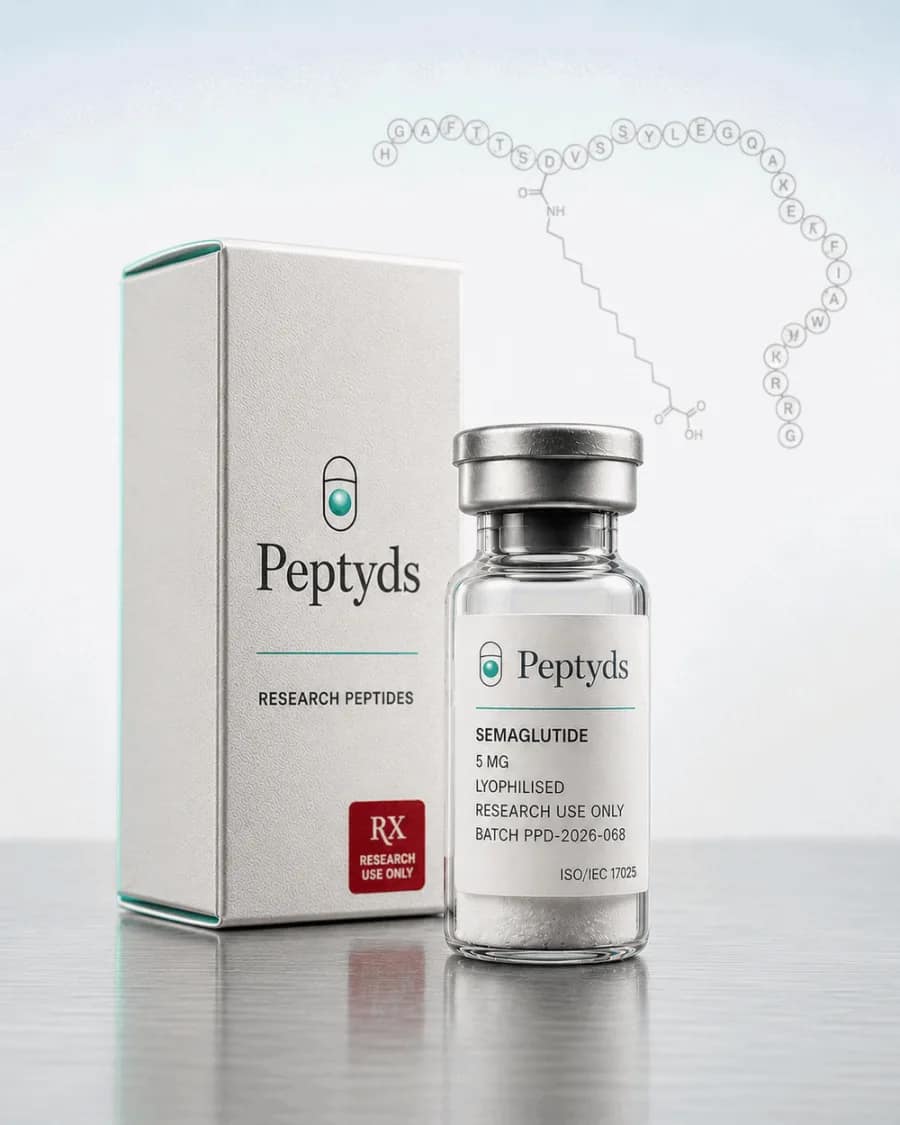
Semaglutide
Semaglutide is a synthetic fatty-acid-acylated GLP-1 receptor agonist of 31 amino acids derived from a modified GLP-1 backbone, studied in metabolic and weight-regulation research for its role in agonising the GLP-1 receptor.
A GLP-1 receptor agonist studied for its effects on appetite regulation and metabolic signalling — investigated in weight and metabolic support contexts.
For Research Use Only — Not for Human Consumption.
This compound has EMA approval as a prescription therapeutic.
Sold for in vitro laboratory research only.
Therapeutic use requires a licensed prescriber.
- Availability
- Delivered in 3–7 days (EU)
- Storage
- Store 2–8 °C. Reconstitute before use.
- Ships from
- European fulfilment centre, tracked express
Lab proof, by batch
- Tested independently, by batch
- Certificate of analysis available
- Purity and identity on record
GLP-1 Receptor Agonist Research.
Semaglutide (CAS 910463-68-2) is a synthetic GLP-1 analogue with extended half-life through C18 fatty-acid conjugation. Clinical investigation has focused on appetite suppression, insulin secretion, and cardiovascular metabolic markers. Formula C187H291N45O59, MW 4113.58 g/mol. Use under clinical guidance only.
- — Wilding et al. — STEP trial: weekly semaglutide and sustained body weight reduction
- — Marso et al. — SUSTAIN-6 cardiovascular outcomes with semaglutide
Research context only. Not medical advice. Consult a qualified clinician before use.
- 5 mg lyophilised powder per vial
- Reconstitute with bacteriostatic water before use
- Store lyophilised at 2–8 °C, keep from light
- Once reconstituted, refrigerate and use within 28 days
- One 5 mg lyophilised Semaglutide vial
- Tamper-evident cap with batch-coded label
- Storage and reconstitution card
What the research reports about this molecule.
Classic parameters from peer-reviewed literature. Not human dosing guidance — read alongside the PubMed references on /learn.
- Sequence
- 31-amino-acid fatty-acid-acylated GLP-1 RA
- Molecular weight
- 4114 Da
- Half-life
- ~7 days
- Mechanism
- GLP-1 receptor agonism
- Research domain
- Metabolic, weight regulation
- Regulatory status
- EMA-authorised as Ozempic / Wegovy; sold research-only here
- Reconstitution
- Bacteriostatic water, USP
- Storage
- Long-term -20°C lyophilised; -80°C for >12 months; reconstituted 2-8°C, ≤4 weeks
Simple, deliberate steps — not a protocol.
These are practical handling notes. Dosing decisions stay between you and your clinician.
- 1
Reconstitute as directed by your clinician — protocol titration from a low starting dose is essential
- 2
Administer subcutaneously at the agreed site and frequency
- 3
Refrigerate reconstituted vial; follow clinician's usage window guidance
How-to-use guide
Read the research protocol
Concise reconstitution, dosing, and handling instructions.
Reconstitution calculator
Research use onlySyringe
Peptide in vial
Bacteriostatic water
Concentration5 mg/mL
Target dose
Pull syringe to
5
units · 0.05 mL
Concentration
5
mg/mL
Doses per vial
40
doses
U-50 2.5 · U-40 2 units
For laboratory research calculation only. Not medical or dosing advice, and not for human or veterinary use.
Others researching Weight / Metabolic Support also compare
- SemaglutideThis pageSizes: 5 mg · 10 mgPrice / mg: €5.00 / mg
- RetatrutideSizes: 10 mg · 60 mgPrice / mg: €4.32 / mg
- TesamorelinSizes: 5 mg · 10 mgPrice / mg: €6.90 / mg
- TirzepatideSizes: 10 mgPrice / mg: €6.50 / mg
Each release is matched with quality documentation through a documented verification path. Identity, purity, and composition test results sit on the product page before you buy.
Every batch is verified by an ISO/IEC 17025-accredited laboratory before release. Identity, purity, and documentation travel with the product — not behind a form.
Sensitive peptides ship in insulated cold packaging with gel packs sized for a 48-hour transit window, tracked door to door.
Everything worth asking before you order.
Shipping, storage, quality, and when to speak to a clinician — without the runaround.
What proof of quality comes with my order?
Every batch ships with a batch code printed on the vial. The matching independent lab report — showing identity, purity, and composition — is linked on the product page and stays on your order page after purchase.
Should I speak to a clinician before using a peptide?
We recommend it — especially if you are pregnant, nursing, managing a medical condition, or combining peptides with prescribed medication. Our product pages are educational. They are not medical advice and they do not replace a conversation with a qualified practitioner.
When will my order ship and arrive?
Orders placed before 14:00 CET Monday–Friday ship the same business day from our European fulfilment centre in The Hague, Netherlands. Standard tracked EU delivery arrives in 2–4 business days; express options are available at checkout.
What does "research only" actually mean on a peptide label?
Research-only means the compound has not been approved by the EMA or any national medicines authority for medical use, and is sold solely for in-vitro and laboratory research. It is not a supplement, a cosmetic, or a medicine, and it carries no claims for human consumption.
How does tirzepatide compare to semaglutide?
Semaglutide is a single GLP-1 receptor agonist; tirzepatide is a dual GLP-1 and GIP receptor agonist, which is associated with larger weight reductions in head-to-head trials — roughly 20–22 percent versus 15 percent over 72 weeks in SURMOUNT-5. Both are EMA-approved as prescription medicines (Wegovy/Ozempic and Mounjaro).
What are the most common side effects of GLP-1 peptides specifically?
Across SUSTAIN, SURPASS, SURMOUNT, and TRIUMPH trials, the dominant adverse events for semaglutide, tirzepatide, and retatrutide are gastrointestinal: nausea, vomiting, diarrhoea, constipation, and abdominal discomfort, usually mild-to-moderate and concentrated during dose titration.
What's the difference between a prescription peptide and a research peptide?
A prescription peptide (e.g. Wegovy, Mounjaro, Vyleesi, Zadaxin in the relevant jurisdictions) has been through EMA or national-authority review, carries an authorised indication, and is dispensed by a pharmacy against a script. A research peptide is a reference-grade compound sold for laboratory use only.
How do I reconstitute a lyophilised peptide vial?
Bring both the lyophilised vial and the bacteriostatic water to room temperature, equalise pressure with a sterile vented needle, then inject the solvent slowly down the side of the vial. Swirl gently — never shake — until clear, and refrigerate at 2–8 °C.
How much bacteriostatic water should I add to my peptide vial?
The calculation is peptide mass (mg) ÷ desired concentration (mg/mL) = volume of bacteriostatic water in mL. For example, a 5 mg vial at 1 mg/mL needs 5 mL; at 2 mg/mL, 2.5 mL. Every Peptyds product page carries a suggested reconstitution volume tuned to the vial size.
How long does a reconstituted peptide stay stable in the fridge?
Most lyophilised peptides reconstituted with bacteriostatic water remain stable for 28–30 days at 2–8 °C, protected from light. A handful of short, fragile sequences — Epithalon among them — drop to roughly 14 days. Never freeze a reconstituted vial.
What side effects are most commonly reported across peptide research?
Across published trials and case series, the most frequent reported events are injection-site reactions (redness, induration, transient discomfort), headache, mild nausea, and temporary fatigue. GLP-1 and dual-agonist class peptides add dose-dependent gastrointestinal effects.
Who should not use peptides?
Peptides are not appropriate for anyone who is pregnant, nursing, planning conception, under 18, managing active cancer, or on immunosuppressants — and competitive athletes governed by WADA must avoid every peptide on the prohibited list. Anyone with a personal or family history of melanoma should specifically avoid melanocortin-receptor agonists.