

Science

Retatrutide vs Tirzepatide: Triple Agonist Against Dual, and What the Evidence Supports

Tirzepatide is a dual GIP and GLP-1 receptor agonist authorised in the EU as Mounjaro. Retatrutide adds a third target, the glucagon receptor, and is an investigational compound in Eli Lilly's pipeline with no EMA authorisation. The headline difference people cite is weight loss — roughly 21% at 72 weeks for tirzepatide in phase 3 SURMOUNT-1 at the highest dose, against roughly 24% at 48 weeks for retatrutide in phase 2 at 12 mg. The more consequential difference is evidence maturity: those are not comparable trial stages, and a phase 2 result is not a phase 3 result.

8 min readUpdated 22 Aug 2026Reviewed by Independent EU laboratory (ISO/IEC 17025)
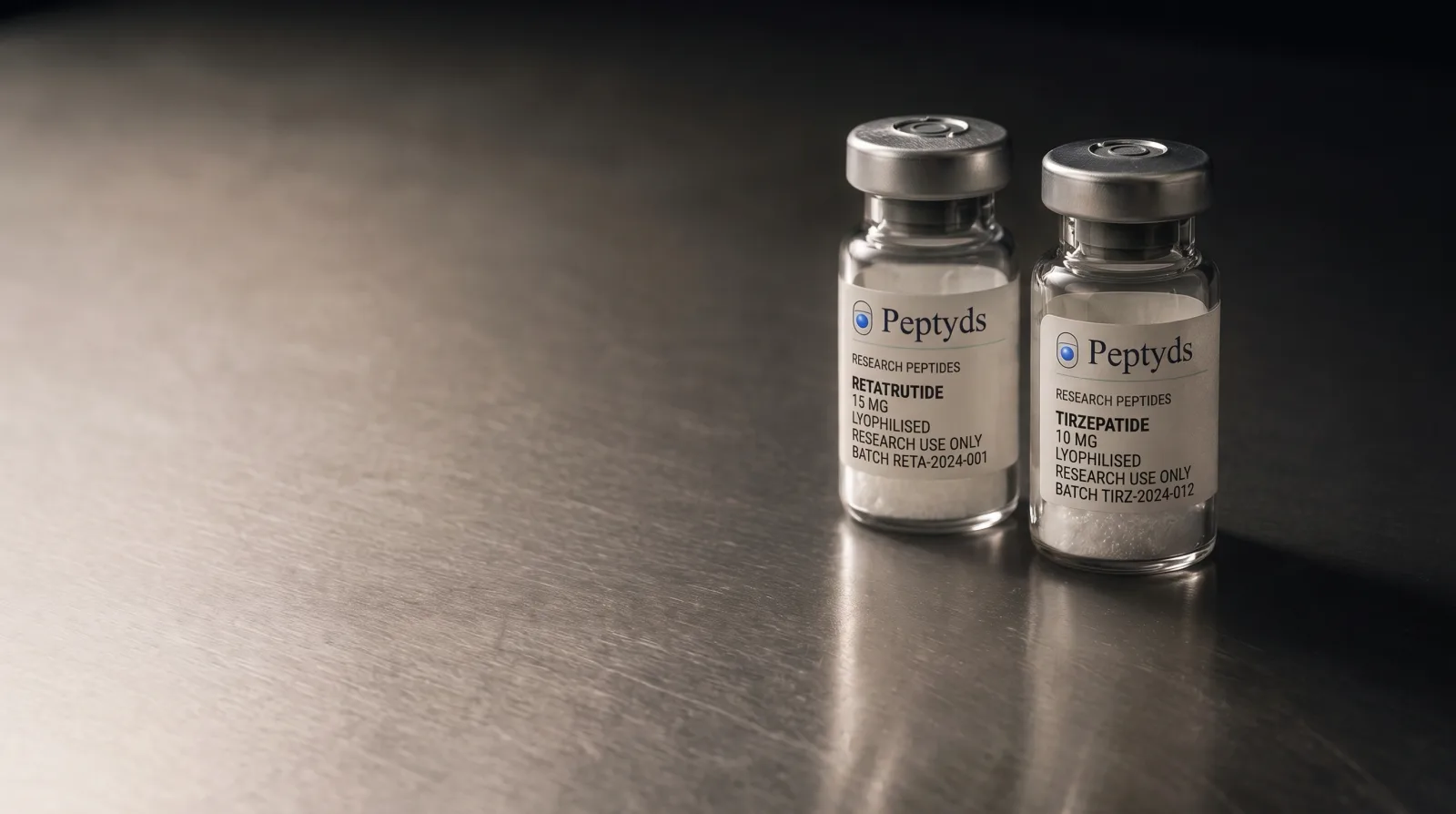
Two lyophilised research peptide vials standing side by side on a brushed stainless laboratory bench, lit from the left with the bench falling away into shadow
Jump to section
  1. 01One receptor apart, and that receptor changes the mechanism
  2. 02The numbers everyone quotes, and what they actually compare
  3. 03Regulatory position: authorised medicine against investigational compound
  4. 04Where the two are genuinely comparable
  • Tirzepatide activates two receptors (GIP, GLP-1). Retatrutide activates three, adding the glucagon receptor.
  • Glucagon-receptor agonism is the mechanistic difference: it raises energy expenditure rather than only suppressing intake.
  • Tirzepatide holds an EMA marketing authorisation as Mounjaro. Retatrutide holds none and remains investigational.
  • The often-quoted 24% versus 21% compares a phase 2 result at 48 weeks with a phase 3 result at 72 weeks. They are not the same class of evidence.
  • Neither is a research-use substitute for a prescribed medicine, and neither should be selected on a percentage alone.

One receptor apart, and that receptor changes the mechanism

Tirzepatide is a dual agonist: it activates the GLP-1 receptor and the glucose-dependent insulinotropic polypeptide (GIP) receptor. Both are incretin pathways, and both act largely by influencing insulin response, gastric emptying and appetite signalling. Retatrutide keeps those two and adds a third — the glucagon receptor.

That third target is not an incremental addition. GLP-1 and GIP agonism work mainly on the intake side of the energy equation: less appetite, slower emptying, altered satiety signalling. Glucagon-receptor agonism works on the expenditure side, increasing hepatic energy output. A compound that does both is acting on the equation from two directions rather than one, which is the mechanistic argument for why the trial figures diverge.

The numbers everyone quotes, and what they actually compare

In SURMOUNT-1, a phase 3 trial, tirzepatide produced roughly 21% mean body-weight reduction at 72 weeks at the highest dose. In its phase 2 obesity trial, retatrutide produced roughly 24% at 48 weeks in the 12 mg group. Those two figures are quoted side by side constantly, and the comparison is weaker than it looks.

Phase 2 trials are smaller, shorter, and select their participants more narrowly than phase 3. Effect sizes very often shrink when a compound moves from phase 2 into a larger, longer, more heterogeneous phase 3 population — that attenuation is one of the most reliable patterns in clinical development. A 24% phase 2 result and a 21% phase 3 result are not two points on the same scale.

The honest summary is that retatrutide looks more potent and has not yet been tested to the standard tirzepatide has already met.

Regulatory position: authorised medicine against investigational compound

Tirzepatide holds an EMA marketing authorisation in the European Union as Mounjaro, which means a published EPAR, an approved label, defined indications and a formal safety profile. Retatrutide has none of that. It sits in Eli Lilly's clinical pipeline and has not been authorised by the EMA for any indication.

This is the difference that matters most in practice and is the one most often skipped. An authorised medicine has a known adverse-event profile assembled from thousands of monitored patients. An investigational compound has a phase 2 safety signal and open questions that only larger trials answer.

Where the two are genuinely comparable

Both are peptide analogues delivered subcutaneously, both are supplied lyophilised for research use and require reconstitution, and both share the gastrointestinal adverse-event pattern that characterises the incretin class — nausea, diarrhoea and constipation, most pronounced during dose escalation.

Handling is identical in kind: store lyophilised material cold, reconstitute with bacteriostatic water, keep the reconstituted vial refrigerated and respect the working window. Neither tolerates repeated freeze-thaw cycles.

Continue reading:How to reconstitute peptidesStorage, stability and handling

Sources

  1. [01]
    European Medicines Agency
    Mounjaro EPAR
  2. [02]
  3. [03]
  4. [04]
  5. [05]
  6. [06]
    European Medicines Agency
    Clinical trials in human medicines
  7. [07]
  8. [08]
  9. [09]

Questions

Is retatrutide stronger than tirzepatide?

On the published figures retatrutide produced a larger mean weight reduction, but at an earlier trial stage. Roughly 24% at 48 weeks in phase 2 for retatrutide against roughly 21% at 72 weeks in phase 3 for tirzepatide. Effect sizes commonly attenuate between phase 2 and phase 3, so the gap should not be read as settled.

Is retatrutide approved in Europe?

No. Retatrutide has no EMA marketing authorisation and remains an investigational compound in Eli Lilly's clinical pipeline. Tirzepatide is authorised in the EU as Mounjaro.

What does the glucagon receptor actually add?

GLP-1 and GIP agonism act mainly on energy intake — appetite, satiety, gastric emptying. Glucagon-receptor agonism acts on energy expenditure, increasing hepatic output. Retatrutide therefore engages both sides of the energy balance rather than one.

Can I use research-grade retatrutide instead of a prescription?

No. Research-grade material is supplied for laboratory research use only. It is not a medicine, carries no therapeutic indication, and is not a substitute for an authorised product prescribed and monitored by a clinician.

Educational content. Not medical advice.

Next step

Choose the route that matches how you read.