

Skin and anti-aging peptides are short signaling molecules studied for collagen synthesis, matrix metalloproteinase modulation, and wound-repair cascades in dermatological research.
Skin & Anti-Aging
All products listed under this goal are supplied for in vitro laboratory research only and are not intended for human consumption or therapeutic use.
Topical peptides for skin renewal — premium on the shelf, lab-verified quality on the label.
Topical peptides chosen for skin renewal — premium formulations with lab-verified quality and clear application guidance.
- How are topical peptides different from a regular serum?
- What testing do these formulations go through?
- How should I apply and store them?
A short list of peptides that fit this goal.
We keep the choice focused. Every peptide here has a clear purpose, ISO/IEC 17025 lab testing, and a product page written without jargon.
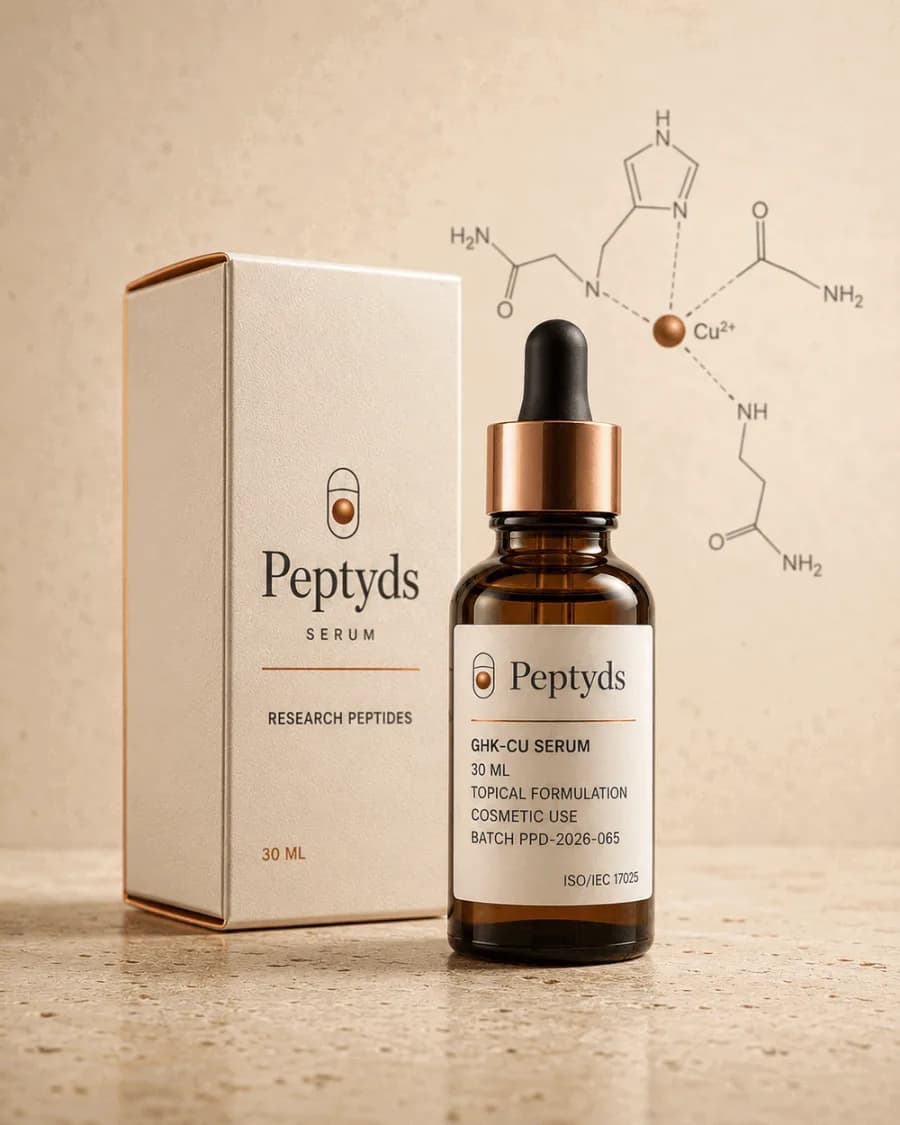
A copper-peptide complex studied for skin barrier support, collagen signalling, and visible texture renewal.
Melanogenesis & Photoprotection Research.
An alpha-MSH-derived tripeptide studied for its anti-inflammatory properties across gut, skin, and systemic inflammatory signalling pathways.
A melanocortin receptor agonist studied for its effects on melanogenesis, sexual function, and appetite regulation through MC1R–MC4R pathway activation.
- skin-renewal
- application-guidance
Each release is matched with quality documentation through a documented verification path. Identity, purity, and composition test results sit on the product page before you buy.
Every batch is verified by an ISO/IEC 17025-accredited laboratory before release. Identity, purity, and documentation travel with the product — not behind a form.
A calm buyer's guide to CoA basics: what to check, what a purity number can and cannot prove, and how Peptyds routes quality proof.
GHK-Cu has a real skin-research footprint, but formulation, route, and evidence limits still matter.
The numbering suggests a sequel. The pharmacology says otherwise: one binds narrowly, the other binds across a receptor family that governs far more than pigmentation.
Goal-led shopping helps guided buyers compare research context, quality proof, and product fit without decoding every molecule first.
Most storage mistakes are not dramatic. They are small process failures: unclear instructions, moisture exposure, light, and avoidable temperature swings.
Peptides are short chains of amino acids — typically 2 to 50 — joined by peptide bonds. Smaller than proteins, larger than single amino acids.
PT-141 and Melanotan II share a chemical family but split completely on receptor selectivity, regulatory approval, and safety. The mole-and-melanoma question is not optional reading.
GHK-Cu and BPC-157 both show up in 'best peptide for skin' searches, but they sit in different research neighbourhoods and use different delivery routes.
Questions people ask about this category.
Honest, short answers to the things most shoppers want to know before they buy.
Most people know the outcome they want — better recovery, long-horizon support, better skin — before they know which molecule fits. Starting from the goal makes the product choice clearer and reduces the risk of buying something that does not fit the routine.
Every batch ships with a batch code printed on the vial. The matching independent lab report — showing identity, purity, and composition — is linked on the product page and stays on your order page after purchase.
Each page opens with a clear purpose line and the testing behind it, then expands into research notes, dosing specifications, and linked peer-reviewed studies for readers who want more depth. You decide how deep you go.