

Research notes

CJC-1295 + Ipamorelin: Complete Guide to the Blend, DAC vs No-DAC

CJC-1295 + ipamorelin is a research blend that pairs a modified GHRH(1-29) analogue with ipamorelin, a selective ghrelin-receptor (GHS-R1a) agonist, so that two separate pituitary pathways for growth-hormone release are stimulated at once. The name CJC-1295 covers two molecules: the albumin-binding 'with DAC' version, whose half-life of roughly 6-8 days was measured in healthy adults, and the 'no-DAC' peptide (modified GRF 1-29) used in most blends, which has no published human studies. GHRH analogues and ghrelin-pathway agonists released growth hormone synergistically in small human studies of other molecules, but the CJC-1295/ipamorelin pairing itself has never been tested in a controlled trial. Both components are on the WADA Prohibited List, and neither is an authorised medicine in the EU.

11 min readUpdated 22 Sept 2026Reviewed by Independent EU laboratory (ISO/IEC 17025)
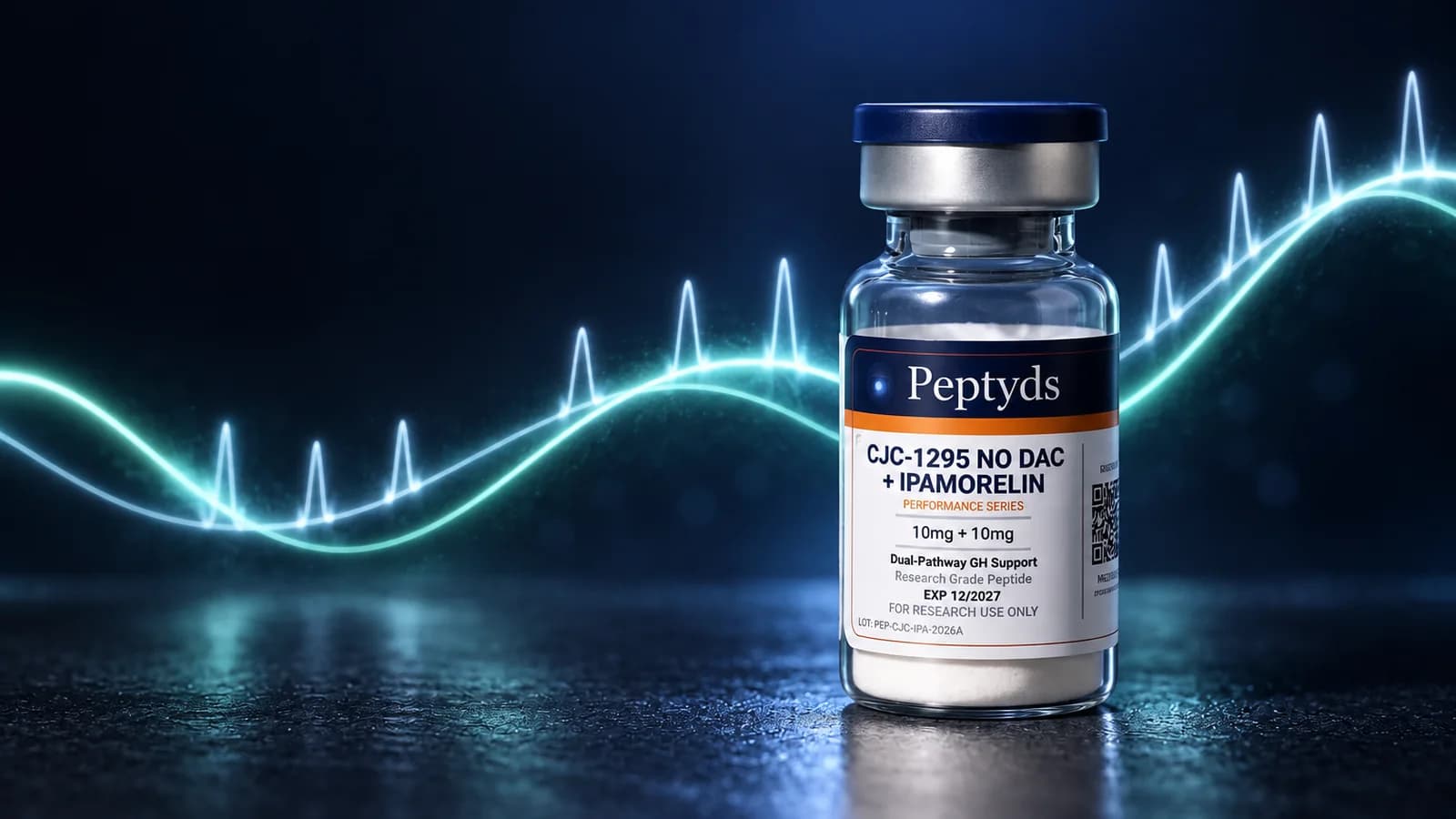
A sealed Peptyds CJC-1295 (no DAC) + ipamorelin research vial on a dark surface, with a glowing mint pulse wave rising and falling behind it.
Jump to section
  1. 01What is CJC-1295 + ipamorelin?
  2. 02CJC-1295 with DAC vs without DAC: what is the difference?
  3. 03What did the human CJC-1295 trials actually measure?
  4. 04What does ipamorelin add to the blend?
  5. 05Why pair a GHRH analogue with a ghrelin-receptor agonist?
  6. 06What safety signals and identity problems are documented?
  7. 07Is CJC-1295 or ipamorelin approved anywhere, and are they banned in sport?
  8. 08How Peptyds frames CJC-1295 + ipamorelin
  • 'CJC-1295' names two molecules: a DAC version that binds albumin and lasts days, and a no-DAC version (modified GRF 1-29) used in most blends.
  • All human CJC-1295 data concern the DAC molecule: in healthy adults it raised GH and IGF-1 for days, with a measured half-life of 5.8-8.1 days.
  • No-DAC CJC-1295 has no published human studies; the widely quoted '30-minute half-life' has no primary source we could find.
  • The synergy rationale comes from studies of GHRP-6, ghrelin and native GHRH; no controlled trial has tested CJC-1295 together with ipamorelin.
  • The FDA lists both CJC-1295 and ipamorelin acetate among compounding substances that may present significant safety risks (Category 2).
  • Neither peptide is authorised by the EMA, and both are named on the WADA 2026 Prohibited List under S2.2.4.

Discussed in this guide

  • CJC-1295 No DAC + IpamorelinA dual-pathway GH secretagogue blend studied for synergistic, pulsatile growth hormone release — investigated in overnight recovery, sleep architecture, and body-composition research.10 mg + 10 mg€7.50 / mg
  • CJC-1295 No DACA short-acting GHRH analogue studied for pulsatile growth hormone release — investigated in sleep quality, overnight recovery, and steady daily vitality.10 mg€4.00 / mg
  • IpamorelinA selective GHRP studied for gentle, pulsatile growth hormone release — investigated in sleep depth, overnight recovery, and measured body-composition routines.5 mg · 10 mg€4.40 / mg

What is CJC-1295 + ipamorelin?

CJC-1295 + ipamorelin is a research blend of two synthetic peptides that act on different receptors within the same system. CJC-1295 is an analogue of growth-hormone-releasing hormone (GHRH) and targets the GHRH receptor on the anterior pituitary. Ipamorelin is a five-amino-acid agonist of the growth-hormone secretagogue receptor (GHS-R1a), the receptor whose natural ligand is the stomach hormone ghrelin. Both routes end in the same place, a pulse of the pituitary's own growth hormone (GH), but they get there through separate signalling pathways.[1][9][12]

The pairing hides a choice that most product pages skip. 'CJC-1295' is used for two different molecules: one carries a Drug Affinity Complex (DAC) that binds blood albumin, the other does not. In blends the peptide is typically the no-DAC form, which also appears on labels and in forensic reports as modified GRF (1-29). The Peptyds blend uses this no-DAC form too. The two versions do not share a dataset, so a claim made for one cannot simply be carried over to the other.[8][16]

This guide covers CJC-1295 in both forms and the reasoning behind the combination. Ipamorelin as a single compound has its own complete guide, and the point-by-point contrast between the two molecules lives in the CJC-1295 vs ipamorelin article, so neither is repeated in full here.

Continue reading:Read CJC-1295 vs ipamorelinIpamorelin: the complete guide

CJC-1295 with DAC vs without DAC: what is the difference?

Both forms start from GHRH(1-29), the first 29 residues of the natural 44-amino-acid hormone. The CJC-1295 peptide carries four substitutions, D-Ala2, Gln8, Ala15 and Leu27, and anti-doping reference work lists its amidated sequence with a monoisotopic mass of about 3,366 Da. The D-Ala2 change matters most: native GHRH is inactivated in plasma when dipeptidylpeptidase IV (DPP-IV) cuts the bond between residues 2 and 3, and a D-amino acid at position 2 prevents that cut.[5][6]

The DAC version adds a lysine carrying a maleimidopropionamide group at the C-terminus. Once in the circulation this group bonds covalently to the free thiol (Cys34) of serum albumin. In the rat studies that identified the compound, CJC-1295 appeared on the albumin band within 15 minutes, remained in circulation beyond 24 hours and was still detectable in plasma after 72 hours.[1]

Without DAC there is no albumin anchor, and no human pharmacokinetic study of the no-DAC peptide has been published. The '30-minute half-life' quoted on many sites has no primary source we could find. The nearest human data point is narrower: adding D-Ala2 alone lengthened the disappearance half-time of GHRH(1-29)-NH2 from about 4 to about 7 minutes in ten healthy men. A 2026 review places no-DAC CJC-1295 in its lowest evidence tier, with no peer-reviewed human studies at all.[7][8]

Continue reading:Compare the blend with CJC-1295 alone

What did the human CJC-1295 trials actually measure?

All human data on CJC-1295 concern the DAC molecule. In two randomised, placebo-controlled, double-blind, ascending-dose trials in healthy adults aged 21 to 61 (lasting 28 and 49 days), a single subcutaneous dose raised mean plasma GH 2- to 10-fold for six days or more and IGF-1 1.5- to 3-fold for 9 to 11 days. The estimated half-life was 5.8 to 8.1 days, IGF-1 stayed above baseline for up to 28 days after repeated doses, and no serious adverse reactions were reported.[2]

A follow-up study sampled blood every 20 minutes overnight in healthy men aged 20 to 40, before and one week after a single dose. GH pulses kept their frequency and size, but trough GH rose 7.5-fold, mean GH by 46% and IGF-1 by 45%. Continuous GHRH-receptor stimulation, in other words, lifted the baseline between pulses rather than flattening the rhythm.[3]

In GHRH-knockout mice, daily CJC-1295 normalised body weight and length, while the same amount spaced 48 or 72 hours apart did not fully normalise growth. What the literature lacks is just as important: the human studies were short, small and measured hormones, not body composition or performance. The only registered patient trial, a phase 2 study in HIV-associated visceral obesity, is listed as terminated with no results posted.[4][17]

What does ipamorelin add to the blend?

Ipamorelin is the pentapeptide Aib-His-D-2-Nal-D-Phe-Lys-NH2, developed at Novo Nordisk from a series derived from GHRP-1. In rat pituitary cells it released GH with a potency similar to GHRP-6. In conscious swine it raised GH without increasing ACTH or cortisol, even at more than 200 times the dose needed for half-maximal GH release, whereas GHRP-6 and GHRP-2 raised both. That animal finding is the origin of its 'selective' label.[9]

In a dose-escalation study in healthy men (five infusion rates, eight volunteers per level), ipamorelin had a terminal half-life of about 2 hours and produced a single episode of GH release that peaked at roughly 40 minutes and then declined to negligible levels at every dose tested.[10]

The two halves of the blend therefore run on different clocks. Ipamorelin's GH episode lasts hours; the DAC form of CJC-1295 acts for days; the no-DAC form sold in blends has never had its human kinetics measured. Ipamorelin's animal and clinical record is covered in its own guide.[10][2][8]

Continue reading:Compare the blend with ipamorelin alone

Why pair a GHRH analogue with a ghrelin-receptor agonist?

The rationale comes from older human physiology studies of different molecules. In 18 healthy men, the hexapeptide GHRP-6 given together with native GHRH(1-44) released GH synergistically at submaximal doses, meaning more than the two responses added together. The authors read this as evidence that the two act through independent mechanisms. Prolactin and cortisol roughly doubled only at the highest GHRP dose, and GHRH caused brief facial flushing in 16 of the 18 men.[11]

The same pattern held for ghrelin itself: in healthy men, low doses of ghrelin combined with GHRH produced a synergistic GH response, with no synergy in ACTH or prolactin release. Two receptors, two signals, one amplified pituitary output is the logic the CJC-1295 + ipamorelin blend borrows.[12]

Borrowed is the key word. None of those studies used CJC-1295 or ipamorelin, and PubMed indexes no controlled study of the two given together; a 2026 endocrine review describes the pairing as driven mainly by anecdote. One 2026 sports-medicine review attributes improved muscle tetanic tension in glucocorticoid-treated rodents to the combination, but the glucocorticoid-rat study with that endpoint tested ipamorelin alongside the glucocorticoid, with no CJC-1295 arm.[8][14][13]

What safety signals and identity problems are documented?

The controlled human trials of CJC-1295 with DAC reported no serious adverse reactions, but they were short and enrolled healthy volunteers. The FDA takes a more cautious line: its list of bulk substances that may present significant safety risks in compounding (Category 2) says FDA has identified serious adverse events associated with CJC-1295, including increased heart rate and a systemic vasodilatory reaction, and that available clinical data are limited. The same list includes ipamorelin acetate, citing possible immunogenicity and serious adverse events, including death, reported when ipamorelin was given intravenously in a gastric-motility study.[2][18]

Identity is a second, practical problem. A Norwegian doping-control laboratory analysing an unlabelled preparation found a 29-amino-acid, C-terminally amidated peptide matching the sequence sold as CJC-1295. Powders seized by Danish customs turned out to be glycine-extended analogues of ipamorelin and of modified GRF (1-29), each carrying one extra amino acid at the N-terminus rather than the named molecule.[15][16]

A one-residue difference is invisible to the eye and easy to miss with a purity figure alone. For a two-peptide blend, the document that settles identity is a batch certificate of analysis that reports the measured mass of each component alongside its HPLC purity.[16][5]

Is CJC-1295 or ipamorelin approved anywhere, and are they banned in sport?

Neither CJC-1295 variant is approved as a medicine by the FDA or the EMA. A search of the EMA medicines database on 22 September 2026 returned no entry for CJC-1295 or for ipamorelin, so neither has an EU marketing authorisation or a European public assessment report.[8][19]

In the United States, both substances appear on the FDA's Category 2 list of bulk drug substances that may present significant safety risks in compounding, as described above. That is a statement about the FDA's safety assessment, not an approval pathway.[18]

In sport the position is explicit. The WADA 2026 Prohibited List, in force since 1 January 2026, names CJC-1295 among GHRH analogues and ipamorelin among growth hormone secretagogues under S2.2.4, growth hormone releasing factors. Substances in class S2 are prohibited at all times, in and out of competition.[20]

How Peptyds frames CJC-1295 + ipamorelin

Peptyds supplies CJC-1295 + ipamorelin as one co-lyophilised vial that combines CJC-1295 without DAC and ipamorelin, with a batch-specific certificate of analysis, for in-vitro laboratory research. We do not present it as a growth-hormone therapy, a body-composition product or a sleep aid.

The honest summary is uneven evidence. The DAC molecule has small, short human hormone studies. The no-DAC molecule in the blend has no human studies. Ipamorelin has human pharmacokinetic data but no approved use. The pairing itself rests on synergy seen with GHRP-6, ghrelin and native GHRH, not on any trial of this combination.[2][8][10][11]

Researchers weighing CJC-1295 against the other GHRH analogues, sermorelin and tesamorelin, will find the family compared side by side in a separate article; tesamorelin is the member with a regulatory-grade trial record.[8]

Continue reading:Sermorelin vs CJC-1295 vs tesamorelinView CJC-1295 + Ipamorelin

Sources

  1. [01]
  2. [02]
  3. [03]
  4. [04]
  5. [05]
  6. [06]
  7. [07]
  8. [08]
  9. [09]
  10. [10]
  11. [11]
  12. [12]
  13. [13]
  14. [14]
  15. [15]
  16. [16]
  17. [17]
  18. [18]
  19. [19]
  20. [20]

Questions

What is CJC-1295 ipamorelin?

A research blend that combines CJC-1295, a modified GHRH(1-29) analogue, with ipamorelin, a selective ghrelin-receptor agonist. The two peptides stimulate pituitary growth-hormone release through separate receptors. Most blends, including the Peptyds vial, use CJC-1295 without DAC.[1][9][8]

What is the difference between CJC-1295 with DAC and without DAC?

Both share the same tetrasubstituted GHRH(1-29) backbone. The DAC version adds a lysine-linked maleimide group that bonds to serum albumin, giving a measured half-life of about 6-8 days in healthy adults. The no-DAC version has no albumin anchor, and its human pharmacokinetics have never been published.[1][2][5][8]

Has the CJC-1295 and ipamorelin combination been studied in humans?

Not in any controlled trial indexed in PubMed. The rationale comes from small human studies in which GHRH combined with GHRP-6 or with ghrelin released growth hormone synergistically, and those studies used different molecules.[11][12][8]

Why is CJC-1295 without DAC also called modified GRF 1-29?

Because the peptide is the first 29 amino acids of GHRH (also called GRF) with four substitutions: D-Ala2, Gln8, Ala15 and Leu27. Forensic and anti-doping laboratories use both names for the same no-DAC sequence.[5][16]

Is CJC-1295 ipamorelin approved in the EU?

No. The EMA medicines database has no entry for either peptide, and neither CJC-1295 variant is approved as a medicine by the FDA or the EMA. The FDA lists both on its Category 2 list of compounding substances that may present significant safety risks.[19][8][18]

Is CJC-1295 banned in sport?

Yes. The WADA 2026 Prohibited List names CJC-1295 as a GHRH analogue and ipamorelin as a growth hormone secretagogue under S2.2.4. Class S2 substances are prohibited at all times, in and out of competition.[20]

Educational content. Not medical advice.

Next step

Choose the route that matches how you read.