

Research notes

Selank vs Semax: Two Russian Neuropeptides Compared

Selank and semax are synthetic seven-amino-acid peptides that share a stabilising Pro-Gly-Pro tail and come from the same Moscow institute, but they are built on different molecules. Selank extends the immune peptide tuftsin and is classed in Russia as an anxiolytic, studied for GABA binding, anxiety and immune effects; semax extends the ACTH(4-7) hormone fragment and is classed as a nootropic, studied for BDNF signalling, stroke and cognition. Human evidence for both is limited to small Russian studies, and neither has EU-wide authorisation or FDA approval.

9 min readUpdated 24 Sept 2026Reviewed by Independent EU laboratory (ISO/IEC 17025)
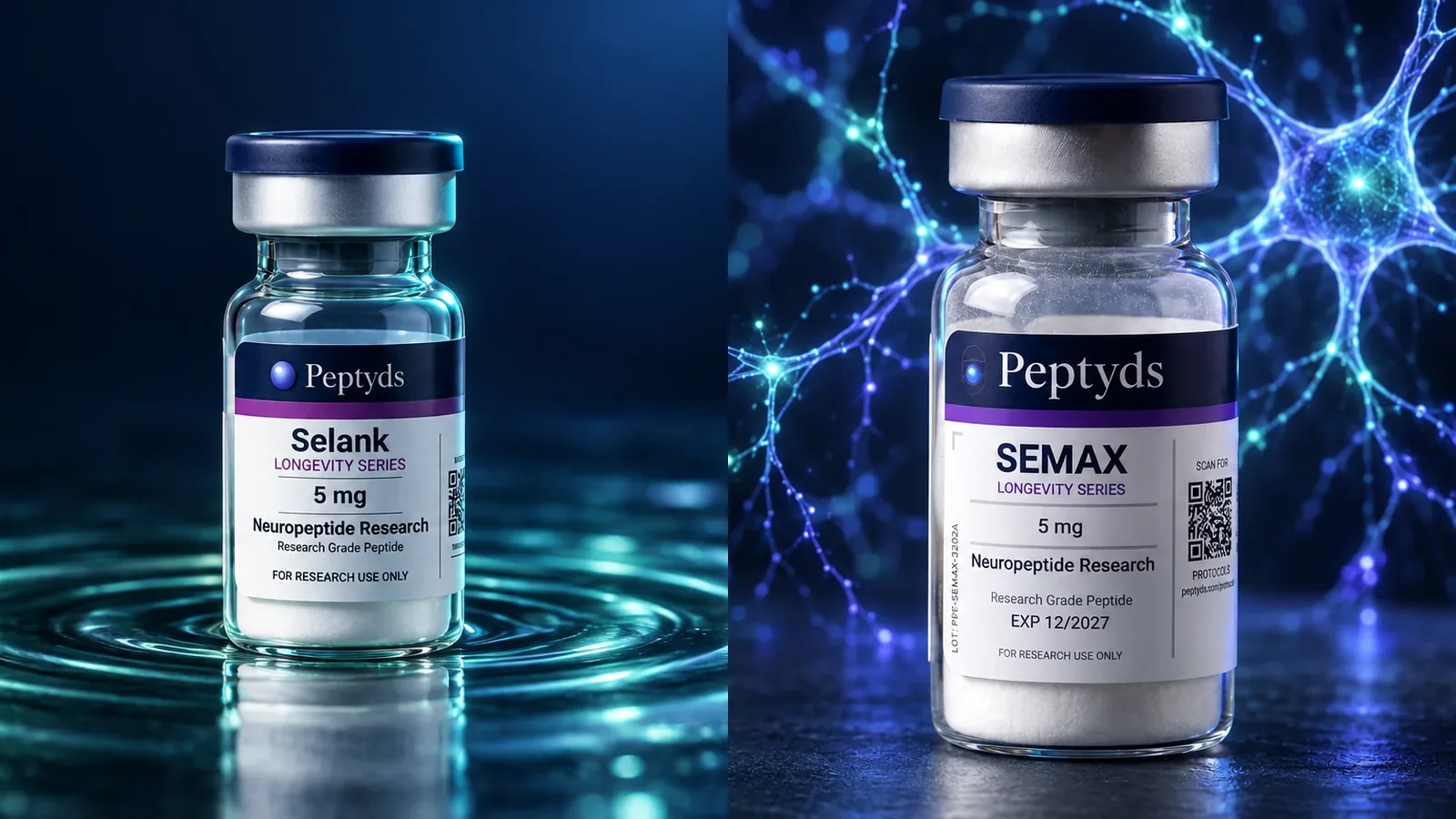
Two sealed Peptyds research vials, selank and semax, side by side on a dark laboratory surface.
Jump to section
  1. 01What is the difference between selank and semax?
  2. 02How do selank and semax compare side by side?
  3. 03Why are selank and semax always mentioned together?
  4. 04Is selank calming and semax stimulating?
  5. 05Have selank and semax been compared directly?
  6. 06Do selank and semax both affect BDNF?
  7. 07How strong is the evidence for each?
  8. 08Are selank and semax approved medicines?
  9. 09Which one fits a given research question?
  • Selank (Thr-Lys-Pro-Arg-Pro-Gly-Pro) and semax (Met-Glu-His-Phe-Pro-Gly-Pro) are synthetic heptapeptides that share a Pro-Gly-Pro tail but are built on tuftsin and on ACTH(4-7) respectively.
  • Selank is classed in Russia as an anxiolytic and studied in GABA, anxiety and immune-gene work; semax is classed as a nootropic and studied for BDNF, experimental stroke and cognition.
  • Both came out of the Institute of Molecular Genetics in Moscow, and the few direct comparisons — an enzyme assay, a rat study, a brain-imaging study — come from the developers' own network.
  • Human evidence is small and Russian for both, with no trial on ClinicalTrials.gov; semax has a few independent laboratory studies, selank none that we found.
  • Both are registered medicines in Russia but have no EU-wide authorisation or FDA approval; Peptyds supplies them for laboratory research only.

The compounds compared here

  • SelankNootropic & Anxiolytic Research.5 mg€7.00 / mg
  • SemaxNeuroprotective & Cognitive Research.5 mg€7.00 / mgOut of stock

What is the difference between selank and semax?

The short answer to selank vs semax: they are two synthetic heptapeptides that share their last three amino acids, Pro-Gly-Pro, but are built on different natural molecules. Selank, Thr-Lys-Pro-Arg-Pro-Gly-Pro, extends tuftsin, a peptide first described as a stimulator of phagocytosis by immune cells. Semax, Met-Glu-His-Phe-Pro-Gly-Pro, extends residues 4–7 of adrenocorticotropic hormone (ACTH), which is why papers call it an ACTH(4-10) analogue.[1][2][3][4]

The research questions differ accordingly. Russian sources class selank as an anxiolytic and semax as a nootropic. Selank's literature concerns GABA-receptor binding, anxiety models and immune-gene expression; semax's concerns BDNF and its TrkB receptor, experimental stroke and cognition.[5][6][7][4][8]

Both come from the same Moscow research network. This page compares them; the selank and semax guides cover each peptide in depth.[5][9]

Continue reading:Selank complete guideSemax complete guide

How do selank and semax compare side by side?

The table summarises what the published literature reports for each peptide. Read it as a map of what has been studied, not of what either peptide does in a person.

| Attribute | Selank | Semax | | --- | --- | --- | | Sequence | Thr-Lys-Pro-Arg-Pro-Gly-Pro | Met-Glu-His-Phe-Pro-Gly-Pro | | Built on | Tuftsin, a phagocytosis-stimulating immune peptide | ACTH(4-7), a fragment of adrenocorticotropic hormone | | Class in Russian sources | Anxiolytic | Nootropic | | Main research threads | GABA binding, anxiety models, immune genes | BDNF and TrkB, experimental stroke, cognition | | Largest human studies | Anxiety-disorder studies of 60–70 patients | Stroke studies of 30 treated patients (80 controls) and of 110 patients | | Healthy-volunteer data | One fMRI study, shared with semax | Two fMRI studies | | Work from outside Russia | None found | A few cell, chemistry and mouse studies | | ClinicalTrials.gov | No registered trial | No registered trial | | Status in Russia | Registered medicine | Registered medicine; on the vital and essential drugs list | | Status in EU / US | No EU-wide authorisation; not in Drugs@FDA | No EU-wide authorisation; not in Drugs@FDA |[1][2][3][5][11][15][17][16][23][25][30][31][26][27][28]

Why are selank and semax always mentioned together?

Because they share a birthplace. Semax was synthesised at the Institute of Molecular Genetics of the Russian Academy of Sciences in Moscow under the academicians I. P. Ashmarin and N. F. Myasoedov, and selank was developed at the same institute together with the Zakusov Institute of Pharmacology.[5][9]

They also share a design. Their developers describe both as hybrid peptides: a natural regulatory sequence joined to Pro-Gly-Pro, a tripeptide from the glyproline family that they report to be unusually stable for a regulatory peptide.[10]

The same names recur in both literatures — Myasoedov co-authored the 1997 semax stroke study and the 2008 selank anxiety study — and the two circulate together outside the clinic too: Belgium's medicines-control laboratory identified selank and semax in two suspicious preparations encountered in 2017 and 2018.[14][11][24]

Is selank calming and semax stimulating?

That is roughly how Russian sources frame them: selank is listed as an anxiolytic and semax as a nootropic, and a joint brain-imaging study described them the same way.[5][17]

The split is not clean, though. In a 1995 rat study, TP-7 — selank's early name — showed psychostimulant as well as anxiolytic activity, both more pronounced than tuftsin's. The 2008 anxiety study reported anti-asthenic and psychostimulant effects of selank alongside the anxiolytic one, and a 2014 study reported a mild nootropic effect.[18][11][12]

Mechanisms overlap as well. Both peptides inhibit the enzymes that break down enkephalins, the body's own opioid peptides — a mechanism the developers proposed for selank's anxiolytic activity.[1][19]

Have selank and semax been compared directly?

Only a few times, and only within the developers' network. In human serum in vitro, both inhibited enkephalin-degrading enzymes more potently than the peptidase inhibitor puromycin; semax reached half-maximal inhibition at 10 µM and selank at 20 µM.[1]

In rats with 6-OHDA lesions that model Parkinson's disease, neither peptide changed motor activity or passive defensive behaviour, while selank lowered anxiety measures in the elevated plus maze.[20]

In 52 healthy volunteers, resting-state fMRI after selank, semax or placebo showed shared and peptide-specific changes in connectivity between the right amygdala, a key region for anxiety, and the right temporal cortex. The abstract reports no measure of anxiety, memory or attention.[17]

None of these shows which peptide is stronger in people, and ClinicalTrials.gov lists no trial of either.[30][31]

Do selank and semax both affect BDNF?

BDNF, a growth factor for nerve cells, is central to the semax literature. In rats, a single application raised hippocampal BDNF protein at most 1.4-fold and phosphorylation of its TrkB receptor 1.6-fold; in a Russian study of 110 stroke patients, plasma BDNF rose in the semax subgroups.[4][15]

For selank, the BDNF record is thin and points elsewhere. A 2008 rat paper reported that selank regulates hippocampal BDNF expression but has no abstract showing in which direction, and in rats given alcohol for 30 weeks, selank prevented the ethanol-induced rise in BDNF rather than raising it.[21][22]

So 'both boost BDNF' overstates the case: the semax effect is modest and comes from rats, and the selank data we could check show no rise.[4][22]

How strong is the evidence for each?

Thin for both. Selank's main human data are three small Russian-language studies in anxiety disorders — 62, 60 and 70 patients, compared with or added to the benzodiazepines medazepam and phenazepam — whose English abstracts do not describe blinding.[11][12][13]

Semax's main human data are Russian stroke studies — 30 treated patients against 80 conventionally treated controls in 1997, and 110 patients in rehabilitation in 2018 — plus two resting-state fMRI studies in healthy volunteers that measured brain networks rather than cognition.[14][15][16][17]

The clearer difference is who else has looked. Every selank experiment we found on PubMed comes from Russian institutions; the few records by authors elsewhere are reviews or a forensic analysis. Semax has drawn a handful of outside laboratories: an Italian group studied its copper binding and protection of cultured cells, and a Chinese group reported better functional recovery after spinal cord injury in female mice.[23][24][3][25]

Are selank and semax approved medicines?

In Russia, yes. A 2022 review counts 14 peptide products registered in the Russian Federation, including semax as a nootropic drug and selank as an anxiolytic, and a 2025 paper notes that semax is on the Russian government's list of vital and essential drugs.[5][26]

Outside Russia, no. Neither appears in the European Commission's Union Register of centrally authorised medicines for human use or in Drugs@FDA, the US database of approved drugs (both checked September 2026).[27][28]

The FDA's page on bulk substances that may present significant safety risks in compounding lists selank acetate and semax among substances once in category 2 whose nominations were withdrawn. The entries note a possible immunogenicity risk from aggregation and peptide-related impurities, and missing information on safety in humans.[29]

Continue reading:Read the Peptyds quality protocol

Which one fits a given research question?

The literature, not the reputation, is the guide. Selank's published models concern anxiety-related behaviour, GABA-receptor binding and immune-gene expression; semax's concern BDNF/TrkB signalling and ischaemic brain injury. A project outside those areas starts with little prior data for either.[6][7][4][8]

Peptyds supplies both as lyophilised research peptides in sealed vials, each with a batch-traceable certificate of analysis, for laboratory research only — not for human or veterinary use. We do not present either as a treatment for anxiety, cognition or stroke.

Continue reading:View SelankView SemaxHow to separate peptide evidence from hype

Sources

  1. [01]
  2. [02]
  3. [03]
  4. [04]
  5. [05]
  6. [06]
  7. [07]
  8. [08]
  9. [09]
  10. [10]
  11. [11]
  12. [12]
  13. [13]
  14. [14]
  15. [15]
  16. [16]
  17. [17]
  18. [18]
  19. [19]
  20. [20]
  21. [21]
  22. [22]
  23. [23]
  24. [24]
  25. [25]
  26. [26]
  27. [27]
  28. [28]
  29. [29]
  30. [30]
  31. [31]

Questions

Is semax stronger than selank?

No study shows that. The one direct potency comparison is an enzyme assay in human serum, where semax inhibited enkephalin-degrading enzymes at half the concentration selank needed. That says nothing about effects in people, and we found no clinical trial comparing the two.[1][30][31]

Which was studied for anxiety, selank or semax?

Selank. Its main clinical studies each enrolled 60 to 70 patients with anxiety disorders and compared it with, or added it to, benzodiazepines. Semax's clinical studies were mainly in ischaemic stroke.[11][13][15]

Do selank and semax both increase BDNF?

The evidence is much stronger for semax, and it comes from rats: one application raised hippocampal BDNF at most 1.4-fold. For selank, a rat alcohol study found that it prevented a rise in BDNF rather than causing one.[4][22]

Were selank and semax developed by the same institute?

Yes. Both came out of the Institute of Molecular Genetics of the Russian Academy of Sciences in Moscow; selank was developed there together with the Zakusov Institute of Pharmacology.[5][9]

Have selank and semax been tested in the same study?

A few times. The clearest examples are an enzyme assay in human serum, a rat model of Parkinson's-like damage and a brain-imaging study in 52 healthy volunteers; none measured a clinical outcome in patients.[1][20][17]

Are selank and semax approved medicines?

In Russia, both are registered medicines. Neither is in the EU's Union Register or in Drugs@FDA, and the FDA lists both among compounding substances whose category 2 nominations were withdrawn.[5][27][28][29]

Educational content. Not medical advice.

Next step

Choose the route that matches how you read.