

Research notes

Semax Peptide: Complete Guide to the ACTH(4-10) Analogue Research

Semax is a synthetic heptapeptide, Met-Glu-His-Phe-Pro-Gly-Pro, that joins the ACTH(4-7) fragment of adrenocorticotropic hormone to a stabilising Pro-Gly-Pro tail; it is usually described as an analogue of ACTH(4-10). In rats it raised brain BDNF and changed gene expression after experimental stroke, and small Russian-language clinical reports describe its use in ischaemic stroke. Almost all of this work comes from one Moscow research network, human data are limited to small clinical and brain-imaging studies, and semax has no marketing authorisation in the EU or the US.

9 min readUpdated 22 Sept 2026Reviewed by Independent EU laboratory (ISO/IEC 17025)
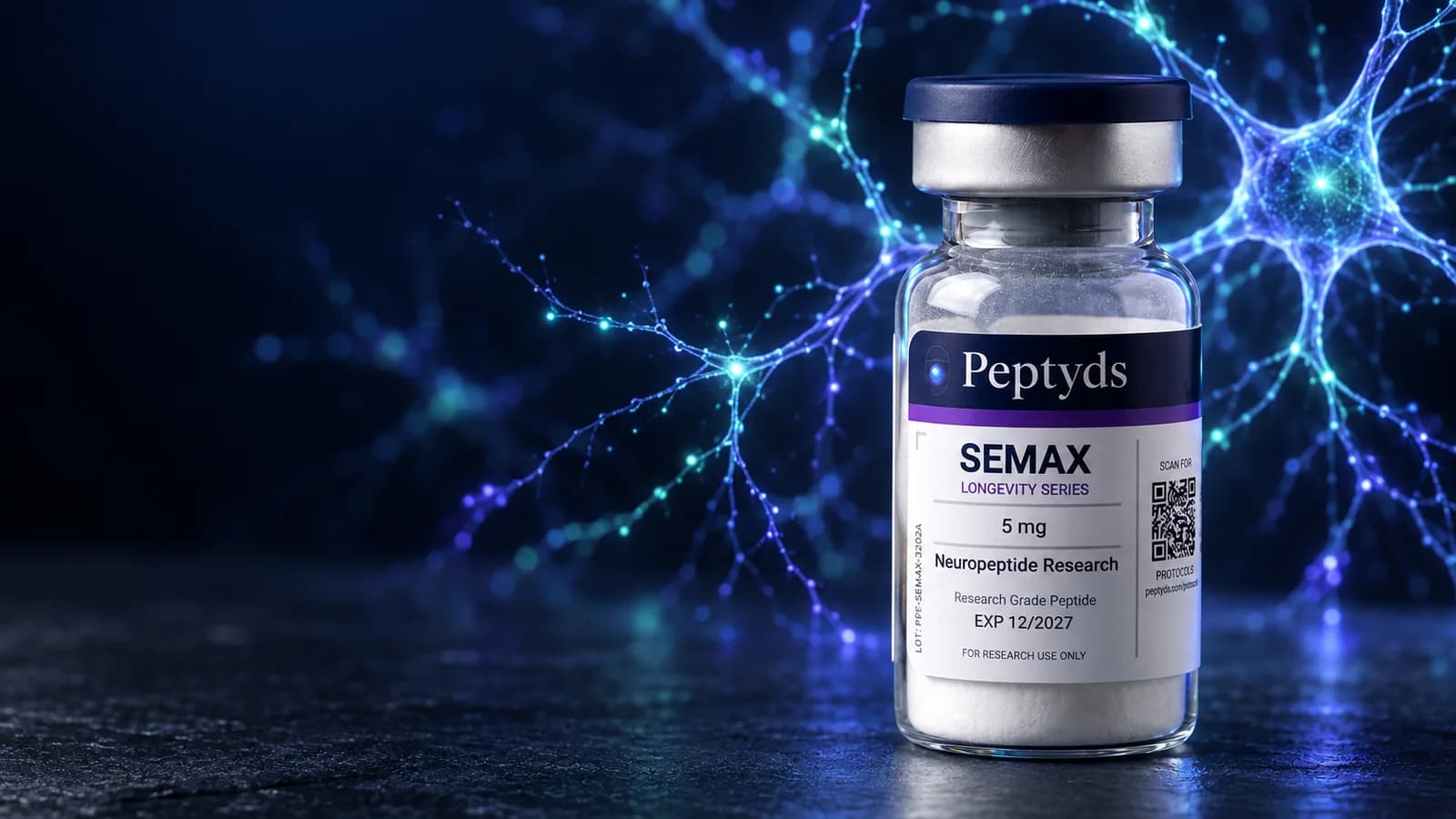
A sealed Peptyds semax research vial in front of a glowing network of blue and violet neurons on a dark background.
Jump to section
  1. 01What is semax?
  2. 02Does semax increase BDNF?
  3. 03What does the semax stroke research show?
  4. 04Does semax improve attention and memory?
  5. 05What other mechanisms have been proposed for semax?
  6. 06How quickly is semax broken down?
  7. 07Is semax an approved medicine in the EU or US?
  8. 08Which semax claims are unsupported?
  • Semax is a synthetic heptapeptide, Met-Glu-His-Phe-Pro-Gly-Pro: the ACTH(4-7) fragment plus a stabilising Pro-Gly-Pro tail, usually described as an ACTH(4-10) analogue.
  • In rats it modestly raised brain BDNF (at most 1.4-fold in the hippocampus) and changed inflammation- and neurotransmission-related gene expression after experimental stroke.
  • Human evidence is limited to small Russian-language stroke studies and two brain-imaging experiments in healthy volunteers that did not measure cognition.
  • Nearly all semax research comes from one Moscow network; independent work is limited to a few cell, chemistry and mouse studies.
  • Semax has no EMA or FDA authorisation and no trial registered on ClinicalTrials.gov; Peptyds supplies it for laboratory research only.

Discussed in this guide

  • SemaxNeuroprotective & Cognitive Research.5 mg€7.00 / mgOut of stock

What is semax?

Semax is a synthetic heptapeptide with the sequence Met-Glu-His-Phe-Pro-Gly-Pro. It keeps residues 4–7 of adrenocorticotropic hormone (ACTH) and adds a C-terminal Pro-Gly-Pro tripeptide, which is why papers describe it both as an ACTH(4-7)-PGP peptide and as an analogue of the ACTH(4-10) fragment.[3][1]

The Pro-Gly-Pro tail belongs to a family its developers call glyprolines, which they report to be unusually stable for regulatory peptides. The ACTH part appears to carry the activity: in a rat model of global cerebral ischaemia, the Pro-Gly-Pro fragment alone showed no neuroprotective effect, and the authors attributed semax's effects mainly to the ACTH(4-7) portion.[7][8]

Semax was developed in Moscow, and nearly all of its literature comes from the Institute of Molecular Genetics of the Russian Academy of Sciences and partner institutes. Its developers describe it as a melanocortin derivative used in the treatment of ischaemic stroke that acts without hormonal side effects; independent groups have published only a handful of papers.[5][6][2]

Continue reading:Semax vials and batch report

Does semax increase BDNF?

The mechanism most often quoted for semax is brain-derived neurotrophic factor (BDNF). In rat basal-forebrain membranes, tritium-labelled semax bound to specific, reversible binding sites, and intranasal semax raised BDNF protein in the basal forebrain within three hours, but not in the cerebellum.[2]

In the rat hippocampus, a single application produced at most a 1.4-fold rise in BDNF protein and a 1.6-fold rise in trkB receptor phosphorylation, with three- and two-fold rises in BDNF exon III and trkB mRNA, alongside more conditioned avoidance responses in a learning task.[1]

The largest numbers come from other settings. In glial cells cultured from newborn rat basal forebrain, BDNF mRNA rose eight-fold and NGF mRNA five-fold 30 minutes after semax was added — gene activity in a dish, not BDNF protein in a living brain. In live rats, intranasal semax changed neurotrophin gene expression in a gene- and region-specific way within an hour: both genes rose in the hippocampus, while NGF expression fell in the frontal cortex.[23][24]

Those are rat results of modest size. The only human BDNF data we found are plasma measurements from a Russian study of stroke patients, not measurements in the brain.[12]

What does the semax stroke research show?

Most semax research concerns ischaemic stroke. In rats with permanent middle cerebral artery occlusion, semax mainly altered the expression of immune-system genes, plus smaller sets of vascular genes, at 3 and 24 hours. After transient occlusion it changed 394 genes at 24 hours, suppressing inflammation-related genes and activating neurotransmission-related ones, and protein-level work found more active CREB and less MMP-9, c-Fos and active JNK.[9][10][5]

The clinical reports are Russian-language and small. A 1997 study compared 30 patients given semax in the acute phase of hemispheric ischaemic stroke with 80 conventionally treated patients and reported some influence on how quickly neurological, especially motor, deficits regressed. A 2018 study of 110 patients in stroke rehabilitation reported higher plasma BDNF and better Barthel index scores in the semax subgroups. Neither English abstract describes randomisation or blinding.[11][12]

A 2024 Russian review concludes that the peptide is clinically effective in both the acute and recovery phases of stroke. Yet no semax trial is registered on ClinicalTrials.gov, and we found no large randomised trial published outside Russia.[13][30]

Does semax improve attention and memory?

Semax's developers wrote in 1997 that it improved memory and attention in animals and in healthy men working under extreme conditions, without adverse effects. That paper summarises the group's own work in Russian, and its abstract does not describe the underlying human studies in enough detail to assess them.[6]

Newer human work uses brain imaging rather than cognitive outcomes. In 24 healthy adults (14 given semax, 10 placebo), resting-state fMRI showed a larger rostral component of the default mode network after semax. A 52-person study comparing semax, selank and placebo found changes in functional connectivity between the right amygdala and the right temporal cortex. Both show that network activity shifted; neither measured memory or attention.[14][15]

In rodents, semax raised levels of the serotonin metabolite 5-HIAA in the striatum without changing dopamine on its own, but it amplified the dopamine release and locomotor activity produced by amphetamine. These are neurochemical signals, not evidence of better cognition.[16]

Continue reading:Selank vs Semax compared

What other mechanisms have been proposed for semax?

Beyond BDNF, the Moscow groups report that semax inhibits enzymes that break down enkephalins. In human serum in vitro it inhibited these enzymes more potently than the peptidase inhibitor puromycin, and the authors suggested this could contribute to its activity.[17]

Independent laboratories have studied narrower questions. An Italian group showed that semax binds copper(II) with high affinity and reduced copper-induced toxicity in neuroblastoma and endothelial cell lines. A Chinese group found that semax improved functional recovery after spinal cord injury in female mice and, using network pharmacology and docking, proposed the μ-opioid receptor as a target.[3][18]

Alzheimer's-disease models are a newer thread. Researchers in Catania reported that semax prevented copper–amyloid-beta complexes from forming and reduced amyloid aggregation in artificial membrane models, and a 2025 Russian study found that semax and a derivative improved behavioural test performance and reduced amyloid deposits in the cortex and hippocampus of APP/PS1 transgenic mice.[26][25]

These findings are real but scattered: different models, different proposed targets and little replication of any single mechanism between laboratories.[17][3][18]

How quickly is semax broken down?

Semax is degraded quickly. In rat serum, most of its breakdown was traced to aminopeptidases and angiotensin-converting enzyme.[20]

Tracer studies in rats show how little reaches the brain. After intravenous administration of tritium-labelled semax, labelled peptide was detected in brain extracts at no more than 0.01% of the amount given. After intranasal administration, about 0.093% of the radioactivity per gram of brain was found at two minutes, 80% of it still intact semax, before rapid breakdown left the tripeptide Pro-Gly-Pro as the main product.[19][21]

Those figures come from rats and radiolabel methods, and we found no comparable human pharmacokinetic study. They also sit uneasily with the finding that Pro-Gly-Pro alone was not neuroprotective in rats, so which molecular species produces semax's reported effects remains an open question.[21][8]

Is semax an approved medicine in the EU or US?

No. Semax has no entry in the European Medicines Agency's medicines database (checked September 2026) and does not appear in Drugs@FDA, the US database of approved drug products.[29][28]

The FDA's page on bulk substances that may present significant safety risks in compounding lists semax (heptapeptide) in the table of substances once placed in category 2 whose nominations were withdrawn. The entry notes a possible immunogenicity risk from aggregation and peptide-related impurities and says the agency has no, or limited, safety information for the proposed routes.[27]

Semax also turns up outside regulated channels. Belgium's medicines-control laboratory identified semax and selank in two suspicious preparations encountered in 2017 and 2018, noted that such peptides are sold online as lyophilised powders or nasal sprays, and wrote that, to its knowledge, neither had completed clinical trials.[22]

Continue reading:Read the Peptyds quality protocol

Which semax claims are unsupported?

Claims that semax is a proven nootropic for healthy people are unsupported. The human evidence consists of small Russian stroke studies and two brain-imaging experiments in healthy volunteers that measured network activity, not cognitive performance.[12][14][15]

Claims that modified versions sold as 'N-acetyl semax amidate' are stronger have almost no primary literature behind them. The independent study we found on N-terminal acetylation reported that acetylated semax did not protect a neuroblastoma cell line against copper toxicity, unlike the parent peptide; we found no peer-reviewed study comparing the potency of these variants in animals or humans.[4][3]

Peptyds supplies semax as a lyophilised research peptide in a sealed vial, with a batch-traceable certificate of analysis, for laboratory research only — not for human or veterinary use. We do not present it as a cognitive enhancer or a stroke treatment.

Continue reading:View SemaxSelank complete guideExplore energy & vitality goalHow to separate peptide evidence from hype

Sources

  1. [01]
  2. [02]
  3. [03]
  4. [04]
  5. [05]
  6. [06]
  7. [07]
  8. [08]
  9. [09]
  10. [10]
  11. [11]
  12. [12]
  13. [13]
  14. [14]
  15. [15]
  16. [16]
  17. [17]
  18. [18]
  19. [19]
  20. [20]
  21. [21]
  22. [22]
  23. [23]
  24. [24]
  25. [25]
  26. [26]
  27. [27]
  28. [28]
  29. [29]
  30. [30]

Questions

What is semax made of?

Semax is a synthetic seven-amino-acid peptide, Met-Glu-His-Phe-Pro-Gly-Pro: the ACTH(4-7) fragment of adrenocorticotropic hormone followed by a Pro-Gly-Pro tail from a peptide family its developers describe as unusually stable.[3][7]

Is semax a hormone?

No. It is derived from a fragment of ACTH, but its developers describe it as acting without hormonal side effects. Its research concerns brain function, mainly stroke and cognition.[5]

Does semax increase BDNF?

In rats, modestly: one application raised hippocampal BDNF protein at most 1.4-fold, and intranasal semax raised BDNF in the basal forebrain within three hours. Human data are limited to plasma BDNF in a Russian stroke study.[1][2][12]

Has semax been tested in humans?

Yes, on a small scale: Russian-language stroke studies of 30 to 110 patients and two brain-imaging studies in healthy volunteers. None is registered on ClinicalTrials.gov, and the abstracts do not describe blinded, randomised designs.[11][12][14][30]

Is semax approved in Europe or the US?

No. It has no entry in the EMA's medicines database or in Drugs@FDA, and the FDA lists semax among compounding substances once in category 2 whose nominations were withdrawn.[29][28][27]

What is the difference between semax and selank?

Both are heptapeptides ending in Pro-Gly-Pro from the same Moscow research network. Semax is built on an ACTH fragment and described as a nootropic; selank is described as an anxiolytic. The Selank vs Semax comparison on Peptyds covers the differences.[17][15]

Educational content. Not medical advice.

Next step

Choose the route that matches how you read.