

Research notes

Selank Peptide: Complete Guide to the Tuftsin-Analogue Research

The selank peptide is a synthetic heptapeptide, Thr-Lys-Pro-Arg-Pro-Gly-Pro, that extends the natural immune peptide tuftsin with a stabilising Pro-Gly-Pro tail. Moscow researchers report that it inhibits enkephalin-degrading enzymes, modulates GABA binding and changes gene expression in rodents, and small Russian-language studies in anxiety disorders compared it with benzodiazepines. The evidence comes almost entirely from one research network, no trial is registered on ClinicalTrials.gov, and selank has no marketing authorisation in the EU or the US.

9 min readUpdated 22 Sept 2026Reviewed by Independent EU laboratory (ISO/IEC 17025)
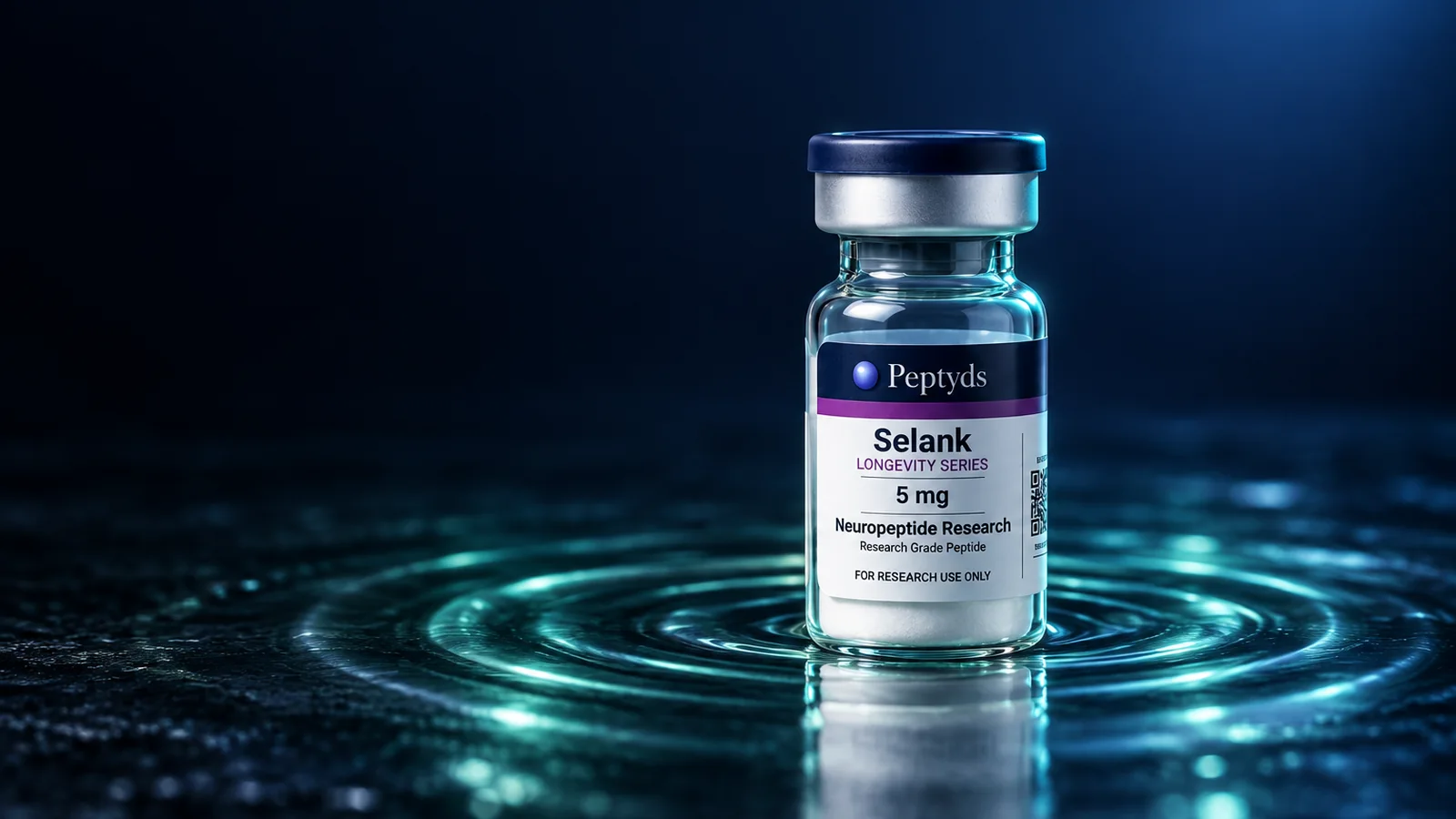
A sealed Peptyds selank research vial standing at the centre of concentric ripples of teal light on a dark, wet surface.
Jump to section
  1. 01What is the selank peptide?
  2. 02What is tuftsin, and why build selank on it?
  3. 03What do the selank anxiety studies show?
  4. 04How is selank thought to work?
  5. 05What do animal studies show on selank, memory and withdrawal?
  6. 06Does selank affect the immune system?
  7. 07Is selank an approved medicine in the EU or US?
  8. 08Which selank claims are unsupported?
  • Selank is a synthetic heptapeptide, Thr-Lys-Pro-Arg-Pro-Gly-Pro: the immune peptide tuftsin plus a stabilising Pro-Gly-Pro tail, called TP-7 in early papers.
  • Proposed mechanisms include inhibition of enkephalin-degrading enzymes and allosteric modulation of GABA binding; gene-expression results differ between rat brain and cultured cells.
  • Human data are three small Russian-language anxiety studies comparing or combining selank with benzodiazepines, plus one brain-imaging study in healthy volunteers.
  • Nearly all selank research comes from a few Moscow institutions, and we found no independent replication of its pharmacology.
  • Selank has no EMA or FDA authorisation and no trial registered on ClinicalTrials.gov; Peptyds supplies it for laboratory research only.

Discussed in this guide

  • SelankNootropic & Anxiolytic Research.5 mg€7.00 / mg

What is the selank peptide?

The selank peptide is a synthetic heptapeptide with the sequence Thr-Lys-Pro-Arg-Pro-Gly-Pro. Its first four residues are tuftsin, a natural peptide first chemically synthesised as Thr-Lys-Pro-Arg in 1973; the last three are the tripeptide Pro-Gly-Pro. Early Russian papers call the same molecule TP-7.[1][5][3]

The Pro-Gly-Pro tail comes from the glyproline family, which the developers report to be unusually stable in the body for regulatory peptides. They describe selank and semax as hybrid peptides built on this principle: a natural regulatory sequence joined to a stabilising glyproline.[6]

Selank research is concentrated in a few Moscow institutions: the Institute of Molecular Genetics of the Russian Academy of Sciences, the Zakusov Institute of Pharmacology and the Mental Health Research Center. We found no independent replication of its pharmacological findings outside that network.[11][15][9]

Continue reading:Selank vials and batch report

What is tuftsin, and why build selank on it?

Tuftsin was described in Nature in 1970 by Najjar and Nishioka at Tufts University, after which it is named. They reported that the phagocytosis-stimulating activity of a leucophilic gamma-globulin fraction could be traced to a single peptide fragment released by an enzyme on the neutrophil membrane.[4]

Its chemical synthesis as the tetrapeptide Thr-Lys-Pro-Arg followed in 1973. Tuftsin is therefore an immune peptide first; Russian researchers later tested tuftsin and its analogues on behaviour.[5][3]

In a 1995 rat study, both tuftsin and TP-7 weakened responses to stressful situations and normalised brain serotonin in animals whose serotonin system had been depleted from birth, and the anxiolytic and stimulant effects of TP-7 were more pronounced than those of tuftsin.[3]

What do the selank anxiety studies show?

The main human data are three small Russian-language studies. In 2008, 62 patients with generalised anxiety disorder or neurasthenia received selank (30) or the benzodiazepine medazepam (32); the anxiolytic effects were reported as similar, with selank also showing anti-asthenic and stimulant effects.[7]

A 2014 study of 60 patients with phobic-anxiety and somatoform disorders compared selank with phenazepam and reported a pronounced anxiolytic and mild nootropic effect that persisted for a week after the peptide was stopped. A 2015 study of 70 patients compared phenazepam alone (30) with phenazepam plus selank (40) and reported fewer phenazepam side effects in the combination group.[8][9]

Healthy-volunteer data are limited to brain imaging. In a 52-person study that compared selank, semax and placebo, resting-state fMRI showed changes in functional connectivity between the right amygdala — a key region in the regulation of anxiety — and the right temporal cortex. The abstract reports no anxiety or performance outcomes.[22]

PubMed indexes the 2008 and 2015 studies as randomised controlled trials, but their English abstracts do not describe blinding or allocation, the samples are small, and all three include the developers among their authors. None is registered on ClinicalTrials.gov.[7][9][27]

How is selank thought to work?

The first proposed mechanism involves enkephalins, the body's own opioid peptides. Patients with generalised anxiety showed a shortened enkephalin half-life in blood, and selank inhibited enkephalin breakdown in plasma in vitro more potently than the peptidase inhibitors bacitracin and puromycin. A second paper from the network reported the same kind of inhibition in human serum.[2][1]

A second line concerns GABA. In radioligand experiments, selank acted as a positive allosteric modulator of GABA binding, and in the rat frontal cortex it changed the expression of 45 of 84 neurotransmission genes one hour after administration. In neuroblastoma cells, however, selank alone changed none of the GABA-system genes studied, although it largely blocked the changes that GABA itself produced.[10][11][12]

Behavioural work points the same way. In rats under unpredictable chronic mild stress, selank combined with diazepam was the most effective treatment for bringing anxiety measures back to pre-stress values, consistent with the authors' hypothesis that selank and benzodiazepines share part of their mechanism.[18]

Monoamine effects depend on the animal. In two mouse strains, selank raised hypothalamic noradrenaline in both but moved dopamine metabolites in opposite directions, and it lowered hippocampal serotonin in only one strain.[13]

Continue reading:Selank vs Semax compared

What do animal studies show on selank, memory and withdrawal?

A 2008 rat study reported that intranasal selank regulated BDNF expression in the hippocampus. The paper has no abstract on PubMed, so the size and direction of the effect cannot be checked from the index record.[14]

In rats given ethanol as their only fluid for 30 weeks, a week of selank prevented the memory and attention problems that developed during withdrawal and prevented the ethanol-induced rise in BDNF in the hippocampus and frontal cortex. It also improved object recognition in nine-month-old rats not exposed to alcohol.[15]

Note the direction: in that model selank kept BDNF from rising rather than raising it, which fits poorly with the simple claim that selank boosts BDNF.[15]

Two rat studies from the Zakusov Institute looked at withdrawal. In alcohol-preferring rats, a single administration of selank abolished withdrawal-induced anxiety in two behavioural tests and prevented mechanical allodynia without changing ethanol intake. In morphine-dependent rats it reduced the overall withdrawal score by 39.6%, slightly less than diazepam's 49.3%.[16][17]

Does selank affect the immune system?

Given tuftsin's origin, the network has also looked at immune effects. In mouse spleen, a single administration of selank cut C3 mRNA three-fold within 30 minutes and shifted several other immune genes over the following hours; its Gly-Pro fragment produced similar changes, which the authors read as the fragment contributing to the effect.[19]

In a Russian-language clinical report, selank completely suppressed IL-6 gene expression in blood cells from patients with depression in vitro, yet IL-6 concentrations rose in the same kind of cultures; patients with generalised anxiety or neurasthenia who received selank for 14 days showed shifts in the balance of Th1 and Th2 cytokines.[20]

In influenza A (H3N2) experiments, selank added to cell cultures a day before infection completely suppressed viral reproduction, and survival of infected animals was highest when it was given preventively; the authors linked this to interferon-alpha gene expression.[21]

We found no controlled human study testing whether selank changes infection risk or immune function; the immune data remain mechanistic and come from the same research network.[19][20]

Is selank an approved medicine in the EU or US?

No. Selank has no entry in the European Medicines Agency's medicines database (checked September 2026) and does not appear in Drugs@FDA, the US database of approved drug products.[26][25]

The FDA's page on bulk substances that may present significant safety risks in compounding lists selank acetate (TP-7) in the table of substances once placed in category 2 whose nominations were withdrawn. The entry notes a possible immunogenicity risk from aggregation and peptide-related impurities and says the agency lacks important information about any safety issues raised by selank acetate in humans.[24]

Belgium's medicines-control laboratory identified selank and semax in two suspicious preparations encountered in 2017 and 2018, noted that such peptides are sold online as lyophilised powders or nasal sprays, and wrote that, to its knowledge, neither had completed clinical trials.[23]

Continue reading:Read the Peptyds quality protocol

Which selank claims are unsupported?

Claims that selank is a non-addictive replacement for benzodiazepines are unsupported. The comparisons come from small Russian-language studies whose abstracts report no assessment of dependence or withdrawal after stopping selank, and none has been repeated outside the developers' network.[7][8][9]

Claims that it is a proven cognitive enhancer or immune booster for healthy people are unsupported too. The healthy-volunteer evidence is a single brain-imaging study of functional connectivity, and the immune findings come from mouse tissue, cell cultures and one small Russian clinical report. Antiviral claims rest on one Russian-language influenza study in cell cultures and animals.[22][19][20][21]

Peptyds supplies selank as a lyophilised research peptide in a sealed vial, with a batch-traceable certificate of analysis, for laboratory research only — not for human or veterinary use. We do not present it as an anti-anxiety or immune treatment.

Continue reading:View SelankSemax complete guideDSIP vs Selank comparedExplore energy & vitality goal

Sources

  1. [01]
  2. [02]
  3. [03]
  4. [04]
  5. [05]
  6. [06]
  7. [07]
  8. [08]
  9. [09]
  10. [10]
  11. [11]
  12. [12]
  13. [13]
  14. [14]
  15. [15]
  16. [16]
  17. [17]
  18. [18]
  19. [19]
  20. [20]
  21. [21]
  22. [22]
  23. [23]
  24. [24]
  25. [25]
  26. [26]
  27. [27]

Questions

What is selank made from?

Selank is a synthetic seven-amino-acid peptide, Thr-Lys-Pro-Arg-Pro-Gly-Pro: the natural tetrapeptide tuftsin followed by a Pro-Gly-Pro tail from a peptide family its developers describe as unusually stable. Early papers call it TP-7.[1][3][6]

Is selank the same as tuftsin?

No. Tuftsin is the four-amino-acid peptide Thr-Lys-Pro-Arg, described in 1970 as a phagocytosis-stimulating fragment; selank adds three more residues. In a 1995 rat study, the anxiolytic and stimulant effects of selank were more pronounced than those of tuftsin.[4][5][3]

Is selank a benzodiazepine?

No. It is a peptide, not a benzodiazepine. Russian research suggests it modulates GABA binding allosterically and inhibits enkephalin breakdown, and small Russian studies compared its anxiolytic effect with that of medazepam and phenazepam.[10][2][7]

Has selank been studied in humans?

Yes, in small Russian-language studies of 60 to 70 patients with anxiety disorders, and in one brain-imaging study of 52 healthy volunteers that also included semax. None is registered on ClinicalTrials.gov.[7][9][22][27]

Is selank approved in the EU or US?

No. It has no entry in the EMA's medicines database or in Drugs@FDA, and the FDA lists selank acetate among compounding substances once in category 2 whose nominations were withdrawn.[26][25][24]

What is the difference between selank and semax?

Both are heptapeptides ending in Pro-Gly-Pro from the same Moscow research network. Selank is built on tuftsin and described as an anxiolytic; semax is built on an ACTH fragment and described as a nootropic. The Selank vs Semax comparison on Peptyds covers the differences.[1][22]

Educational content. Not medical advice.

Next step

Choose the route that matches how you read.