

Research notes

DSIP Peptide: Complete Guide to Delta Sleep-Inducing Peptide Research

DSIP (delta sleep-inducing peptide) is a nine-amino-acid peptide, Trp-Ala-Gly-Gly-Asp-Ala-Ser-Gly-Glu, isolated in 1977 from the cerebral venous blood of rabbits whose sleep had been induced by thalamic stimulation, and named for the delta-wave EEG activity it produced. The evidence behind it is old and thin: animal results were inconsistent, human sleep studies were small and short, independent double-blind trials found little or no clinical benefit, and no DSIP gene, precursor or receptor has been identified. It has no EMA authorisation, and the FDA lists it, as emideltide, on its page of compounding substances that may present significant safety risks.

12 min readUpdated 22 Sept 2026Reviewed by Independent EU laboratory (ISO/IEC 17025)
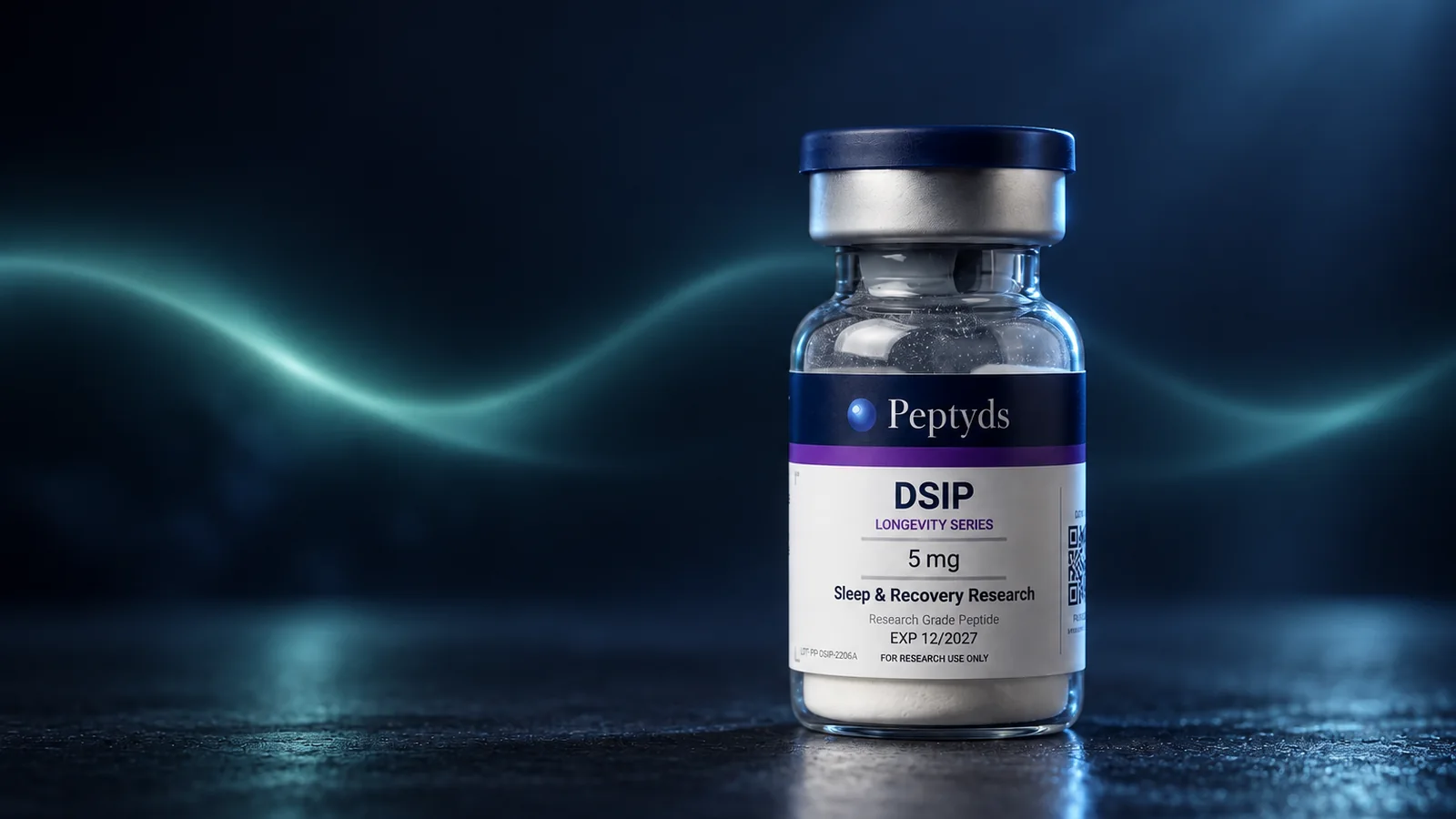
A sealed Peptyds DSIP research vial on a dark reflective surface, with a slow wave of mint light drifting across the deep navy background.
Jump to section
  1. 01What is DSIP peptide?
  2. 02How was DSIP discovered?
  3. 03Does DSIP promote sleep in animals?
  4. 04What did human DSIP sleep studies find?
  5. 05Does DSIP lower cortisol or change other hormones?
  6. 06What else has DSIP been studied for?
  7. 07Is DSIP produced naturally in the body?
  8. 08What is the regulatory status of DSIP?
  9. 09How Peptyds frames DSIP: a research compound with open questions
  • DSIP is a nonapeptide (WAGGDASGE, molecular weight about 849) first isolated from rabbit cerebral venous blood by a Basel group in 1977.
  • Its sleep effect was inconsistent in animals: early rabbit and rat studies reported more delta sleep, while a 1980 rat study found no increase and concluded it is not a specific sleep-promoting substance.
  • Human sleep studies were small, short and intravenous; the independent double-blind trials judged the benefit of little clinical significance.
  • Hormone data conflict: one study saw lower ACTH, another saw no effect on ACTH or cortisol, and growth hormone and prolactin were unchanged in healthy women.
  • No DSIP gene, precursor protein or receptor has been identified, and a protein once called 'DSIP-immunoreactive peptide' turned out to be unrelated in sequence (it is now known as GILZ).
  • DSIP has no EMA authorisation, the FDA reports missing human safety data, and Peptyds supplies it for in-vitro laboratory research only.

Discussed in this guide

  • DSIPSleep Architecture & Neuromodulation Research.5 mg · 10 mg€5.50 / mg

What is DSIP peptide?

DSIP peptide, short for delta sleep-inducing peptide, is a nine-amino-acid peptide with the sequence Trp-Ala-Gly-Gly-Asp-Ala-Ser-Gly-Glu (WAGGDASGE) and a molecular weight of about 849. It was named after its first reported effect: an increase in slow-wave (delta) and spindle activity in the electroencephalogram of rabbits when it was infused into the brain's ventricles.[1][6]

Its structure resembles no other known peptide family, and nearly five decades after its discovery its natural origin and biological role remain unresolved. A 2006 review in the Journal of Neurochemistry described the hypothesis that DSIP is a physiological sleep factor as extremely poorly documented and still weak.[9]

The FDA lists it under the name emideltide. Online it is often presented as a natural sleep hormone; this guide sets out what the primary literature, most of it published between 1977 and the mid-1990s, actually supports, from sleep and hormones to withdrawal and pain.[32][7]

Continue reading:DSIP research vials and batch documentation

How was DSIP discovered?

DSIP came out of the Basel laboratory of Schoenenberger and Monnier, part of a long search for humoral, blood-borne sleep factors. The peptide was isolated from the dialysate of cerebral venous blood taken from rabbits whose sleep had been induced by electrical stimulation of the intralaminar thalamus, then sequenced and synthesised.[2][9][6]

In the key experiment, the synthetic nonapeptide, five possible breakdown fragments, two analogues and a related tripeptide were infused into the brain ventricles of rabbits under double-blind conditions, with 58 animals including controls in the 1977 PNAS report. Only synthetic DSIP produced a significant and specific enhancement of delta and spindle EEG patterns; the fuller 1978 report put the mean rise in delta activity at 35% and found only the alpha-aspartyl form active.[1][2]

The same group reported that intravenous DSIP in freely moving rabbits increased cortical delta activity and reduced motor activity for five hours, which they took as evidence that it crosses the blood-brain barrier. These were small rabbit experiments measuring EEG patterns: they established a signal, not a mechanism.[3][9]

Does DSIP promote sleep in animals?

The early literature reported sleep effects across species. A 1984 review summarised findings that DSIP mainly increased delta sleep in rabbits, rats, mice and humans, with effects on REM sleep more prominent in cats, and a 1979 study reported longer sleep in rats. The same review noted a U-shaped activity curve for both dose and infusion time, so more peptide did not reliably mean more effect.[6][4]

Independent replication was less kind. In a 1980 rat study, systemic DSIP did not reduce motor activity, and injection or infusion into the brain ventricles did not significantly increase sleep or EEG delta power over the next two hours; delta power actually fell after third-ventricle administration. The authors concluded that DSIP does not qualify as a specific sleep-promoting substance.[5]

Part of the inconsistency may be chemical. A 1987 study attributed the rapid disappearance of injected DSIP in blood to degradation, while two analogues broke down more slowly and persisted longer. Kovalzon's group later reported slow-wave-sleep promotion with certain synthetic analogues in rabbits and rats, but not with DSIP itself.[8][9]

What did human DSIP sleep studies find?

The first human studies came from the group that discovered the peptide. In six healthy volunteers given a morning intravenous infusion under double-blind crossover conditions, median total sleep time rose by 59% over the next 130 minutes compared with placebo, without classic sedation and without observed side effects. A 1987 placebo-controlled study in 14 chronic insomniacs reported better night sleep and daytime performance over seven nights.[10][11]

Other early reports were uncontrolled. An open study of seven patients with severe insomnia, each given a series of ten injections, reported sleep normalised in all but one for follow-up periods of three to seven months, without any comparison group.[12]

Independent double-blind trials did not confirm a meaningful effect. In a 1987 crossover study in chronic insomniacs, most sleep changes under DSIP were not significant against baseline or placebo nights, and the differences that were significant already existed at baseline; the authors judged the improvement of little clinical significance. A 1992 study of 16 chronic insomniacs found slightly higher sleep efficiency and shorter sleep latency, but called the effects weak and possibly due to chance changes in the placebo group, concluding that short-term DSIP treatment is not likely to be of major therapeutic benefit.[13][14]

Taken together, the human sleep studies described here were small, short and intravenous, published between 1981 and 1992, and the most favourable results came from the originating group or from uncontrolled work. Kovalzon and Strekalova's 2006 review concluded that the link between DSIP and sleep was never further characterised.[9][14]

Continue reading:Compare Ipamorelin vs DSIP for sleep research

Does DSIP lower cortisol or change other hormones?

DSIP is often described online as lowering cortisol, and the human data conflict. In eight healthy men, a DSIP infusion produced a significant fall in ACTH, the pituitary hormone that drives cortisol release, without changing vasopressin. But a 1995 study found that DSIP left both CRH-stimulated and meal-related ACTH and cortisol secretion unchanged in healthy men, and its authors concluded that their data do not support an inhibitory role in humans.[15][16]

Growth hormone did not move either. In a 1993 study of eight healthy women, DSIP infusion had no effect on basal, circadian or arginine-stimulated growth hormone and prolactin secretion, a relevant finding because DSIP is often discussed alongside growth-hormone secretagogues.[17]

Measurements of the body's own DSIP-like material also cut against the sleep-hormone story. In 12 volunteers sampled every 30 minutes for 24 hours, plasma DSIP-like immunoreactivity peaked around 15:00 and was lowest around 01:00, was lower during REM and slow-wave sleep than during waking, and tracked body temperature; the authors suggested that circulating DSIP may be associated with suppression of slow-wave and REM sleep.[18]

What else has DSIP been studied for?

In the 1980s DSIP was tried in withdrawal and pain. A report on 107 inpatients in alcohol or opiate withdrawal described symptoms disappearing or improving markedly after intravenous DSIP in most of those evaluated, based on ratings by physicians and nursing staff, and a pilot study in seven patients with chronic pain episodes reported lower pain levels in six. Neither report describes a placebo control.[19][20]

Animal studies have reported other effects. In a rat model, DSIP and an analogue reduced the incidence, severity and duration of drug-provoked audiogenic seizures, and a rat study of cerebral ischaemia reported fewer postural abnormalities and lower mortality. These are single-model animal findings.[21][22]

A 2009 randomised study points the other way from the peptide's name. In 24 women undergoing anaesthesia, 12 of whom received DSIP intravenously as an adjunct to isoflurane, the peptide increased heart rate, reduced heart-rate variability and, paradoxically, reduced EEG delta rhythm and lightened the measured depth of anaesthesia.[23]

Is DSIP produced naturally in the body?

DSIP was isolated from blood, and antibodies against it label neurosecretory nuclei of the hypothalamus in several vertebrate species, yet no gene encoding it, no precursor protein and no receptor have been identified. Kovalzon and Strekalova argued in 2006 that the DSIP-like immunoreactivity seen in tissues may come, at least partly, from one or more related peptides rather than from DSIP itself.[9][26]

One trail shows the problem. When researchers purified large DSIP-like immunoreactive material from pig brain in 1993, it turned out to be a 77-residue protein recognised by an anti-DSIP antiserum, but with an amino-acid sequence unrelated to DSIP and a leucine-zipper motif. The human gene for that protein is catalogued as TSC22D3, better known as glucocorticoid-induced leucine zipper (GILZ), with 'delta sleep-inducing peptide immunoreactor' listed among its alternative names.[24][25]

Other ideas remain hypotheses. A 2011 database search found a closely related sequence, WKGGNASGE, inside histone demethylases encoded by the JMJD1B gene and proposed such proteins as possible precursors of peptides with DSIP-like activity. Until a precursor is confirmed, measurements of 'endogenous DSIP' in blood or cerebrospinal fluid are best read as antibody signals rather than proof of a DSIP hormone.[26][9][24]

What is the regulatory status of DSIP?

No medicine containing DSIP has an EMA authorisation. A September 2026 search of the European Medicines Agency's medicines database returned no entry for DSIP, delta sleep-inducing peptide or emideltide, and there is no European Public Assessment Report (EPAR).[31]

In the United States, the FDA's page on bulk drug substances for compounding that may present significant safety risks lists emideltide (DSIP) among substances previously placed in category 2 whose nominations were later withdrawn by the nominators. The FDA's stated concerns are possible immunogenicity for certain routes of administration, complexities with peptide-related impurities and characterisation of the active ingredient, and the absence of safety information for the proposed route; the agency says it lacks sufficient information to know whether the drug would cause harm in humans.[32]

How Peptyds frames DSIP: a research compound with open questions

Peptyds supplies DSIP as a lyophilised research peptide for in-vitro laboratory research only, with batch-specific quality documentation under the same protocol as the rest of the catalogue. We do not present it as a sleep aid, a cortisol-lowering product or a recovery supplement.[9][31]

For experimental design, the literature flags stability as a practical variable. DSIP breaks down quickly in blood, and in a human intestinal cell model only about 8% remained after two hours on the apical side, with tryptophan as the main metabolite. Animal and cell studies also disagree on how it crosses the blood-brain barrier: by a non-competitive route in rats, a saturable mechanism in perfused guinea-pig brain, or simple diffusion in a cultured endothelial model.[8][30][27][28][29]

The honest research frame is short: a nonapeptide with a 1977 EEG signal in rabbits, inconsistent animal replication, small and contradictory human studies, and no identified gene or receptor. Anyone considering personal use should know that it has no EMA authorisation and that the FDA reports a lack of human safety information; clinical questions belong with a qualified healthcare professional.[9][14][32]

Continue reading:View DSIPCompare DSIP vs SelankCompare Ipamorelin vs DSIPExplore the muscle & sleep goalResearch evidence versus hype

Sources

  1. [01]
  2. [02]
  3. [03]
  4. [04]
  5. [05]
  6. [06]
  7. [07]
  8. [08]
  9. [09]
  10. [10]
  11. [11]
  12. [12]
  13. [13]
  14. [14]
  15. [15]
  16. [16]
  17. [17]
  18. [18]
  19. [19]
  20. [20]
  21. [21]
  22. [22]
  23. [23]
  24. [24]
  25. [25]
  26. [26]
  27. [27]
  28. [28]
  29. [29]
  30. [30]
  31. [31]
  32. [32]

Questions

What is DSIP peptide?

DSIP, or delta sleep-inducing peptide, is a nine-amino-acid peptide (WAGGDASGE) isolated in 1977 from the cerebral venous blood of rabbits whose sleep had been induced by thalamic stimulation. It was named for the increase in EEG delta activity it produced in rabbits. The FDA lists it under the name emideltide.[1][2][32]

Does DSIP improve sleep in humans?

The evidence is weak. Early studies from the discovering group, in 6 and 14 people, reported more or better sleep after intravenous DSIP. Independent double-blind trials in chronic insomnia found effects that were small, inconsistent or explained by baseline differences, and judged them of little clinical value. The human sleep studies reviewed here are all small and date from 1981 to 1992.[10][11][13][14]

Is DSIP made naturally by the body?

It is called endogenous because DSIP-like material has been measured in brain, blood and other tissues, but no gene, precursor protein or receptor for DSIP has been identified. A larger protein once called 'DSIP-immunoreactive peptide' proved to have an unrelated sequence and is now known as GILZ (TSC22D3). Whether DSIP itself is a natural hormone remains unresolved.[6][9][24][25]

Does DSIP lower cortisol?

Not reliably. One small study in eight men found that DSIP lowered ACTH, the hormone upstream of cortisol, but a 1995 study found no effect on stimulated or meal-related ACTH and cortisol secretion in healthy men. DSIP also left growth hormone and prolactin unchanged in a study of healthy women.[15][16][17]

Does DSIP cross the blood-brain barrier?

Animal and cell studies suggest it can, but they disagree on how: a radiolabelled DSIP analogue crossed the rat blood-brain barrier by a non-competitive mechanism, a guinea-pig perfusion study reported a saturable transport system, and a cell-culture model pointed to simple diffusion. DSIP is also broken down quickly in blood, which complicates any reading of effects in living animals.[27][28][29][8]

Is DSIP an approved medicine?

No EMA authorisation or EPAR exists for DSIP (emideltide). The FDA lists emideltide on its page of compounding substances that may present significant safety risks, citing possible immunogenicity, impurity and characterisation issues and a lack of human safety information. Peptyds supplies DSIP for in-vitro laboratory research only.[31][32]

Educational content. Not medical advice.

Next step

Choose the route that matches how you read.