

Science

Peptide vs Polypeptide vs Protein: What Is a Polypeptide?

A polypeptide is a chain of amino acids joined by peptide bonds. Peptides sit at the short end of that scale: the US National Library of Medicine's MeSH vocabulary calls chains of about 2–12 amino acids oligopeptides and about 13 or more polypeptides, while proteins are polypeptides — sometimes several chains together — that fold into defined three-dimensional structures. There is no single official cut-off: pharmacology reviews often define peptides as fewer than 50 amino acids, and the US FDA treats polymers of 40 or fewer amino acids as peptides for its biologics rules.

7 min readUpdated 22 Sept 2026Reviewed by Independent EU laboratory (ISO/IEC 17025)
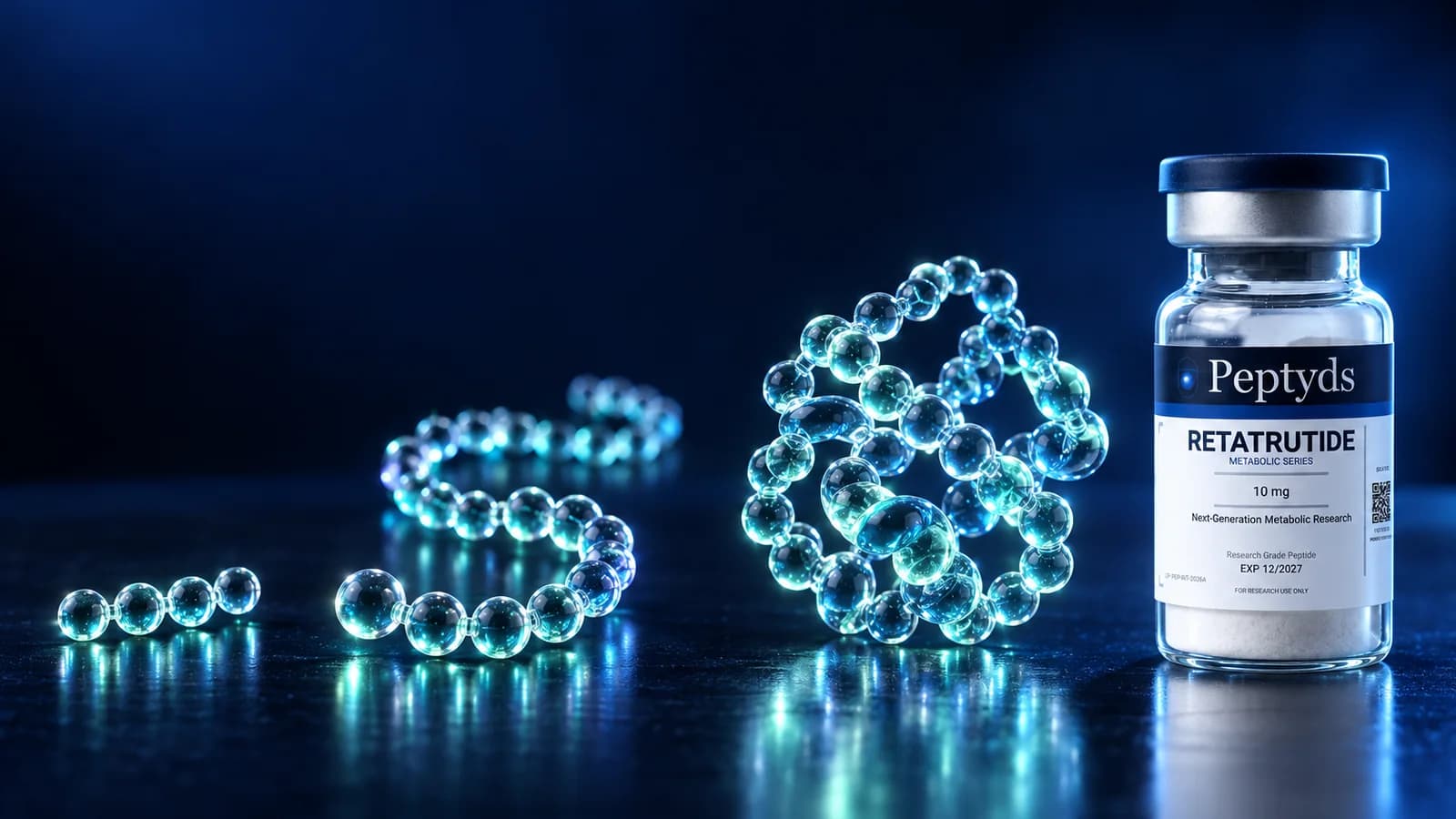
Chains of glass beads growing from a short strand to a long chain to a folded cluster, beside a sealed Peptyds research vial on a dark surface.
Jump to section
  1. 01What is a polypeptide?
  2. 02Peptide vs polypeptide vs protein: where is the line?
  3. 03Is a protein just a long polypeptide?
  4. 04Examples from four to 191 amino acids
  5. 05How are peptides and proteins made?
  6. 06Why does the difference matter in the lab?
  • A polypeptide is a chain of amino acids joined by peptide bonds; peptides, polypeptides and proteins differ mainly in length and organisation.
  • MeSH calls chains of about 2–12 amino acids oligopeptides and about 13 or more polypeptides; proteins are larger and fold into complex structures.
  • There is no universal cut-off: pharmacology reviews often use fewer than 50 amino acids for peptides, while the FDA uses 40 or fewer.
  • Proteins can contain several chains — haemoglobin has four, insulin two — and their amino-acid sequence determines how they fold.
  • Short peptides are usually made by solid-phase chemical synthesis; large proteins such as somatropin by recombinant expression.

Discussed in this guide

  • SelankNootropic & Anxiolytic Research.5 mg€7.00 / mg
  • Epithalon PremiumA tetrapeptide studied for its role in supporting telomerase activity and circadian rhythm — framed for long-horizon routines.10 mg€6.90 / mgOut of stock
  • SemaxNeuroprotective & Cognitive Research.5 mg€7.00 / mgOut of stock

What is a polypeptide?

A polypeptide is a chain of amino acids joined by peptide bonds between neighbouring amino acids. The word describes structure, not function: the same chemistry links two amino acids in a dipeptide and hundreds in a large protein.[1]

The US National Library of Medicine's MeSH vocabulary, used to index the biomedical literature, groups these chains by length. Oligopeptides have between two and twelve amino acids; polypeptides have approximately 13 or more; proteins are described as larger versions of peptides that can form complex structures such as enzymes and receptors.[1][3]

Peptide chains are not always simple lines. MeSH notes that peptide bonds can join amino acids into linear, branched or cyclical structures, and that proteins can be modified, cross-linked, cleaved or assembled from several subunits after they are made.[1][2]

Continue reading:What are peptides? A plain-English guide

Peptide vs polypeptide vs protein: where is the line?

There is no single official cut-off, so it helps to know which convention a source is using. MeSH draws its oligopeptide–polypeptide line at about 12 to 13 amino acids. Pharmacology reviews commonly define therapeutic peptides as chains of fewer than 50 amino acids, one of them adding a molecular weight below 10 kDa.[1][4][5]

Regulators draw their own line. For its biologics framework, the US FDA treats polymers of 40 or fewer amino acids as peptides rather than proteins. Protein products such as insulin and human growth hormone, historically approved as ordinary new drug applications, were deemed biologics licences on 23 March 2020.[6]

So the same molecule can be a peptide in one document and a protein in another. Tesamorelin is a good example: it is widely called a peptide, yet its US prescribing information describes the 44-amino-acid sequence of human growth-hormone-releasing factor plus a hexenoyl group — above the FDA's 40-residue peptide line.[13][6]

Continue reading:The science behind Peptyds

Is a protein just a long polypeptide?

Not quite. MeSH defines proteins as linear polypeptides made on ribosomes that may then be modified, cross-linked, cleaved or assembled into complexes of several subunits, and it stresses that the amino-acid sequence determines the shape the chain takes as it folds — and with it the protein's function.[2]

How a sequence dictates a folded structure has been one of biology's central questions for half a century. Computer simulations can now fold some small proteins accurately, and structure prediction has become far more successful than early researchers thought possible.[7]

Many proteins are built from more than one chain. Haemoglobin is a tetramer of two alpha- and two beta-globin chains, each carrying a haem group. Insulin is much smaller but also has two chains: an A-chain of 21 amino acids and a B-chain of 30.[8][9]

Insulin also shows how one chain can become a two-chain protein. It is made as a larger precursor, named proinsulin in 1967, which is processed into the mature hormone; recombinant production follows a similar route, refolding the precursor and converting it into insulin with two enzymes.[10][9]

Examples from four to 191 amino acids

Epitalon, a research tetrapeptide, is four amino acids long (Ala-Glu-Asp-Gly). Semax and selank are heptapeptides of seven. By the MeSH convention all three are oligopeptides, a subset of peptides.[11][12][3]

Tesamorelin (44 amino acids plus a hexenoyl group) and insulin (51 amino acids in two chains) sit in the zone where conventions disagree. Recombinant human growth hormone, somatropin, is unambiguously a protein: its US prescribing information describes 191 amino acids and a molecular weight of 22,124 daltons, with a sequence identical to pituitary growth hormone.[13][9][14]

Peptides are also cut from proteins. Most bioactive peptides — peptide neurotransmitters, neuropeptides and peptide hormones — are generated by proteolytic cleavage of larger precursor proteins, and the breakdown of haemoglobin yields peptides with biological activity of their own.[8]

Continue reading:Epitalon complete guide

How are peptides and proteins made?

Short peptides are usually made chemically, one amino acid at a time, on a solid support. A 2016 review describes Fmoc solid-phase peptide synthesis as the method of choice, with multiton production of therapeutic peptides driving down the cost of the building blocks. Tesamorelin's prescribing information, for instance, describes it as produced synthetically.[15][13]

Large proteins are usually made biologically. In 1979, synthetic genes for the insulin A- and B-chains were expressed separately in E. coli, and the purified chains were then mixed, reduced and reoxidised until insulin could be detected. Somatropin is likewise produced by recombinant DNA technology in E. coli.[16][14]

Biological production brings its own folding problem. Recombinant proinsulin expressed in E. coli accumulates in inclusion bodies that have to be denatured and refolded before enzymes convert it into mature insulin.[9]

Why does the difference matter in the lab?

Size changes how molecules behave. Unmodified peptides usually undergo extensive proteolytic cleavage, which gives them short half-lives, whereas proteins depend on a folded structure that can be lost and sometimes has to be restored by refolding.[4][9]

It also changes how identity and purity are checked. An FDA laboratory showed that liquid chromatography with high-resolution mass spectrometry can confirm a peptide's sequence, determine its amino-acid composition and quantify impurities below 0.1% in a single run — the kind of evidence that belongs behind a peptide certificate of analysis.[17]

Continue reading:What HPLC purity means for peptidesLyophilised peptides: storage and stability

Sources

  1. [01]
  2. [02]
    National Library of Medicine
    MeSH descriptor: Proteins
  3. [03]
    National Library of Medicine
    MeSH descriptor: Oligopeptides
  4. [04]
  5. [05]
  6. [06]
  7. [07]
  8. [08]
  9. [09]
  10. [10]
  11. [11]
  12. [12]
  13. [13]
  14. [14]
  15. [15]
  16. [16]
  17. [17]

Questions

What is the difference between a peptide and a polypeptide?

Both are chains of amino acids joined by peptide bonds. 'Peptide' is the general term; 'polypeptide' usually means a longer chain. MeSH uses about 13 or more amino acids for polypeptides and calls chains of 2–12 amino acids oligopeptides.[1][3]

Is a polypeptide a protein?

Not necessarily. A protein is made of one or more polypeptide chains that fold into a specific three-dimensional structure and may be modified or assembled with other chains. MeSH describes proteins as larger versions of peptides that form complex structures such as enzymes and receptors.[2][1][7]

How many amino acids make a protein?

There is no universal number. Pharmacology reviews often call chains of fewer than 50 amino acids peptides, and the US FDA treats 40 or fewer as peptides for its biologics rules. Human growth hormone, at 191 amino acids, is clearly a protein.[4][6][14]

What bond holds a polypeptide chain together?

The peptide bond, which joins neighbouring amino acids along the chain. MeSH also notes that proteins can be cross-linked after they are made, which is one way separate chains or distant parts of a chain are held together.[1][2]

Is insulin a peptide or a protein?

It sits near the boundary. Insulin has 51 amino acids in two chains of 21 and 30, and the FDA lists insulin among the protein products that moved to its biologics framework in March 2020.[9][6]

Are research peptides polypeptides?

Some are, some are not. Epitalon has four amino acids and semax and selank seven, which makes them oligopeptides; tesamorelin, at 44, is long enough to count as a polypeptide — or a protein under the FDA's definition. What matters in the lab is the exact sequence and a batch-specific analysis.[11][12][13]

Educational content. Not medical advice.

Next step

Choose the route that matches how you read.