

Research notes

Ipamorelin Peptide: Complete Guide to the Selective GH Secretagogue

Ipamorelin is a synthetic pentapeptide (Aib-His-D-2-Nal-D-Phe-Lys-NH2) that activates the growth-hormone secretagogue receptor GHS-R1a, the ghrelin receptor, to trigger a pulse of the pituitary's own growth hormone. Its 'selective' label comes from a 1998 swine study in which it released GH without raising ACTH or cortisol, unlike older GH-releasing peptides. In healthy men it had a terminal half-life of about 2 hours and produced a single GH episode peaking at roughly 40 minutes, and its only published efficacy trial, in post-operative ileus, found no significant benefit over placebo. Ipamorelin has no marketing authorisation in the EU and is prohibited in sport under WADA class S2.

10 min readUpdated 22 Sept 2026Reviewed by Independent EU laboratory (ISO/IEC 17025)
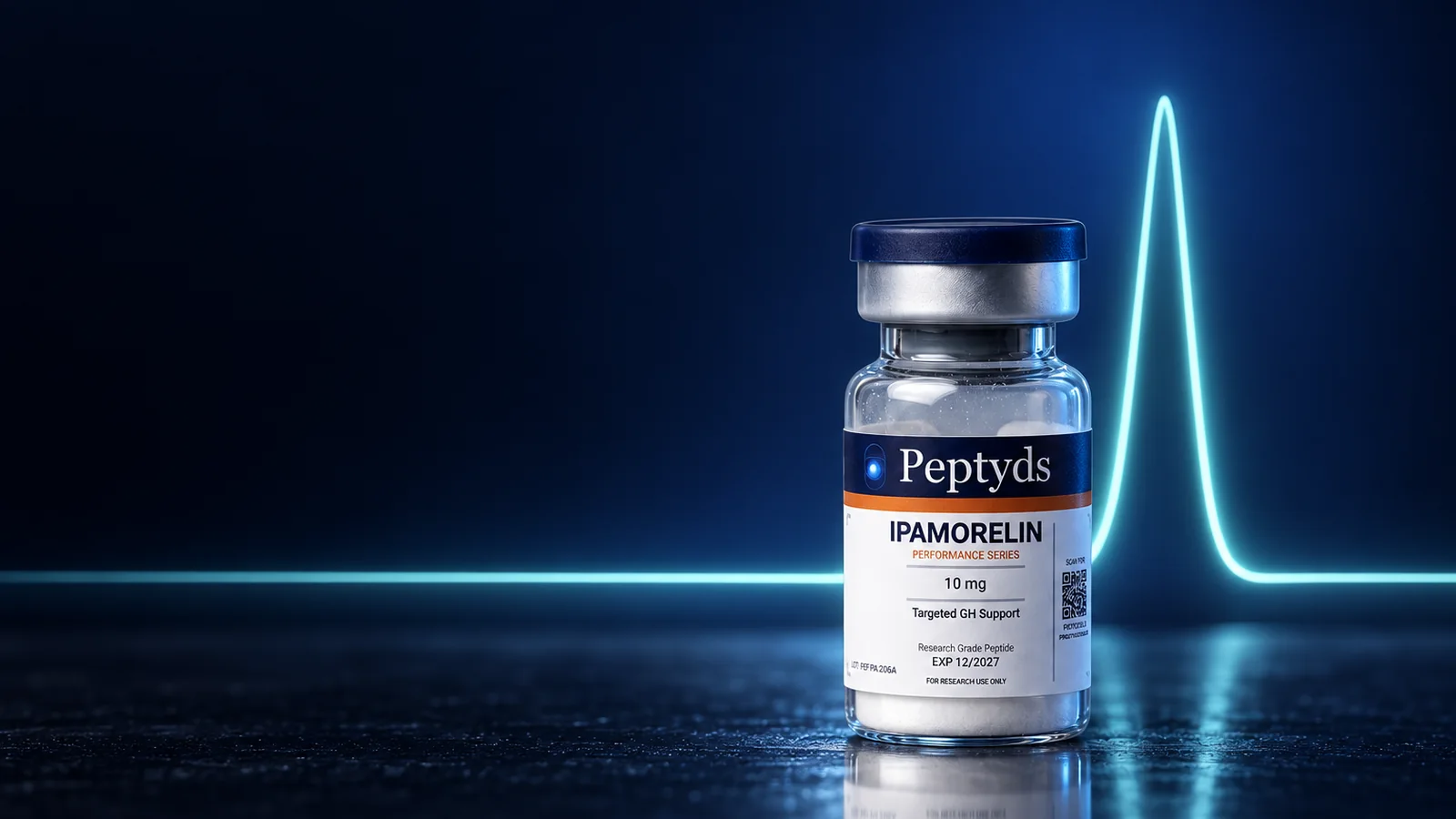
A sealed Peptyds ipamorelin research vial on a dark surface, with a single sharp peak of mint light rising from a flat line behind it.
Jump to section
  1. 01What is the ipamorelin peptide?
  2. 02Is ipamorelin really selective for growth hormone?
  3. 03What is the half-life of ipamorelin?
  4. 04What did animal studies of ipamorelin find?
  5. 05Does ipamorelin affect appetite and body fat?
  6. 06Has ipamorelin been tested in clinical trials?
  7. 07Is there evidence that ipamorelin improves sleep?
  8. 08Regulatory status, quality risks and how Peptyds frames ipamorelin
  • Ipamorelin is a synthetic pentapeptide (Aib-His-D-2-Nal-D-Phe-Lys-NH2) that activates GHS-R1a, the ghrelin receptor, to release the pituitary's own growth hormone.
  • Its 'selective' reputation comes from swine, where it raised GH without raising ACTH or cortisol, even far above the GH-releasing range.
  • In healthy men it had a terminal half-life of about 2 hours and produced a single GH episode peaking at roughly 40 minutes.
  • Rodent studies show bone-growth and anti-catabolic effects, but also GH-independent increases in body fat and food intake.
  • Its only published efficacy trial, in post-operative ileus, found no significant benefit over placebo, and no study has measured sleep.
  • Ipamorelin has no EU authorisation, sits on the FDA's Category 2 compounding list and is prohibited in sport under WADA S2.2.4.

Discussed in this guide

  • IpamorelinA selective GHRP studied for gentle, pulsatile growth hormone release — investigated in sleep depth, overnight recovery, and measured body-composition routines.5 mg · 10 mg€4.40 / mg

What is the ipamorelin peptide?

Ipamorelin is a synthetic pentapeptide with the sequence Aib-His-D-2-Nal-D-Phe-Lys-NH2. It came out of a Novo Nordisk chemistry programme in the 1990s, from a series of compounds built by removing the central Ala-Trp dipeptide of growth-hormone-releasing peptide 1 (GHRP-1). In rat pituitary cells it released growth hormone (GH) with a potency and efficacy similar to GHRP-6, and blocking experiments showed that it works through the GHRP receptor rather than the GHRH receptor.[1]

That receptor was cloned in 1996 from pig and human pituitary and hypothalamus as a G-protein-coupled receptor for synthetic GH secretagogues, and named GHS-R. Three years later its natural ligand was identified: ghrelin, a 28-amino-acid peptide from the stomach whose serine-3 carries an octanoyl group that is essential for activity. Ipamorelin is therefore best described as a ghrelin-receptor (GHS-R1a) agonist.[4][5]

Acting on this receptor, ipamorelin prompts the pituitary to release its own GH. It is not growth hormone and contains none. In healthy men each exposure produced a single episode of GH release that fell back to negligible levels, which is why the molecule is described in research as a secretagogue rather than a replacement.[1][2]

Continue reading:View Ipamorelin

Is ipamorelin really selective for growth hormone?

The claim traces to one set of experiments. In conscious swine, none of the secretagogues tested changed FSH, LH, prolactin or TSH, but GHRP-6 and GHRP-2 both raised ACTH and cortisol. Ipamorelin did not raise ACTH or cortisol beyond the levels seen after GHRH, even at doses more than 200-fold above those needed for half-maximal GH release. On that basis the authors called it the first GHRP-receptor agonist with a GH selectivity similar to GHRH's.[1]

Why that matters: in healthy men, the older hexapeptide GHRP-6 roughly doubled prolactin and cortisol at its highest tested dose, so the cleaner endocrine profile is a real point of difference within the class. Hexarelin, another GHRP, is compared with ipamorelin in a separate page.[6]

The limit is equally real. The selectivity data were generated in animals, and the published human pharmacokinetic study of ipamorelin modelled GH responses without reporting ACTH, cortisol or prolactin. A 2026 endocrine review describes the ipamorelin profile as comparatively clean in available human work but places most secretagogues in an evidence tier without controlled efficacy data.[2][18]

Continue reading:Compare hexarelin vs ipamorelin

What is the half-life of ipamorelin?

The only published human pharmacokinetic study gave ipamorelin as 15-minute intravenous infusions at five escalating rates to healthy male volunteers, eight per dose level. Exposure rose in proportion to dose, the terminal half-life was about 2 hours, clearance was 0.078 L/h/kg and the volume of distribution at steady state was 0.22 L/kg.[2]

At every dose the GH response was a single episode, peaking at about 0.67 hours (roughly 40 minutes) and declining exponentially to negligible concentrations. Variability between volunteers was larger for the GH response than for the drug's own kinetics, a reminder that the same exposure does not produce the same pituitary output in everyone.[2]

Rat data add context. Ipamorelin's systemic clearance was five-fold lower than that of GHRP-6, it was excreted mainly in urine rather than bile, 60-80% was recovered intact, and nasal bioavailability was estimated at about 20%. These are animal figures and should not be read as human values.[3]

What did animal studies of ipamorelin find?

Most of the ipamorelin literature is rodent work. In adult female rats treated for 15 days, it increased longitudinal bone growth in the tibia in a dose-dependent way, from 42 to as much as 52 micrometres per day, together with body-weight gain. Total IGF-1, IGF-binding proteins and bone-turnover markers did not change, and the pituitary GH response to a later challenge was only marginally reduced.[7]

Over 12 weeks of continuous delivery in young adult female rats, ipamorelin and GHRP-6 increased bone mineral content, but mainly by making bones larger: corrected for the higher body weight, total mineral content was unchanged and volumetric density did not rise. In rats given high-dose glucocorticoids, ipamorelin counteracted the fall in periosteal bone formation and muscle tetanic tension, and it neutralised the steroid-driven negative nitrogen balance, though less efficiently than GH itself at the doses used.[8][9][10]

These studies establish that ipamorelin behaves like a GH secretagogue in rats. They do not establish any effect in humans: the human studies of GH secretagogues such as ipamorelin did not measure bone, muscle or body-composition endpoints, so recovery and physique claims made for it rest on this animal base.[18]

Does ipamorelin affect appetite and body fat?

One finding rarely appears on product pages. GH itself is lipolytic, yet in mice twice-daily ipamorelin increased fat-pad weights relative to body weight, both in GH-deficient animals and in animals with normal GH. In GH-intact mice, two weeks of ipamorelin or GHRP-6 raised relative body fat measured by DEXA, and the secretagogues, unlike GH, increased serum leptin and food intake. The authors concluded that GH secretagogues can increase body fat through GH-independent mechanisms that may include increased feeding.[11]

Rat work on post-surgical recovery points the same way: repeated intravenous ipamorelin significantly increased food intake and body-weight gain over 48 hours after abdominal surgery. That is consistent with ipamorelin acting on the ghrelin receptor, whose natural ligand is an appetite signal as well as a GH releaser.[12][15]

Ipamorelin is often discussed next to MK-677. The differences between the two in chemistry, route and time course are covered in a dedicated comparison rather than repeated here.

Continue reading:Read ipamorelin vs MK-677

Has ipamorelin been tested in clinical trials?

Yes, but not for growth, muscle or sleep. Its clinical development targeted post-operative ileus, the stalled gut motility that can follow abdominal surgery. The rationale came from rodents: in rats that had laparotomy with intestinal manipulation, a single intravenous dose shortened the time to first bowel movement, and repeated dosing increased faecal output, food intake and weight gain.[12]

The human test was a multicentre, double-blind, placebo-controlled phase 2 trial in adults undergoing bowel resection. Of 117 patients enrolled, 114 formed the analysis population; ipamorelin or placebo was infused intravenously twice daily for up to seven days. Median time to the first tolerated solid meal was 25.3 hours with ipamorelin and 32.6 hours with placebo, a difference that was not statistically significant (p = 0.15), and no secondary endpoint differed either. Treatment was well tolerated.[13]

A larger phase 2 dose-finding study enrolled 320 patients and was completed in 2014, but no results have been posted on its registry record. No ipamorelin product holds an EU marketing authorisation, for this or any other indication.[14][20]

Is there evidence that ipamorelin improves sleep?

Not for ipamorelin itself. A PubMed search for 'ipamorelin AND sleep' run on 22 September 2026 returned two review articles and no primary study: no trial, animal or human, has measured sleep with ipamorelin. Sleep claims attached to it are extrapolations.[16]

The extrapolation starts from ghrelin. In a small study of seven volunteers, intravenous ghrelin given in the late evening increased slow-wave sleep across the night, reduced REM sleep in part of the night and raised GH, prolactin and early-night cortisol. The authors suggested ghrelin may be an endogenous sleep-promoting factor.[15]

Ipamorelin shares ghrelin's receptor but differs from it in structure, kinetics and, in animals, in its effect on cortisol, so the ghrelin result cannot be transferred to it. Whether ipamorelin changes sleep architecture is an open question. DSIP is compared with ipamorelin on a separate page.[15][1]

Continue reading:Compare ipamorelin vs DSIP

Regulatory status, quality risks and how Peptyds frames ipamorelin

Ipamorelin has no entry in the EMA medicines database and no EU marketing authorisation. The FDA lists ipamorelin acetate in Category 2, bulk substances that may present significant safety risks in compounding, citing possible immunogenicity, the analytical complexity of its unnatural amino acids, and serious adverse events, including death, reported when it was given intravenously in a gastric-motility study. In sport, the WADA 2026 Prohibited List names ipamorelin under S2.2.4, prohibited at all times.[20][19][21]

Identity is a documented problem in unregulated supply. Anti-doping laboratories analysing black-market products found Gly-ipamorelin, the same peptide with one extra glycine at the N-terminus, confirmed by custom synthesis. A purity percentage alone would not catch that; a certificate of analysis that reports the measured mass would.[17]

Peptyds supplies ipamorelin as a lyophilised compound with a batch certificate of analysis, for in-vitro laboratory research only. We do not present it as a growth-hormone therapy, a body-composition product or a sleep aid. Researchers comparing it with recombinant GH, or with the CJC-1295 blend it is often paired with, will find both covered in dedicated guides.

Continue reading:Read HGH vs ipamorelinCJC-1295 + ipamorelin: the complete guide

Sources

  1. [01]
  2. [02]
  3. [03]
  4. [04]
  5. [05]
  6. [06]
  7. [07]
  8. [08]
  9. [09]
  10. [10]
  11. [11]
  12. [12]
  13. [13]
  14. [14]
  15. [15]
  16. [17]
  17. [18]
  18. [19]
  19. [20]
  20. [21]

Questions

What is ipamorelin used for in research?

As a tool compound for the ghrelin receptor (GHS-R1a) and pituitary growth-hormone release. It has been studied in rats in bone-growth and glucocorticoid models, and in humans in a pharmacokinetic study and in post-operative ileus trials.[1][7][13]

How long does ipamorelin last?

In healthy men its terminal half-life was about 2 hours. Each exposure produced a single episode of growth-hormone release that peaked at roughly 40 minutes and then declined to negligible levels.[2]

Does ipamorelin raise cortisol or prolactin?

In swine it did not raise ACTH or cortisol, even far above the doses that released growth hormone, whereas GHRP-6 and GHRP-2 raised both; none of the secretagogues tested changed prolactin in that study. The published human pharmacokinetic study did not report these hormones, so the selectivity evidence is mainly animal.[1][2]

Does ipamorelin increase appetite?

It activates the ghrelin receptor, and ghrelin stimulates appetite. In mice, ipamorelin increased food intake and relative body fat through mechanisms independent of growth hormone, and in rats after surgery repeated dosing increased food intake and weight gain.[15][11][12]

Is ipamorelin the same as growth hormone?

No. Ipamorelin contains no growth hormone. It is a five-amino-acid secretagogue that prompts the pituitary to release its own growth hormone in a single episode, which then declines to negligible levels.[1][2]

Is ipamorelin an approved medicine?

No. The EMA medicines database has no entry for ipamorelin, the FDA lists ipamorelin acetate among compounding substances that may present significant safety risks, and the WADA 2026 Prohibited List names it under S2.2.4.[20][19][21]

Educational content. Not medical advice.

Next step

Choose the route that matches how you read.