

Shop by goal

Peptides for Muscle Growth: What Body-Composition Research Shows

The compounds marketed as peptides for muscle growth mostly act on the growth hormone–IGF-1 axis: GHRH analogues (tesamorelin, CJC-1295, sermorelin), ghrelin-receptor agonists (ipamorelin, GHRP-2 and GHRP-6, plus the non-peptide MK-677) and IGF-1 analogues such as IGF-1 LR3. In human trials, raising GH-axis activity added roughly 0.6–2 kg of lean or fat-free mass in specific populations, but strength did not improve in the randomised trials that measured it, while fluid retention and poorer glucose control were common. CJC-1295 without DAC, IGF-1 LR3 and PEG-MGF have no peer-reviewed human studies at all.

9 min readUpdated 22 Sept 2026Reviewed by Independent EU laboratory (ISO/IEC 17025)
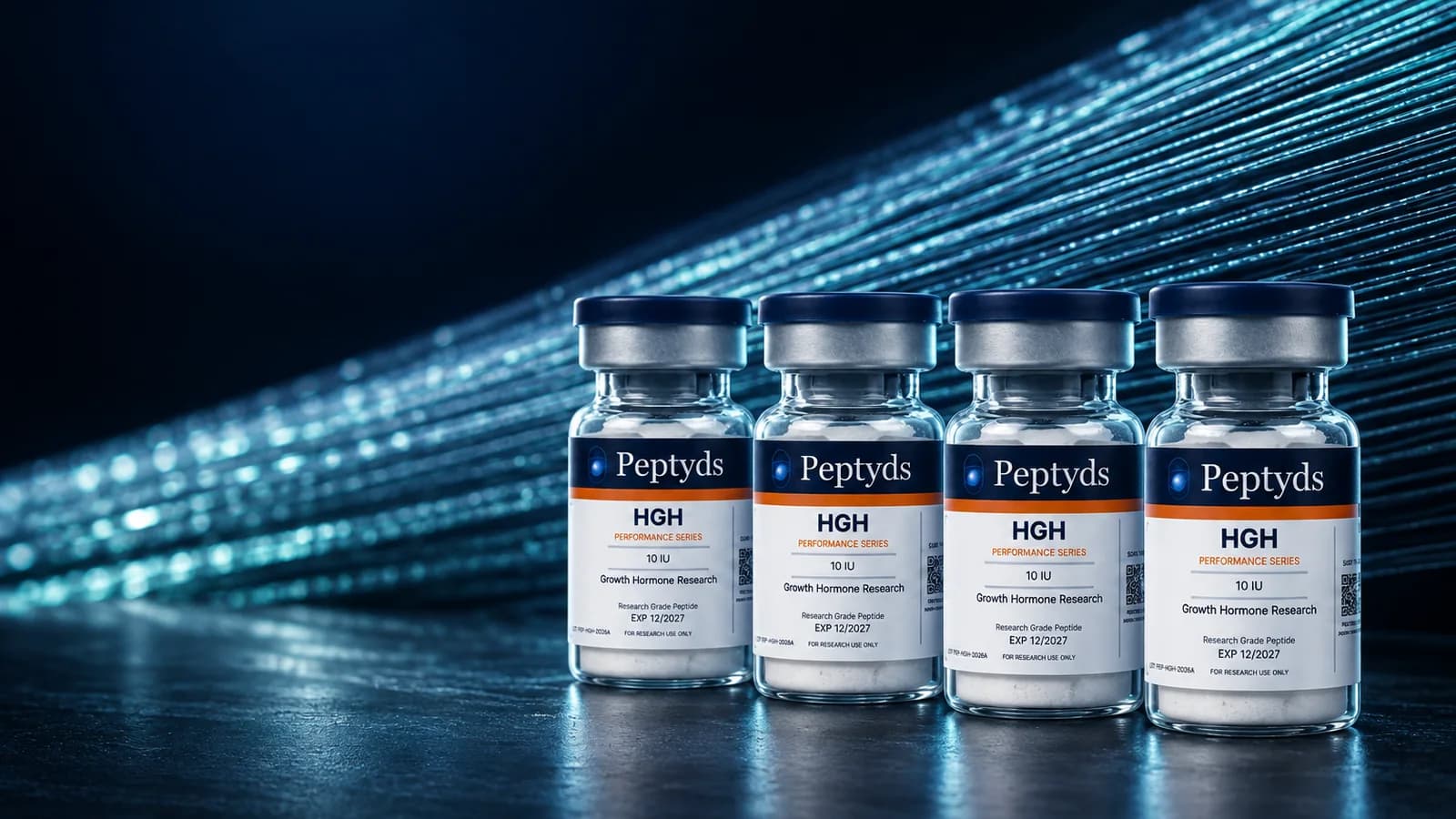
Four sealed Peptyds HGH research vials in a row on a dark surface beneath sweeping streaks of teal light.
Jump to section
  1. 01Do peptides build muscle? What the research actually measures
  2. 02What does growth hormone itself do to muscle and fat?
  3. 03GHRH analogues: tesamorelin, CJC-1295 and sermorelin
  4. 04Ghrelin-receptor agonists: ipamorelin, GHRPs and MK-677
  5. 05IGF-1 LR3 and mechano growth factor: cell and animal data only
  6. 06What are the risks and regulatory flags?
  7. 07How to read 'muscle peptide' claims — and how Peptyds frames them
  • Almost every compound sold for muscle growth acts on the GH–IGF-1 axis, and none is approved for building muscle or physique.
  • Growth hormone itself added about 2 kg of lean mass in older and in young, fit adults, but strength and exercise capacity did not improve in athletes.
  • Oral MK-677 raised fat-free mass by 1.1 kg over a year in adults aged 60–81 without changing strength, while fasting glucose rose.
  • Tesamorelin's randomised trials concern visceral fat in specific groups; its FDA label says it is not a weight-loss drug.
  • CJC-1295 without DAC, IGF-1 LR3 and PEG-MGF have no peer-reviewed human studies, and MGF did not affect muscle cells when replication was attempted.
  • Scan-measured lean mass includes water, and GH expands body water — so a lean gain is not proof of new muscle.

Discussed in this guide

  • TesamorelinA GHRH analogue studied for visceral fat reduction and body-composition support — used in clinician-supervised metabolic and growth hormone contexts.5 mg · 10 mg€6.90 / mg
  • CJC-1295 No DAC + IpamorelinA dual-pathway GH secretagogue blend studied for synergistic, pulsatile growth hormone release — investigated in overnight recovery, sleep architecture, and body-composition research.10 mg + 10 mg€7.50 / mg
  • IpamorelinA selective GHRP studied for gentle, pulsatile growth hormone release — investigated in sleep depth, overnight recovery, and measured body-composition routines.5 mg · 10 mg€4.40 / mg
  • MK-677Ibutamoren mesylate — an orally active ghrelin receptor agonist studied for GH pulse amplification, lean muscle accretion, and sleep-architecture support.5 mg · 10 mg · 15 mg · 20 mg€5.95 / mgOut of stock
  • IGF-1 LR3A long-acting IGF-1 analogue studied for anabolic signalling and measured body-composition support — framed for clinician-guided recovery protocols.1 mg€89.00 / mgOut of stock

Do peptides build muscle? What the research actually measures

The compounds sold as peptides for muscle growth share one target: the growth hormone (GH)–IGF-1 axis. GHRH analogues such as CJC-1295 stimulate the pituitary's GH-releasing hormone receptor; secretagogues such as ipamorelin act on the ghrelin receptor instead; IGF-1 analogues bypass the pituitary and act on the IGF-1 receptor directly. A 2026 clinical review of these 'research compounds' notes that none has regulatory approval for any physique or performance indication.[1][8][14]

So the useful question is not 'does it build muscle?' but 'what was measured, and in whom?' The same review sorts the human evidence into tiers: randomised trials inside one approved indication for tesamorelin; small phase I/II studies without body-composition endpoints for most other GHRH analogues and secretagogues; and no peer-reviewed human studies at all for CJC-1295 without DAC, IGF-1 LR3 and PEG-MGF.[1]

Continue reading:How to choose a peptide by research goal

What does growth hormone itself do to muscle and fat?

GH is the benchmark, because a secretagogue can only raise it. A systematic review of randomised trials in healthy older adults (18 study populations, mean age 69) found that GH increased lean body mass by 2.1 kg and reduced fat mass by 2.1 kg, with no change in body weight. Treated participants had more soft-tissue swelling, joint pain, carpal tunnel syndrome and breast enlargement, and were somewhat more likely to develop diabetes or impaired fasting glucose.[2]

In young, physically fit adults (27 study samples, mean age 27), the same research group found the same 2.1 kg rise in lean body mass — yet strength and exercise capacity did not appear to improve, and exercise capacity may even have worsened. Their conclusion was blunt: claims that GH enhances physical performance are not supported by the scientific literature.[3]

Part of that gap is water. In a randomised, placebo-controlled crossover study in eight healthy men, two weeks of high-dose GH expanded extracellular fluid volume by almost a litre, and four of the eight reported puffy eyes, tingling or joint pain. Fat-free mass on a scan counts that water, so a lean-mass gain is not the same thing as new contractile muscle.[4]

GHRH analogues: tesamorelin, CJC-1295 and sermorelin

Tesamorelin is the only member of the group with regulatory-grade trials. In 412 people with HIV and abdominal fat accumulation, 26 weeks of treatment cut visceral fat by 15.2% while it rose 5.0% on placebo, and IGF-1 rose 81%. A 12-month trial in 60 abdominally obese adults with low GH secretion also reduced visceral fat without changing fat under the skin. The FDA label covers excess abdominal fat in HIV-associated lipodystrophy only and states that tesamorelin is not indicated for weight-loss management.[5][6][7]

CJC-1295 with DAC binds to albumin in the blood, which stretched its half-life to 5.8–8.1 days in healthy adults aged 21–61: a single administration raised GH two- to ten-fold for six days or more and IGF-1 1.5- to three-fold, with normal GH pulses preserved. None of these studies measured muscle or strength. CJC-1295 without DAC — the form usually sold blended with ipamorelin — has no peer-reviewed human studies.[8][9][1]

Sermorelin-type GHRH(1-29) data are older and smaller. In 19 adults aged 55–71, sixteen weeks of a nightly GHRH(1-29) analogue raised IGF-1 and increased lean body mass in the men but not in the women. In 11 older men, six weeks of nightly GHRH(1-29) left scan-measured muscle and fat unchanged, although two of six strength tests improved in that small single-group study.[10][11]

Continue reading:Sermorelin vs CJC-1295 vs tesamorelin

Ghrelin-receptor agonists: ipamorelin, GHRPs and MK-677

Ipamorelin is a five-amino-acid growth hormone secretagogue. In rats and pigs it released GH about as potently as GHRP-6 but, unlike GHRP-6 and GHRP-2, did not raise ACTH or cortisol even at more than 200 times the GH-releasing dose. Its human record is a pharmacokinetic study in healthy men (half-life about two hours, one GH pulse peaking at 40 minutes) and a postoperative-ileus trial that missed its endpoints. Controlled evidence for the popular CJC-1295 plus ipamorelin combination remains limited.[12][13][14][1]

MK-677 (ibutamoren) is usually grouped with these peptides but is an orally active non-peptide. It has the best body-composition data in the class: in a two-year randomised trial in 65 adults aged 60–81, it restored GH and IGF-1 to young-adult levels and raised fat-free mass by 1.1 kg against a 0.5 kg loss on placebo — without changes in strength or function, and with higher fasting glucose and lower insulin sensitivity. A trial in 123 older hip-fracture patients was stopped early over a congestive heart failure signal.[15][16][17]

Anamorelin, an oral ghrelin-receptor agonist developed for cancer cachexia, shows the same split at scale. In two phase 3 trials with 979 lung-cancer patients, lean body mass rose by 0.99 and 0.65 kg while it fell on placebo, but handgrip strength did not differ. The EMA refused its marketing authorisation in 2017.[18][19]

Continue reading:MK-677 complete guide

IGF-1 LR3 and mechano growth factor: cell and animal data only

IGF-1 LR3 is IGF-1 with arginine in place of glutamate at position 3 and a 13-amino-acid extension at the N-terminus — changes that weaken binding to IGF-binding proteins. In rat muscle cells (L6 myoblasts) it was more potent than native IGF-1 at stimulating protein synthesis and slowing protein breakdown, and in growing rats it matched the growth effects of a roughly six-fold larger amount of IGF-1. There are no peer-reviewed human studies.[20][21][1]

Mechano growth factor (MGF), sold in pegylated form as PEG-MGF, is a 24-amino-acid peptide from the tail of an IGF-1 splice variant, credited online with activating muscle stem cells. When two pharmaceutical research groups tried to reproduce that, MGF did not increase proliferation of mouse or human myoblasts or of primary muscle stem cells, while mature IGF-1 did. The FDA has identified no human exposure data for PEG-MGF.[22][23][1]

Continue reading:IGF-1 LR3 vs MK-677 vs ipamorelin

What are the risks and regulatory flags?

The side effects follow the axis. Across GH-axis peptides, the 2026 review lists fluid retention, muscle and joint pain, appetite changes and blood-sugar disturbance, plus cortisol and prolactin rises with GHRP-2, GHRP-6 and hexarelin. The tesamorelin label adds elevated IGF-1, glucose intolerance or diabetes and a warning about neoplasms, and MK-677 raised fasting glucose in older adults.[1][7][16]

Regulators have flagged the class. The FDA lists ibutamoren (MK-677), ipamorelin, GHRP-2 and GHRP-6 among bulk substances that may present significant safety risks in pharmacy compounding, citing the heart-failure signal for ibutamoren; CJC-1295 and PEG-MGF were reviewed with safety concerns before their nominations were withdrawn. WADA's 2026 Prohibited List names GHRH analogues (including CJC-1295 and tesamorelin), secretagogues (including ipamorelin and ibutamoren), GH-releasing peptides, IGF-1 analogues and mechano growth factors under S2.[23][24]

How to read 'muscle peptide' claims — and how Peptyds frames them

Three questions sort most claims. Was the endpoint strength or function, or only an IGF-1 level? Was the population the one being implied — people with HIV lipodystrophy, cancer cachexia or a hip fracture are not healthy athletes? And was it a controlled human trial, an animal study or no study at all? On current evidence, lean-mass gains appear in specific groups, strength gains do not, and the most-promoted blends and IGF-1 analogues have no human data.[16][3][18][1]

Peptyds supplies these compounds for in-vitro laboratory research only, with batch documentation, and does not present any of them as a way to build muscle, lose fat or improve performance. The goal page sets out the research context for each compound side by side.

Continue reading:Explore the body composition goalRead the quality protocol

Sources

  1. [01]
  2. [02]
  3. [03]
  4. [04]
  5. [05]
  6. [06]
  7. [07]
  8. [08]
  9. [09]
  10. [10]
  11. [11]
  12. [12]
  13. [13]
  14. [14]
  15. [15]
  16. [16]
  17. [17]
  18. [18]
  19. [19]
  20. [20]
  21. [21]
  22. [22]
  23. [23]
  24. [24]

Questions

What peptides are studied for muscle growth?

Mainly compounds acting on the GH–IGF-1 axis: GHRH analogues (tesamorelin, CJC-1295, sermorelin), ghrelin-receptor agonists (ipamorelin, GHRP-2, GHRP-6, hexarelin) and IGF-1 analogues (IGF-1 LR3, PEG-MGF). MK-677 is usually grouped with them but is an oral non-peptide. None is approved for building muscle.[1][15]

Do growth hormone secretagogues increase muscle mass?

They can raise lean or fat-free mass in some groups: MK-677 added 1.1 kg of fat-free mass over a year in adults aged 60–81, and anamorelin increased lean mass in lung-cancer cachexia. Strength did not improve in either trial, and part of any scan-measured gain can be water.[16][18][4]

Has IGF-1 LR3 been tested in humans?

Not in any peer-reviewed study. The evidence is cell work in rat myoblasts and growth studies in rats, where it was more potent than native IGF-1 because it binds IGF-binding proteins weakly.[1][20][21]

Is MK-677 a peptide?

No. MK-677 (ibutamoren) is an orally active non-peptide that mimics growth hormone-releasing peptides at the ghrelin receptor. In trials it raised GH and IGF-1 but also fasting glucose, and a hip-fracture trial was stopped early over a heart-failure signal.[15][16][17]

Is there clinical evidence for the CJC-1295 and ipamorelin blend?

Not for the combination. CJC-1295 with DAC has pharmacokinetic studies in healthy adults, ipamorelin has a pharmacokinetic study and a negative postoperative-ileus trial, and CJC-1295 without DAC — the form usually blended — has no peer-reviewed human studies.[8][13][14][1]

Are muscle-growth peptides banned in sport?

Yes. WADA's 2026 Prohibited List names GHRH analogues such as CJC-1295 and tesamorelin, secretagogues such as ipamorelin and ibutamoren (MK-677), GH-releasing peptides, IGF-1 analogues and mechano growth factors under S2, prohibited at all times.[24]

Educational content. Not medical advice.