

Research notes

MK-677 (Ibutamoren) Complete Guide: Non-Peptide Oral GH Secretagogue

MK-677 (ibutamoren) is a non-peptide small molecule developed by Merck in the 1990s as an orally active growth-hormone secretagogue. It is a spiroindoline that acts as an agonist at the ghrelin/growth-hormone-secretagogue receptor 1a (GHSR-1a) — the same receptor the peptide ipamorelin binds — but it is not itself a peptide. Once-daily oral dosing produces sustained 24-hour elevations of GH pulses and IGF-1 in published human studies, and the most-cited clinical trial (Nass 2008, JAMA Internal Medicine) showed fat-free mass gains in healthy older adults over two years with a mild safety signal that included transient insulin-sensitivity changes. MK-677 is on the WADA Prohibited List as a GH secretagogue, and it has no EMA EPAR as an authorised medicine in the EU. This article explains the molecule honestly — its category, its mechanism, what the trials actually showed, and where the regulatory framing puts it.

12 min readUpdated 13 May 2026Reviewed by Independent EU laboratory (ISO/IEC 17025)
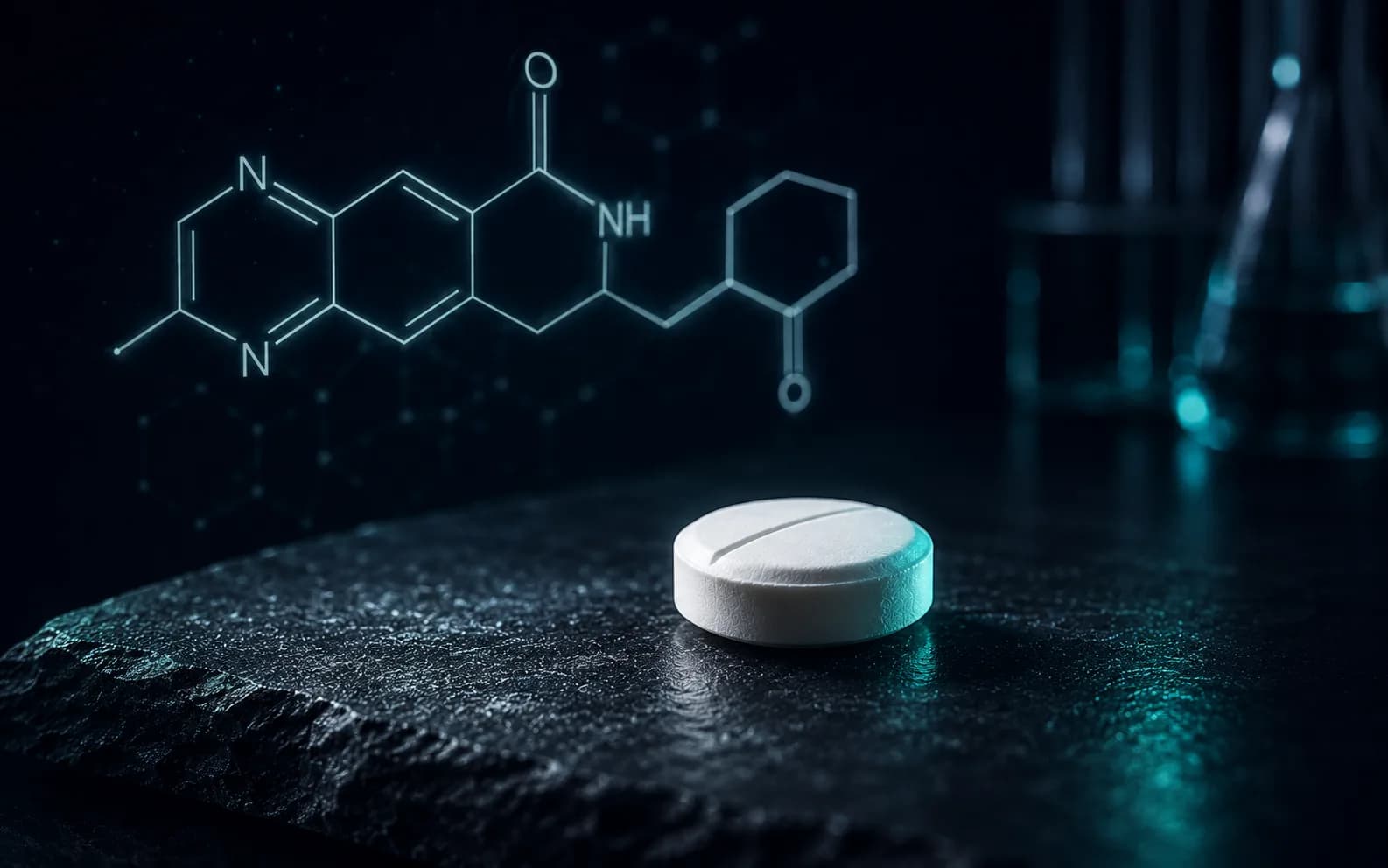
Abstract editorial illustration of the MK-677 spiroindoline small-molecule structure on a deep navy lab surface, signalling non-peptide chemistry.
Jump to section
  1. 01MK-677 is not a peptide — first thing to get right
  2. 02Merck history and original development context
  3. 03Mechanism: GHSR-1a agonist with 24-hour GH and IGF-1 elevation
  4. 04Animal and human research: what the trials actually showed
  5. 05Side effects and safety signals from published trials
  6. 06WADA Prohibited List status and regulatory framing
  7. 07MK-677 versus ipamorelin: same receptor, different category
  8. 08How a careful buyer reads an MK-677 page
  • MK-677 is a non-peptide small molecule, not a peptide — calling it a peptide is the most common marketing error in this category.
  • It is a spiroindoline ghrelin-receptor (GHSR-1a) agonist, orally active and dosed once daily.
  • Published human trials show sustained 24-hour GH and IGF-1 elevation; long-term Merck-led trials studied frailty and body composition in older adults.
  • The Nass 2008 elderly fracture-recovery trial (JAMA Internal Medicine) is the most-cited human clinical reference and showed fat-free mass gains with mild safety signals.
  • MK-677 is on the WADA Prohibited List under S2 (peptide hormones, growth factors, related substances and mimetics).
  • MK-677 has no EMA EPAR — it is not an authorised medicine for any indication in the EU.
  • Common framing as 'oral GH peptide' is wrong on two counts: not a peptide, and not a direct GH analogue. It is a receptor agonist that triggers endogenous GH release.
  • This is mechanism and regulatory orientation, not a dosing protocol or treatment recommendation.

MK-677 is not a peptide — first thing to get right

MK-677 (ibutamoren mesylate) is a non-peptide small molecule. Its core scaffold is a spiroindoline, a fused bicyclic structure with a molecular weight around 528 g/mol. It has no peptide bond. It is not produced by solid-phase peptide synthesis. Calling it a peptide — which most retail pages and forums do — is the single most common factual error in this product category.[1][7]

Why the precision matters: peptide-quality language (HPLC purity, sequence verification, lyophilisation handling) maps poorly onto a small-molecule oral. MK-677 quality is read through pharmacopeial purity tests, identity by NMR, mass spectrometry, and ICH-style validated method documentation — different toolkit, same standard of caring whether the molecule on the label is the molecule in the capsule.[15]

This guide treats MK-677 as what it is: an orally active small-molecule receptor agonist with a Merck pharmaceutical-development history, real published human data, a clear regulatory profile in the EU, and a place on the WADA Prohibited List. None of that is improved by mislabelling it as a peptide.[1][9]

Merck history and original development context

MK-677 was developed at Merck in the 1990s as part of a programme to identify orally bioavailable growth-hormone secretagogues — small molecules that could be taken as a pill and would trigger the body's own GH release rather than replacing growth hormone with recombinant injection. The compound was characterised in receptor-binding and pharmacokinetic studies before progressing to human trials.[1][7][6]

Merck-led clinical work in the late 1990s and 2000s tested MK-677 in healthy adults, older adults with reduced GH secretion, frailty, hip-fracture recovery, and other settings. The early NEJM-coverage trials established that oral administration produced GH and IGF-1 elevations comparable in magnitude to what GH-secretagogue peptides produce by injection — a meaningful pharmacology result in its own right.[6][1]

Despite the development effort, MK-677 did not advance to marketing authorisation. The compound exists in the literature as a thoroughly characterised pharmaceutical that did not complete the regulatory pathway to becoming an approved medicine. That is part of why it now circulates as a research-chemical-category product rather than a prescription drug.[2][10]

Mechanism: GHSR-1a agonist with 24-hour GH and IGF-1 elevation

MK-677 binds the growth-hormone-secretagogue receptor 1a (GHSR-1a) — the receptor that endogenous ghrelin uses to signal to the pituitary. As a GHSR-1a agonist, MK-677 mimics ghrelin's signal and triggers the pituitary to release growth hormone in its physiological pulsatile pattern. The downstream effect is elevated GH pulses and, secondarily, sustained IGF-1 elevation produced in the liver.[7][1]

Once-daily oral dosing of MK-677 produces a 24-hour elevation of GH and IGF-1 in published human trials. That sustained-elevation profile is different from injectable GH-secretagogue peptides like ipamorelin, which have short half-lives and require more frequent administration to maintain receptor engagement. The 'sustained 24-hour elevation' framing is the published pharmacokinetic profile, not a marketing claim.[2][6]

Because the mechanism is receptor agonism rather than direct GH replacement, MK-677 's effect depends on a functioning pituitary that can release GH in response to the signal. In severe GH-deficiency contexts where the pituitary cannot respond, the mechanism does not apply — recombinant GH is the EMA-authorised route for diagnosed deficiency.[1][11]

Animal and human research: what the trials actually showed

Animal work established the GHSR-1a mechanism, dose-response, and effect on GH pulses, IGF-1, body composition, and bone-density endpoints in rodent models. The animal literature is consistent and forms the preclinical foundation for the human trials.[1][7]

The two-year Nass et al. trial published in JAMA Internal Medicine (2008) is the most-cited human clinical reference. It enrolled healthy older adults, used oral MK-677 daily, and reported increases in fat-free mass over two years compared with placebo. Bone-density results were limited. Safety signals included increased appetite (an expected ghrelin-pathway effect), fluid retention, mild and transient changes in insulin sensitivity and fasting glucose, and modest oedema in some participants.[3]

Separately, hip-fracture recovery trials in elderly populations have tested whether MK-677 accelerates functional recovery after fracture by restoring GH/IGF-1 to younger-adult levels. Published results are more mixed than the body-composition trial and have not produced an indication-approval signal strong enough for regulatory follow-through.[4][3]

The Sigalos and Pastuszak 2018 frame: MK-677 is a well-characterised pharmacology with a real but modest body-composition effect in elderly populations, a clean enough safety signal for short-to-medium-term healthy-subject trials, and an unestablished long-term human safety dataset. That is the honest summary.[2][3][5]

Side effects and safety signals from published trials

Published trials report a consistent side-effect cluster tied to ghrelin-pathway activation: increased appetite (sometimes substantial), mild fluid retention with associated oedema, and transient changes in fasting glucose and insulin sensitivity. The insulin-sensitivity changes have been the most-discussed clinical signal — modest, reversible on stopping the drug, but enough to recommend caution in metabolic-risk populations.[3][2]

Some participants in long-term trials reported sleep changes — both vivid dreams and sleep-quality alterations — likely reflecting the GH/IGF-1 axis link to slow-wave sleep architecture. Lethargy and joint stiffness have been reported sporadically. None of these signals halted the trials, but all of them informed Merck's eventual decision not to pursue marketing authorisation.[5][2]

Long-term safety beyond two years is not characterised by large randomised human trials. Online discussion sometimes conflates short-term-trial safety with multi-year unsupervised use; that extrapolation runs ahead of the published evidence.[2][13]

WADA Prohibited List status and regulatory framing

MK-677 is on the WADA Prohibited List under category S2 (peptide hormones, growth factors, related substances and mimetics). It is prohibited in-competition and out-of-competition for athletes subject to WADA jurisdiction. Listed under S2 even though it is not technically a peptide — WADA's category-naming reflects the pharmacological effect (GH-axis stimulation) rather than chemical class.[9]

On the medicines side, MK-677 has no EMA EPAR. There is no authorised European-medicine route for purchasing it as a treatment, and there is no EMA-evaluated risk-benefit assessment supporting it as a therapy for any indication. The compound circulates in research-chemical and consumer-supplement contexts; that distribution does not imply regulatory endorsement.[10][12]

In context: the only EMA-authorised therapy for diagnosed adult or paediatric growth-hormone deficiency is recombinant human growth hormone (somatropin), prescribed after diagnostic workup by a specialist. MK-677, GHRH analogues, and GHRPs do not occupy that therapeutic slot.[11][12]

MK-677 versus ipamorelin: same receptor, different category

Both MK-677 and ipamorelin bind GHSR-1a — the ghrelin/growth-hormone-secretagogue receptor. That is the only thing they have in common structurally. Ipamorelin is a synthetic pentapeptide (five amino acids), administered by injection, with a short pharmacokinetic profile. MK-677 is a non-peptide spiroindoline, taken orally, with a sustained 24-hour effect.[1][7][8]

Functionally, both produce GH pulses through the same receptor pathway. Ipamorelin's foundational characterisation emphasises selectivity for GH release with minimal cortisol or prolactin signal in preclinical work. MK-677's published profile shows similar GH-release magnitude with a far longer duration of action per dose, but with the ghrelin-pathway side-effect cluster (appetite, fluid retention, insulin-sensitivity changes) that comes from receptor engagement at the level small-molecule oral dosing produces.[8][3]

Reading 'MK-677 is oral ipamorelin' is the wrong shorthand. It is closer to 'MK-677 and ipamorelin share a receptor but are different drugs with different routes, durations, and side-effect profiles'. The comparison article covers this in side-by-side detail.[7][1]

Continue reading:View MK-677View IpamorelinRead MK-677 vs Ipamorelin comparisonExplore muscle and sleep goal

How a careful buyer reads an MK-677 page

Category honesty first. Does the page state that MK-677 is a non-peptide small molecule, not a peptide? Does it explain that the GHSR-1a mechanism is receptor agonism, not direct GH replacement? Does it cite the actual clinical literature, including the Nass two-year trial and the side-effect cluster the trial reported?[1][3][10]

Then regulatory framing. Does the page acknowledge that MK-677 has no EMA EPAR and is not an authorised medicine? Does it state that the compound is on the WADA Prohibited List for athletes? Does it avoid presenting it as a 'safer alternative to GH' — a comparison that runs ahead of the long-term safety data?[9][10]

Then quality. Identity (NMR, mass spectrometry), purity by HPLC with method documentation, batch-specific certificate of analysis, ISO/IEC 17025 lab signal. These read differently for a small molecule than for a peptide, but the underlying discipline — knowing what is in the capsule — is the same.[14][15]

Continue reading:View MK-677View IpamorelinExplore body composition goal

Sources

  1. [01]
  2. [02]
  3. [03]
  4. [04]
  5. [05]
  6. [06]
  7. [07]
  8. [08]
  9. [09]
  10. [11]
  11. [12]
    European Medicines Agency
    Clinical trials in human medicines
  12. [13]
  13. [14]
  14. [15]

Questions

Is MK-677 a peptide?

No. MK-677 (ibutamoren) is a non-peptide small molecule — a spiroindoline with a molecular weight around 528 g/mol. It has no peptide bond and is not produced by peptide synthesis. The widespread habit of marketing it as a 'peptide' is the most common factual error in this category. It acts on the ghrelin/growth-hormone-secretagogue receptor (GHSR-1a) — the same receptor as the peptide ipamorelin — but the chemistry is different.[1][7]

What does MK-677 actually do?

It is an orally active GHSR-1a (ghrelin-receptor) agonist. By mimicking ghrelin's signal to the pituitary, it triggers endogenous growth-hormone pulses and sustained IGF-1 elevation. Published human trials show once-daily oral dosing produces a 24-hour GH/IGF-1 elevation profile. It does not replace growth hormone; it stimulates the body's own release.[2][6]

What did the Nass 2008 elderly MK-677 trial show?

The two-year trial published in JAMA Internal Medicine enrolled healthy older adults and reported increases in fat-free mass with daily oral MK-677 versus placebo. Bone-density results were limited. Reported side effects included increased appetite, mild fluid retention, modest transient changes in fasting glucose and insulin sensitivity, and occasional oedema. It is the most-cited human clinical reference for MK-677.[3]

Is MK-677 banned in sport?

Yes. MK-677 is on the WADA Prohibited List under category S2 (peptide hormones, growth factors, related substances and mimetics). It is prohibited in-competition and out-of-competition. The S2 categorisation reflects pharmacological effect (GH-axis stimulation) rather than chemical class.[9]

Is MK-677 approved as a medicine in the EU?

No. MK-677 has no EMA EPAR. It is not an authorised medicine for any indication in the EU. Recombinant human growth hormone is the EMA-authorised therapy for diagnosed growth-hormone deficiency, prescribed by specialists after diagnostic workup.[10][11]

How does MK-677 differ from ipamorelin?

Both bind GHSR-1a but they are otherwise different drugs. Ipamorelin is a synthetic pentapeptide, injected, short-acting. MK-677 is a non-peptide oral with a 24-hour duration of action. Ipamorelin's preclinical profile emphasises GH-release selectivity with minimal cortisol or prolactin signal. MK-677's long-duration receptor engagement is associated with the ghrelin-pathway side-effect cluster (appetite, fluid retention, insulin-sensitivity changes). They share a receptor target, not a therapeutic profile.[8][1][3]

Educational content. Not medical advice.

Next step

Choose the route that matches how you read.