

Research notes

IGF-1 and IGF-1 LR3: Complete Guide to the Growth Factor and Its Analogue

IGF-1 (insulin-like growth factor 1) is a 70-amino-acid hormone, made mainly by the liver in response to growth hormone and also locally in tissues, that signals through the IGF-1 receptor and circulates largely bound to IGF-binding proteins. IGF-1 LR3 is an 83-amino-acid research analogue with a 13-residue N-terminal extension and arginine in place of glutamate at position 3; these changes cut its affinity for binding proteins roughly a thousand-fold and made it several times more potent than IGF-1 in rat growth studies. Despite the 'long' in its name, rat studies found that LR3 is cleared from plasma faster than native IGF-1, not slower. IGF-1 LR3 has no published human studies and no approval anywhere, the IGF-1 medicine authorised in the EU is mecasermin (a copy of native IGF-1), and IGF-1 and its analogues are prohibited in sport under WADA S2.3.

11 min readUpdated 22 Sept 2026Reviewed by Independent EU laboratory (ISO/IEC 17025)
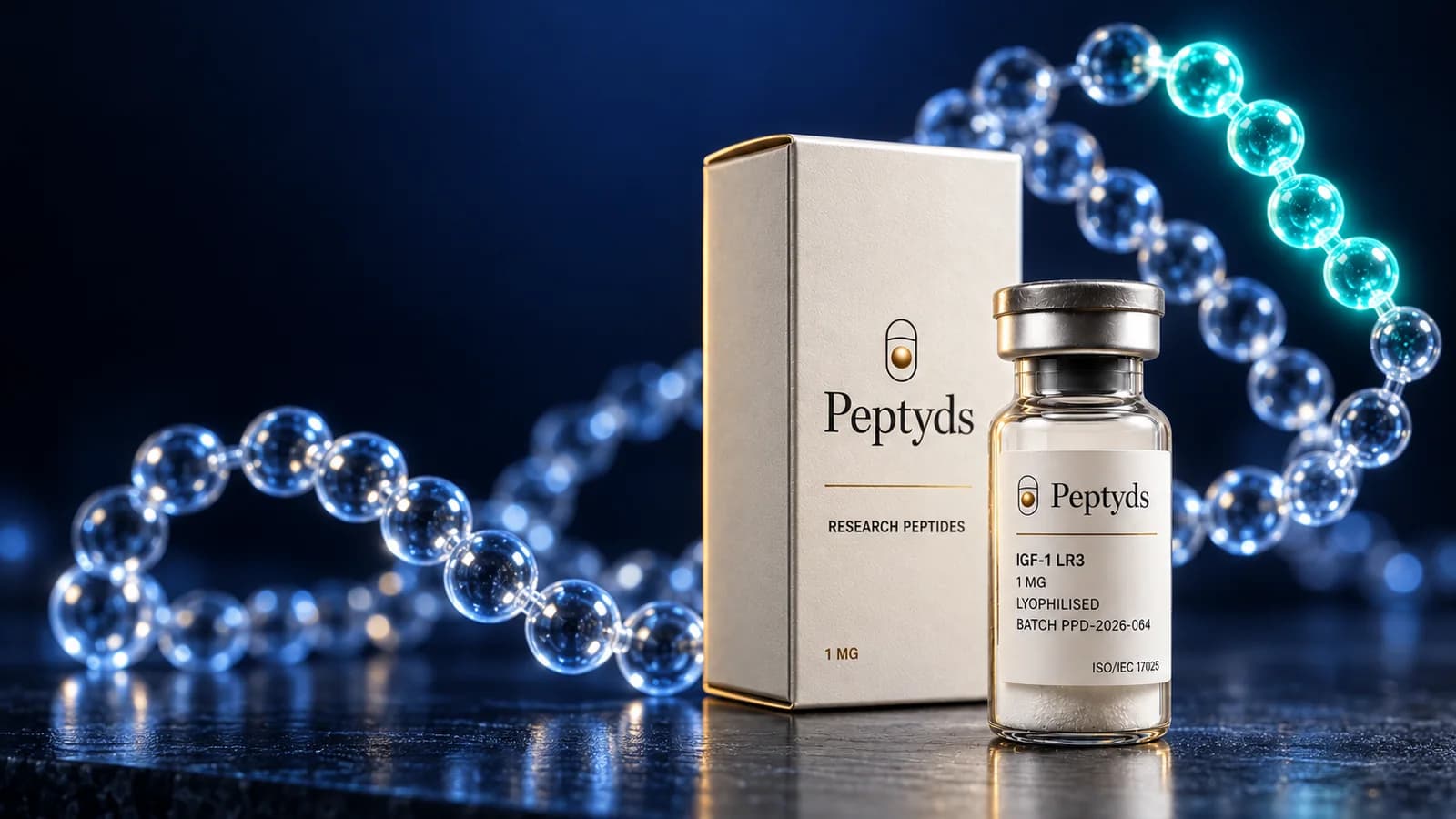
A sealed Peptyds IGF-1 LR3 research vial and its white carton on dark stone, beneath a looping chain of glass beads lit in blue and teal.
Jump to section
  1. 01What is IGF-1 and what does it do?
  2. 02Why do IGF-binding proteins matter?
  3. 03What is IGF-1 LR3?
  4. 04What is the half-life of IGF-1 LR3?
  5. 05What did animal studies of IGF-1 LR3 find?
  6. 06Has IGF-1 LR3 been studied in humans?
  7. 07What are the safety concerns with IGF-1 and its analogues?
  8. 08Regulatory status and how Peptyds frames IGF-1 LR3
  • IGF-1 is a 70-amino-acid hormone made by the liver under growth-hormone control and locally in tissues, signalling through the IGF-1 receptor.
  • In blood, IGF-1 is mostly held in a 150-kDa complex with IGFBP-3 and the acid-labile subunit, which keeps it in circulation.
  • IGF-1 LR3 is an 83-residue analogue whose N-terminal extension and Arg3 substitution cut binding-protein affinity about a thousand-fold.
  • Despite its name, LR3 was cleared from rat plasma about ten times faster than IGF-1; the popular '20-30 hour half-life' has no primary source.
  • It was anabolic in rats but reduced growth and suppressed the GH axis in pigs, and it lowered blood glucose more potently than IGF-1.
  • IGF-1 LR3 has no human studies and no approval; IGF-1 and its analogues are prohibited in sport under WADA S2.3.

Discussed in this guide

  • IGF-1 LR3A long-acting IGF-1 analogue studied for anabolic signalling and measured body-composition support — framed for clinician-guided recovery protocols.1 mg€89.00 / mgOut of stock

What is IGF-1 and what does it do?

IGF-1, insulin-like growth factor 1, is a single-chain polypeptide of 70 amino acids held together by three disulfide bridges. When its sequence was determined in 1978, it showed obvious homology to proinsulin, which explains the name: parts of IGF-1 mirror the B and A chains of insulin.[1]

IGF-1 is the main downstream messenger of growth hormone. The liver secretes it into the circulation when stimulated by GH, and many other tissues produce it locally, where it acts on neighbouring cells. It signals through the IGF-1 receptor, which is expressed on almost all cells, and it is involved in growth, tissue repair and the regulation of protein, carbohydrate and fat metabolism.[2][3]

The local supply matters more than the blood level suggests. When the IGF-1 gene was deleted only in the liver of mice, circulating IGF-1 fell dramatically, yet body weight, body length and femur length did not differ from normal littermates. The authors read this as direct evidence for the importance of IGF-1 made and used within tissues.[4]

Continue reading:View IGF-1 LR3

Why do IGF-binding proteins matter?

Almost no IGF-1 travels alone. Six distinct IGF-binding proteins (IGFBPs) bind it with an affinity equal to or greater than the IGF-1 receptor's. In serum, about 75-80% of IGFs sit in a roughly 150-kDa ternary complex with IGFBP-3 (less often IGFBP-5) and a glycoprotein called the acid-labile subunit; most of the rest is bound to the other IGFBPs.[2]

Binding changes how IGF-1 behaves. Unbound IGFs have a circulating half-life of under 10 minutes, binding to an IGFBP extends it, and the large ternary complex keeps IGF-1 in the bloodstream. Binding also blocks IGF-1 from acting on the insulin receptor and lets tissues control where and when the growth factor is released to its receptor.[2]

This buffering is the key to understanding IGF-1 LR3. Its design goal was not a stronger fit to the receptor but an escape from the binding proteins, and that single change explains both its higher potency in some experiments and its faster clearance in others.[5][6]

What is IGF-1 LR3?

IGF-1 LR3, also written Long R3 IGF-I or LR3IGF-I, was produced in the early 1990s by an Australian research group as a recombinant fusion protein. It consists of the first 11 amino acids of methionyl porcine growth hormone, a Val-Asn linker, and the full IGF-1 sequence with the glutamate at position 3 replaced by arginine. That adds 13 residues to IGF-1's 70, which is why the analogue is usually described as 83 amino acids long.[5][1]

In rat L6 myoblasts, which secrete binding proteins, the long analogues were more potent than IGF-1 at stimulating protein and DNA synthesis and at inhibiting protein breakdown, with Long [Arg3]-IGF-I among the most potent. In chicken embryo fibroblasts, which do not secrete detectable binding proteins, it was less potent than IGF-1. The gain, in other words, depends on the presence of IGFBPs.[5]

Later measurements quantified the trade-off. IGF-1 has roughly a thousand-fold higher affinity than LR3IGF-I for IGFBP-3, IGFBP-4 and total rat plasma binding proteins, which gave LR3IGF-I five to ten times the potency in cultured myoblasts. At the IGF-1 receptor itself, LR3IGF-I binds about three-fold less well than IGF-1.[6][8]

What is the half-life of IGF-1 LR3?

'Long' refers to the N-terminal extension, not to how long the molecule lasts. The '20 to 30 hours' figure repeated on many sites has no primary source that we could find, and the animal measurements point the other way. In rats given radiolabelled tracers intravenously, LR3IGF-I was cleared from plasma far faster than IGF-1: a metabolic clearance rate of about 9.2-9.8 mL/min per kg, against 0.90 for IGF-1 in non-pregnant animals, with most LR3IGF-I circulating as free peptide.[7]

The explanation is the binding proteins. Because LR3IGF-I barely associates with them, it misses the protective 150-kDa complex and is removed from the blood much more rapidly than IGF-1. The point was confirmed in pregnant rats, whose binding-protein levels fall sharply: only IGF-1's clearance changed, speeding up almost to the rate seen with LR3IGF-I.[6][7]

An anti-doping study reached the same conclusion by a different route: after a single intramuscular dose in rats, intact LongR3-IGF-I disappeared from blood after about 4 hours, while N-terminally truncated breakdown products remained detectable for up to 16 hours. Its effects can still outlast its presence; in pigs and marmosets, the low-binding variants lowered blood glucose for longer than IGF-1 despite their faster clearance.[12][10]

Continue reading:IGF-1 LR3 vs MK-677 vs ipamorelin

What did animal studies of IGF-1 LR3 find?

The anabolic reputation comes from rats. In young male rats made catabolic with dexamethasone, IGF-1 delivered by osmotic pump partly reversed weight and nitrogen loss, and LR3IGF-I was about 2.5-fold more potent than IGF-1. Muscle protein synthesis and breakdown both shifted in an anabolic direction, but part of the response was growth of the gut, which increased in weight by up to 45%.[8]

In growing female rats treated for 14 days, IGF-1 increased weight gain, nitrogen retention and food-conversion efficiency by 18-26% at the highest dose, and a much smaller amount of LR3IGF-I produced similar effects. Organ and carcass measurements showed that body proportions were largely maintained, and muscle protein synthesis and breakdown rose only slightly.[9]

The result did not carry across species. In finisher pigs, a four-day LR3IGF-I infusion decreased daily weight gain and food intake and lowered plasma IGFBP-3, IGF-1 and insulin. Mean GH fell by 23% and the area under the GH peaks by 60%, and adding porcine GH did not restore growth. The authors concluded that suppression of the animal's own GH axis may explain why LR3IGF-I inhibited growth in pigs.[11]

Continue reading:Explore the body-composition goal

Has IGF-1 LR3 been studied in humans?

No. A 2026 endocrine review that sorted GH-axis peptides into evidence tiers placed IGF-1 LR3 in its lowest tier, with no peer-reviewed human studies and support only from preclinical extrapolation and user narratives. An anti-doping laboratory describes the IGF-1 analogues as never approved for use in humans. Everything written about LR3's effects in people is therefore inference.[18][12]

Native IGF-1 does have a human record. Recombinant IGF-1, mecasermin, has been authorised in the EU since 2007 as Increlex for the long-term treatment of children and adolescents with severe primary IGF-1 deficiency, a rare growth disorder; the EMA's summary lists hypoglycaemia among its common side effects and rules it out in patients with active or suspected neoplasia.[17]

Outside that indication the human results are sobering. In a randomised, placebo-controlled trial in healthy women over 60, a year of twice-daily IGF-1 raised blood IGF-1 into the young-adult range but changed nothing measured: not bone density, lean mass, fat mass, strength, lipids, mood or memory. The study was stopped after 16 participants because no outcome was moving.[15]

What are the safety concerns with IGF-1 and its analogues?

Low blood sugar is the most direct risk of this insulin-related growth factor. In pigs and marmoset monkeys, IGF-1 variants that bind poorly to IGFBPs, LR3IGF-I among them, were two to three times more potent than IGF-1 at lowering plasma glucose, and the cumulative glucose suppression over four hours was about four to eight times greater. For native IGF-1, the EMA lists hypoglycaemia among mecasermin's common side effects.[10][17]

Growth signalling is the second, longer-term concern. A meta-analysis of 21 studies with 3,609 cancer cases found that higher circulating IGF-1 was associated with a modestly increased risk of prostate cancer and premenopausal breast cancer. That is an association in observational data about the body's own IGF-1, not proof that an analogue causes cancer; separately, the authorised IGF-1 medicine must not be used in patients with active or suspected neoplasia.[16][17]

The third risk is the product itself. Anti-doping chemists found a black-market injection vial containing Long-R3-IGF-I with a His-tag still attached, a purification handle used in laboratory production, and noted that its effects in humans have never been described. Another laboratory found abundant oxidised, lower-quality forms of the analogue in black-market products.[13][12]

Continue reading:Peptide research: evidence vs hype

Regulatory status and how Peptyds frames IGF-1 LR3

IGF-1 LR3 has never been approved for use in humans. In the EU, the authorised IGF-1 medicine is mecasermin, a copy of native IGF-1, for a narrow paediatric indication. In sport, the WADA 2026 Prohibited List names insulin-like growth factor 1 (IGF-1, mecasermin) and its analogues under S2.3, growth factors and growth factor modulators, a class prohibited at all times.[12][17][19]

The analogue does have an established laboratory role. In serum-free cultures of Chinese hamster ovary cells producing recombinant proteins, LongR3 could replace insulin as the growth factor and sustained cell viability under production conditions better than insulin did. That laboratory use, not human physiology, is where the analogue has a documented purpose.[14]

Peptyds supplies IGF-1 LR3 as a lyophilised compound with a batch certificate of analysis, for in-vitro laboratory research only. We do not present it as a muscle-building, recovery or anti-ageing product, and we do not describe it as long-acting, because the published pharmacokinetics say otherwise.[7]

Continue reading:Read the quality protocol

Sources

  1. [01]
  2. [02]
  3. [03]
  4. [04]
  5. [05]
  6. [06]
  7. [07]
  8. [08]
  9. [09]
  10. [10]
  11. [11]
  12. [12]
  13. [13]
  14. [14]
  15. [15]
  16. [16]
  17. [17]
  18. [18]
  19. [19]

Questions

What does IGF-1 do?

IGF-1 is the main messenger of growth hormone. The liver releases it into the blood in response to GH and many tissues make it locally; through the IGF-1 receptor it promotes cell growth, proliferation and survival and helps regulate protein, carbohydrate and fat metabolism.[2][3]

What is the difference between IGF-1 and IGF-1 LR3?

IGF-1 LR3 is IGF-1 with a 13-residue N-terminal extension and arginine instead of glutamate at position 3. It binds IGF-binding proteins about a thousand times less strongly and the IGF-1 receptor about three times less strongly, so it is more potent where binding proteins are present.[5][6][8]

What is the half-life of IGF-1 LR3?

No human half-life has been published. In rats it was cleared from plasma about ten times faster than IGF-1, because it escapes the binding proteins that keep IGF-1 in circulation, and after an intramuscular dose intact LR3 disappeared from rat blood within about four hours.[7][6][12]

Is IGF-1 LR3 the same as mecasermin?

No. Mecasermin is recombinant native IGF-1, authorised in the EU as Increlex for severe primary IGF-1 deficiency in children. IGF-1 LR3 is a modified analogue with an 83-residue sequence that has never been approved for human use.[17][5][12]

Does IGF-1 LR3 lower blood sugar?

In animal studies, yes. In pigs, LR3IGF-I and related low-binding variants lowered plasma glucose two to three times more potently than IGF-1 and for longer. Hypoglycaemia is also a listed common side effect of the authorised IGF-1 medicine, mecasermin.[10][17]

Is IGF-1 LR3 banned in sport?

Yes. The WADA 2026 Prohibited List names insulin-like growth factor 1 and its analogues under S2.3, growth factors and growth factor modulators, a class prohibited at all times, in and out of competition.[19]

Educational content. Not medical advice.

Next step

Choose the route that matches how you read.