

Research notes

IGF-1 LR3 vs MK-677 vs Ipamorelin: Which GH-Pathway Peptide for Research?

IGF-1 LR3 (Long-Arg3-IGF-1) is a recombinant 83-amino-acid analogue of human IGF-1 that binds the IGF-1 receptor directly, with extended plasma half-life (~20-30 hours) achieved by reduced binding to IGF-binding proteins. MK-677 (ibutamoren) is an orally bioavailable small-molecule non-peptide agonist of the growth-hormone-secretagogue receptor (GHSR-1a), with a plasma half-life of ~24 hours, that stimulates endogenous pituitary GH and downstream IGF-1 elevation. Ipamorelin is a selective pentapeptide injectable GHSR-1a agonist with a short half-life (~2 hours) and a clean selectivity profile that minimises cortisol and prolactin elevation versus older GHRP-family peptides. The three are not interchangeable: different receptor, different route, different time-action, different clinical-evidence base, different side-effect profile.

12 min readUpdated 14 May 2026Reviewed by Independent EU laboratory (ISO/IEC 17025)
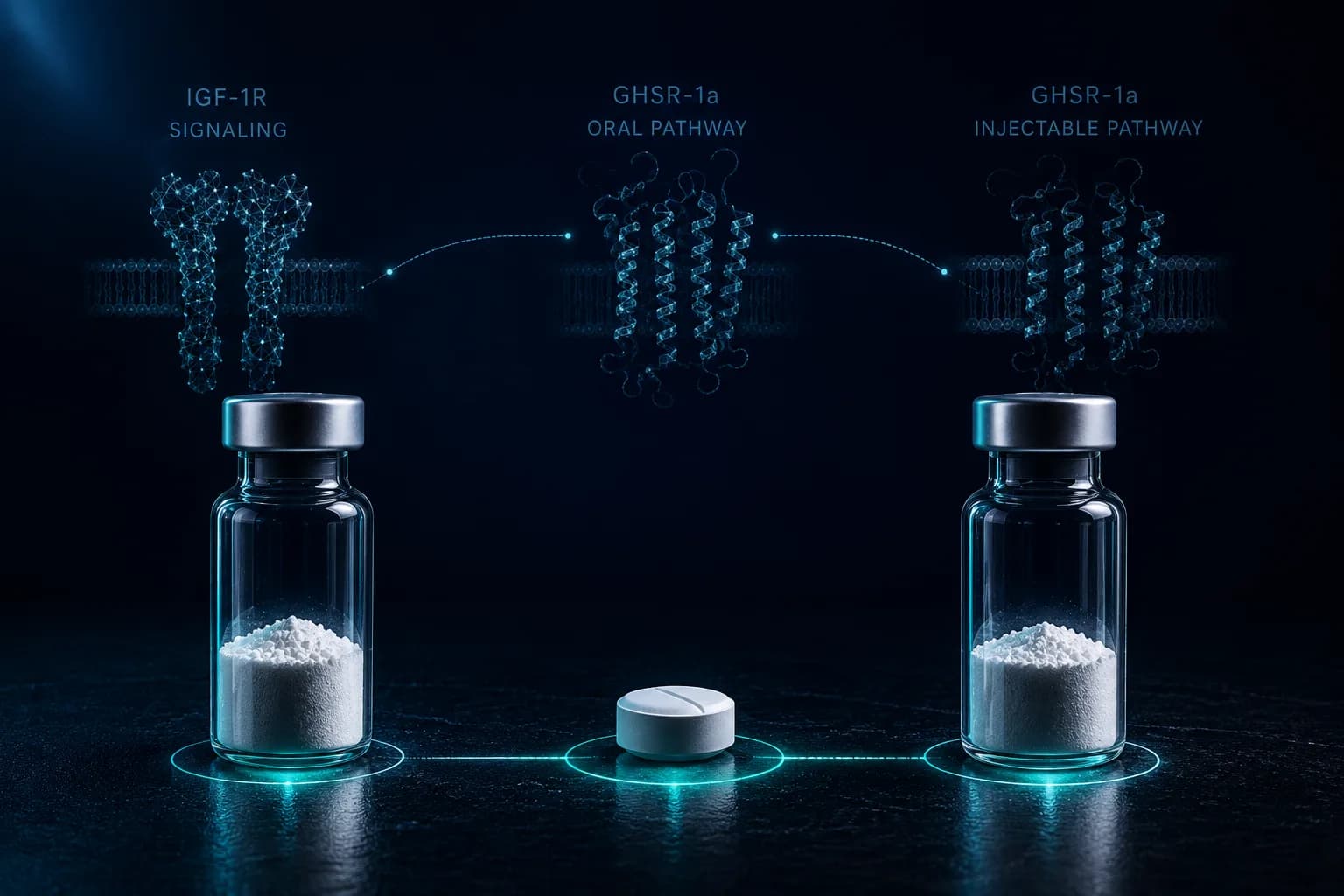
Three peptide vials photographed at editorial angles on a navy laboratory surface — illustrating a structural comparison of three molecules that converge on the GH/IGF-1 axis from different mechanistic starting points.
Jump to section
  1. 01Three mechanisms that converge on the same axis
  2. 02IGF-1 LR3: direct receptor agonism, IGFBP-resistant analogue
  3. 03MK-677 / ibutamoren: oral GHSR-1a agonist with multi-year human data
  4. 04Ipamorelin: the selective GHSR-1a pentapeptide
  5. 05Side-by-side: receptor, route, half-life, evidence depth
  6. 06Which to research for which goal: a framework
  • IGF-1 LR3 is a direct IGF-1 receptor agonist — it bypasses the pituitary entirely and acts downstream of where the other two molecules act.
  • MK-677 is an oral GHSR-1a agonist with ~24h half-life, supporting once-daily dosing and broad systemic GH/IGF-1 elevation — the only one of the three with multi-year human clinical-trial data.
  • Ipamorelin is an injectable selective GHSR-1a pentapeptide with a clean cortisol and prolactin profile and a ~2-hour half-life, supporting multiple-pulse research dosing protocols.
  • All three are research peptides without EMA or FDA approval for general adult use. MK-677 is on the WADA Prohibited List under S2.
  • The 'which is best' question is misframed — they answer different research questions through different mechanisms and have different evidence depths.

Three mechanisms that converge on the same axis

The growth-hormone / insulin-like growth factor-1 (GH/IGF-1) axis can be touched at three distinct levels. The hypothalamus releases GHRH (and ghrelin) that stimulate the anterior pituitary. The pituitary releases GH that travels to peripheral tissues. The liver, in response to GH, secretes IGF-1 that acts on IGF-1 receptors across muscle, bone, and connective tissue. Each level offers a different intervention point — and IGF-1 LR3, MK-677, and ipamorelin each enter at a different level.[9][1]

IGF-1 LR3 acts at the lowest level: directly on peripheral IGF-1 receptors as a synthetic recombinant ligand. It bypasses the pituitary entirely. MK-677 acts at the highest level above the pituitary: as an oral ghrelin-mimetic small molecule that stimulates GHSR-1a on the pituitary somatotrophs to release endogenous GH, which then drives endogenous IGF-1. Ipamorelin acts at the same level as MK-677 — GHSR-1a agonism — but as an injectable selective pentapeptide rather than an oral small molecule, with a far shorter half-life and a cleaner selectivity profile.[5][9][8]

That structural difference is the whole comparison. Saying 'all three raise IGF-1' is technically true and analytically empty — the route, time-action, side-effect profile, and clinical-evidence depth differ in ways that matter for research design.[4][1][7]

IGF-1 LR3: direct receptor agonism, IGFBP-resistant analogue

IGF-1 LR3 is recombinant human IGF-1 (the native 70-amino-acid sequence) extended at the N-terminus with a 13-amino-acid sequence including an arginine substitution at position 3. The combined molecule is 83 amino acids. The 'Long' refers to the N-terminal extension; the 'R3' refers to the Arg3 substitution. Both modifications dramatically reduce binding affinity to IGF-binding proteins (IGFBPs) — particularly IGFBP-3, which sequesters the vast majority of circulating native IGF-1.[1][2][3]

The pharmacological consequence is that IGF-1 LR3 has a much higher fraction of free, receptor-available molecule in plasma at any given total concentration, and a plasma half-life of approximately 20-30 hours (versus minutes for native free IGF-1 once liberated from IGFBPs). The molecule has been characterised in vitro and in animal protein-anabolism models — including the Tomas FM et al. 1993 work showing superior protein anabolism in growing rats versus equimolar native IGF-1.[1][2]

What IGF-1 LR3 lacks is a robust human clinical-trial dataset against a defined therapeutic endpoint. The molecule is widely used in cell-culture research as a serum-free growth supplement and has been studied in animal models, but it is not an EMA- or FDA-approved human medicine. There is no Egrifta-equivalent dossier for IGF-1 LR3 in any indication.[2][18]

MK-677 / ibutamoren: oral GHSR-1a agonist with multi-year human data

MK-677 (ibutamoren mesylate, developmental code MK-0677) is a non-peptide spiropiperidine small molecule discovered by Merck in the 1990s. It is an oral, full-agonist ligand of the growth-hormone-secretagogue receptor 1a (GHSR-1a) — the same receptor activated endogenously by ghrelin and by the GHRP/ipamorelin/hexarelin peptide family. Oral bioavailability is in the moderate-to-good range; plasma half-life is approximately 24 hours, supporting once-daily oral dosing.[4][15][16]

What distinguishes MK-677 from every other peptide in this comparison is the depth of human clinical-trial data. Nass et al. 2008 reported the results of a 2-year randomised placebo-controlled trial of MK-677 in older adults (n=65), with documented increases in fat-free mass, GH/IGF-1 axis activity, and energy expenditure. The MK-677 hip-fracture-recovery trial (Bach et al. 2004), the elderly-adult body-composition data, and the catabolic-state research literature collectively give MK-677 a multi-year human dataset that no other oral GH-axis molecule in the consumer-research market has.[12][13][14]

MK-677 is on the WADA Prohibited List under section S2 (Peptide hormones, growth factors, related substances and mimetics) and is prohibited in competitive sport at all times. It is not an EMA- or FDA-approved consumer medicine. Documented side-effect signals include water retention, transient appetite stimulation (ghrelin-mimetic biology), and small shifts in fasting glucose and HbA1c in a subset of participants.[17][12][14]

Ipamorelin: the selective GHSR-1a pentapeptide

Ipamorelin is a synthetic pentapeptide (Aib-His-D-2-Nal-D-Phe-Lys-NH2) discovered at Novo Nordisk in the mid-1990s and first characterised in detail by Raun et al. 1998. It binds GHSR-1a — the same receptor as MK-677 — but as a selective pentapeptide agonist rather than a small molecule. Plasma half-life is approximately 2 hours, supporting multi-pulse subcutaneous dosing protocols typical of GH-axis research.[8][7][5]

The defining feature of ipamorelin in the GHRP family is its selectivity. Older GHRPs (GHRP-2, GHRP-6, hexarelin) reliably stimulate GH release but also produce measurable cortisol and prolactin elevation as off-target effects — a property that limits their research utility. Ipamorelin was specifically designed to retain GH-secretagogue potency while minimising those off-target cortisol and prolactin responses, which the original Raun characterisation confirmed in healthy adults.[7][8]

Ipamorelin is frequently paired with a GHRH analogue (CJC-1295 no-DAC, sermorelin) in research protocols because GHRH and GHSR-1a agonism are synergistic at the pituitary somatotroph — combined stimulation produces a larger GH pulse than either alone, by activating two complementary signalling pathways. The ipamorelin clinical-evidence base is smaller than MK-677's: there is mechanism-of-action data and short-term tolerability data, but not multi-year body-composition trial data.[10][7][11]

Side-by-side: receptor, route, half-life, evidence depth

A structural comparison table for orientation: IGF-1 LR3 acts on the IGF-1 receptor, is injected subcutaneously, has a ~20-30 hour half-life, and is supported primarily by in-vitro and animal-model anabolism research with no major human RCTs. MK-677 acts on GHSR-1a, is taken orally, has a ~24-hour half-life, and is the only one of the three with multi-year placebo-controlled human trial data (Nass 2008, Murphy 1997, hip-fracture trial). Ipamorelin acts on GHSR-1a, is injected subcutaneously, has a ~2-hour half-life, and is supported primarily by mechanism-of-action and short-term human tolerability research.[1][12][7][9]

The route difference is operationally significant. MK-677 is oral once-daily — the simplest research protocol of the three. Ipamorelin is multiple-injection-per-day because of its short half-life — the most complex protocol. IGF-1 LR3 is once-daily injection with long systemic exposure between doses.[2][8][15]

The side-effect signature also differs. MK-677 carries documented appetite stimulation and water retention as ghrelin-receptor consequences. Ipamorelin is comparatively clean on cortisol and prolactin, but its short half-life still produces brief discrete GH pulses rather than sustained elevation. IGF-1 LR3 acts downstream of the pituitary so does not trigger appetite or pulsatile pituitary effects, but produces sustained IGF-1 receptor signalling that has its own theoretical risk profile.[12][7][1]

Which to research for which goal: a framework

If the research question is about the IGF-1 receptor specifically — protein anabolism, downstream IGF-1 signalling, satellite-cell or connective-tissue biology — IGF-1 LR3 acts at the receptor of interest. If the question is about sustained low-grade elevation of the endogenous GH/IGF-1 axis with oral dosing and the deepest human-trial data behind any molecule in this class, MK-677 is the answer. If the question is about brief, selective, pituitary-level GH pulses with minimal cortisol/prolactin off-target effect, ipamorelin (often paired with a GHRH analogue) is the protocol.[1][12][10]

None of these molecules is an EMA- or FDA-approved consumer medicine for body-composition, longevity, or anti-ageing indications. They are research peptides with mechanistic literature. The framework is for narrowing a research question, not for prescribing a treatment.[18][17]

Stacking — combining two or three of these molecules — has a mechanistic argument behind it (different receptors, complementary signalling) but the human-trial literature on combination protocols is thin. The published combination work in this space is mostly GHRH-analogue plus GHSR-1a-agonist pairings (CJC-1295 + ipamorelin, sermorelin + ipamorelin), with limited combination evidence involving IGF-1 LR3 or MK-677 specifically.[10][11]

Continue reading:View IGF-1 LR3View MK-677View IpamorelinRead MK-677 complete guide

Sources

  1. [01]
  2. [02]
  3. [03]
  4. [04]
  5. [05]
  6. [06]
  7. [07]
  8. [08]
  9. [09]
  10. [10]
  11. [11]
  12. [12]
  13. [13]
  14. [14]
  15. [15]
  16. [16]
  17. [17]
  18. [18]

Questions

IGF-1 LR3 vs native IGF-1 — what's the difference?

Native human IGF-1 is a 70-amino-acid peptide that circulates predominantly bound to IGF-binding proteins (mainly IGFBP-3), leaving only a small fraction free and receptor-available. IGF-1 LR3 is an 83-amino-acid analogue with an N-terminal 13-residue extension and an Arg3 substitution that dramatically reduce IGFBP binding. Plasma half-life is ~20-30 hours for IGF-1 LR3 versus minutes for free native IGF-1, and the free receptor-available fraction is much higher at any given total concentration.[1][2][3]

What's the half-life of MK-677?

Plasma half-life of MK-677 (ibutamoren mesylate) is approximately 24 hours, which is what supports the once-daily oral dosing schedule used in the published clinical trials. The GH/IGF-1 axis response is sustained low-grade elevation rather than discrete pulses.[4][15][12]

Does ipamorelin elevate cortisol?

The original Raun et al. 1998 characterisation reported that ipamorelin retains GH-secretagogue potency comparable to GHRP-6 while producing minimal effects on cortisol and prolactin in healthy adults. That clean selectivity profile is the molecule's defining feature versus older GHRPs (GHRP-2, GHRP-6, hexarelin) which produce more measurable cortisol and prolactin elevation.[7][8]

Which of the three is safest?

All three are research peptides without EMA or FDA approval for general adult use, and none has a long-term consumer-safety dataset in the way an approved medicine would. MK-677 has the deepest human-trial data (multi-year placebo-controlled), but also documented appetite stimulation, water retention, and glucose-tolerance shifts. Ipamorelin has a clean short-term cortisol/prolactin profile but a shorter human-evidence base. IGF-1 LR3 has the least human-trial data of the three. 'Safest' is the wrong frame — choose based on research question and consult a qualified healthcare professional before any clinical use.[12][7][18]

Can you stack them?

The published human-trial literature on combining IGF-1 LR3, MK-677, and ipamorelin is thin. The most evidenced combination in this space is GHRH-analogue plus GHSR-1a-agonist (e.g. CJC-1295 plus ipamorelin), where the two-pathway synergy has mechanistic support. Stacking IGF-1 LR3 with either GH-secretagogue would mean simultaneously elevating IGF-1 receptor signalling from both above (endogenous GH-driven IGF-1) and below (direct IGF-1 LR3 receptor agonism) — a research-design choice without clinical-trial validation.[10][11][1]

Educational content. Not medical advice.

Next step

Choose the route that matches how you read.