

Science

HGH vs Ipamorelin: Supplying the Hormone Against Prompting Its Release

HGH is recombinant human growth hormone — the 191-amino-acid hormone itself, administered directly, producing a sustained rise in circulating levels. Ipamorelin is a selective ghrelin-receptor agonist that stimulates the pituitary to release its own growth hormone in pulses, leaving the body's feedback loops intact. Recombinant growth hormone is authorised in the EU for specific deficiency indications; ipamorelin has no marketing authorisation anywhere and remains a research compound.

8 min readUpdated 28 Aug 2026Reviewed by Independent EU laboratory (ISO/IEC 17025)
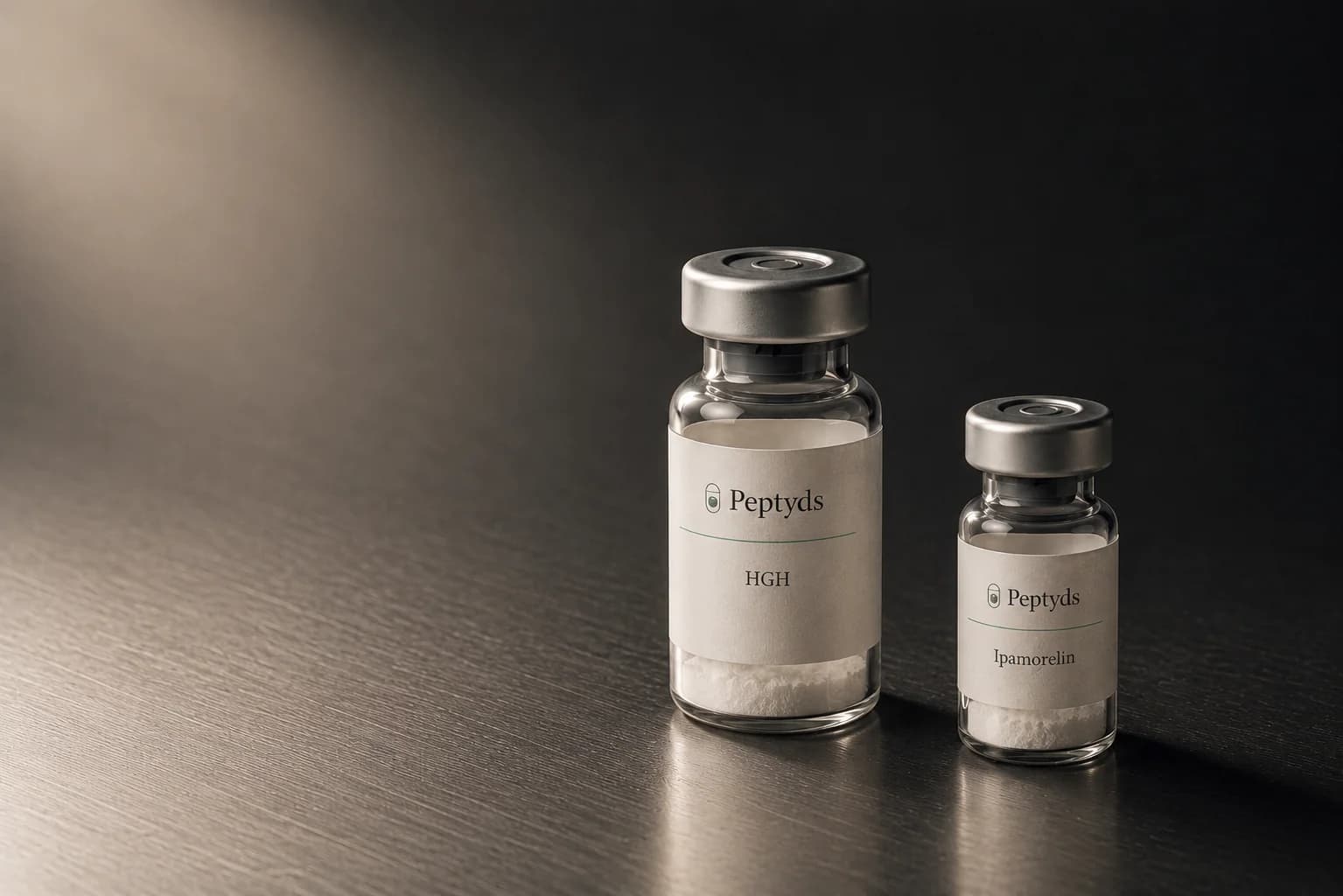
Two Peptyds research vials on a dark brushed-metal bench, a taller HGH vial beside a smaller Ipamorelin vial, lit from the upper left
Jump to section
  1. 01Two entirely different points of intervention
  2. 02Pulsatility is the difference that matters physiologically
  3. 03Why ipamorelin specifically, among the secretagogues
  4. 04Regulatory position, which is not symmetrical
  • HGH supplies the hormone directly. Ipamorelin asks the pituitary to release more of its own.
  • Direct administration produces sustained elevation; secretagogues preserve the natural pulsatile pattern and the negative-feedback loop that limits it.
  • Ipamorelin is the most selective compound in its class — it was characterised specifically for releasing growth hormone without meaningfully raising cortisol or prolactin.
  • Recombinant growth hormone holds EU authorisations for defined deficiency indications. Ipamorelin holds none.
  • The choice is not potency versus safety; it is whether you want to override a regulatory system or work through it.

Two entirely different points of intervention

Recombinant human growth hormone is the hormone: a 191-amino-acid polypeptide identical to what the pituitary produces. Administering it raises circulating growth hormone directly, independent of whether the pituitary would have released any.

Ipamorelin does not contain growth hormone. It is a pentapeptide that binds the ghrelin receptor (GHS-R1a) in the pituitary and prompts the gland to release its own stored hormone. The output is therefore bounded by what the pituitary holds and by the feedback that governs it — somatostatin still applies the brake, and the release still arrives in pulses.

Pulsatility is the difference that matters physiologically

Endogenous growth hormone is not secreted at a steady level. It arrives in bursts, concentrated around slow-wave sleep, with low troughs between them. That pattern is not incidental — receptor sensitivity and downstream signalling are shaped by the peaks and the intervals between them.

Direct administration flattens that curve into sustained elevation. A secretagogue amplifies the existing pulses instead of replacing them. Which of those is preferable depends entirely on the question being asked, and anyone presenting one as simply superior is skipping the physiology.

Why ipamorelin specifically, among the secretagogues

Ipamorelin was characterised for selectivity rather than potency. Earlier ghrelin-receptor agonists released growth hormone but also raised cortisol, prolactin and appetite. Ipamorelin was identified as producing growth-hormone release with markedly less of that spillover, which is why it remains the reference point in its class despite not being the strongest.

It is also why ipamorelin is commonly paired with a GHRH analogue such as CJC-1295: the two act on different receptors and their combination produces a larger release than either alone.

Continue reading:CJC-1295 vs IpamorelinIpamorelin vs MK-677

Regulatory position, which is not symmetrical

Recombinant human growth hormone is an authorised medicine in the European Union for defined indications, principally growth hormone deficiency, with published assessment reports and prescribing information. That authorisation is narrow and specific — it is not an approval for general use.

Ipamorelin holds no marketing authorisation in any jurisdiction. It has never completed the clinical programme that would produce one, and its safety profile rests on early pharmacological characterisation rather than large monitored populations.

Sources

  1. [01]
  2. [02]
  3. [03]
  4. [04]
  5. [05]
  6. [06]
    European Medicines Agency
    Clinical trials in human medicines

Questions

Is ipamorelin as strong as HGH?

No, and the mechanism explains why. Recombinant growth hormone adds hormone from outside; ipamorelin releases what the pituitary already holds, under feedback control that limits the total. A secretagogue cannot exceed the reservoir it draws on.

Why would anyone choose a secretagogue over the hormone itself?

Because it preserves the pulsatile release pattern and the negative-feedback loop that governs it, rather than overriding both. Whether that matters depends on the research question — it is a difference in kind, not simply a weaker version of the same thing.

What makes ipamorelin more selective than other secretagogues?

It was characterised as releasing growth hormone with markedly less effect on cortisol and prolactin than earlier ghrelin-receptor agonists. That selectivity, not potency, is why it remains the reference compound in its class.

Is either one approved in Europe?

Recombinant human growth hormone holds EU authorisations for defined deficiency indications. Ipamorelin holds no marketing authorisation anywhere and remains a research compound.

Educational content. Not medical advice.

Next step

Choose the route that matches how you read.