

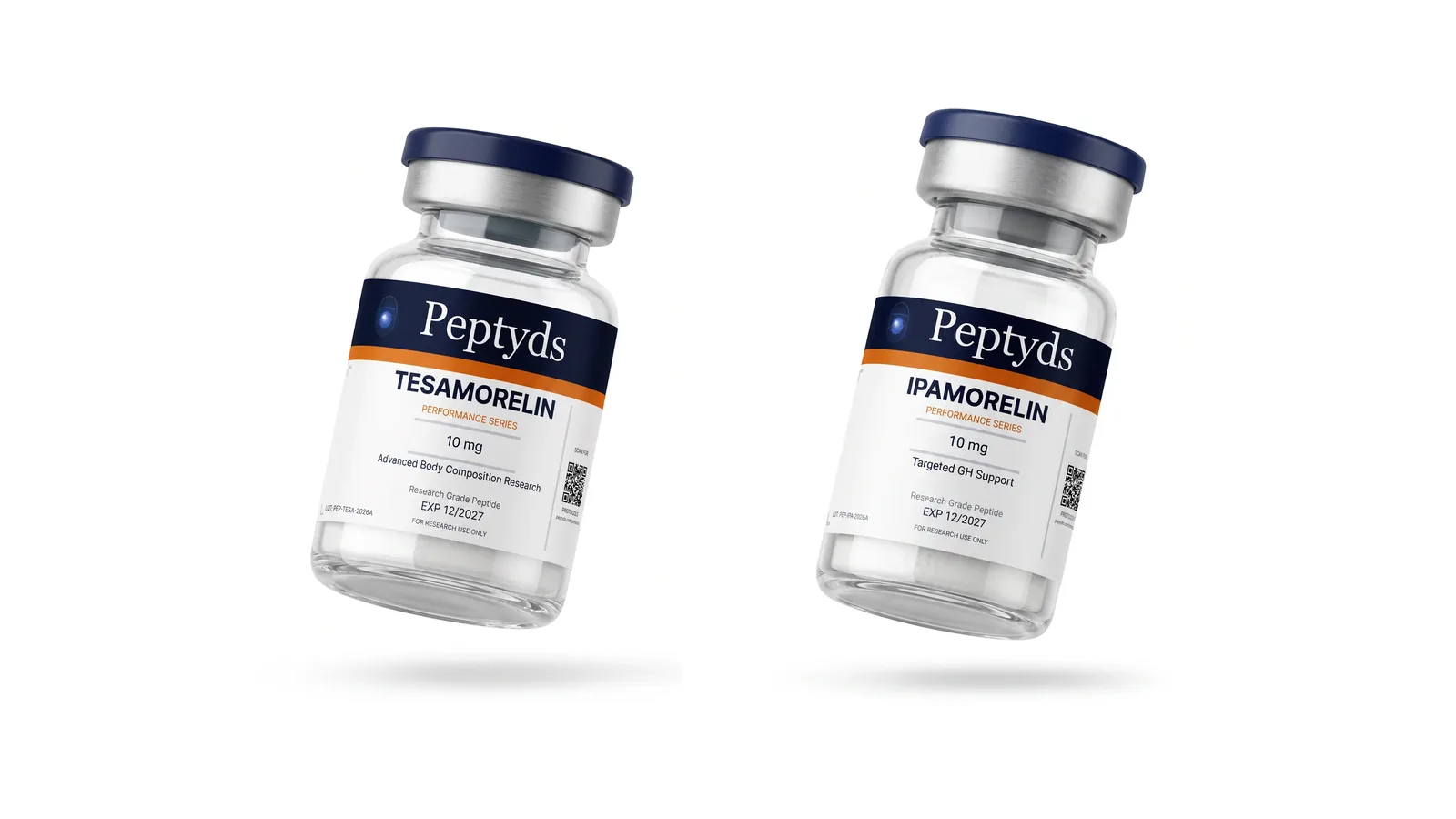
Two receptors, one pituitary target
Tesamorelin and ipamorelin are both classified as growth-hormone secretagogues, a category defined as much by what they are not as by what they do: neither is growth hormone, and neither supplies it directly. Both act upstream, prompting the anterior pituitary to release its own GH in a pulse, then step back. What actually separates the two is which receptor does the prompting.[1][2]
Tesamorelin is the larger molecule: a stabilised 44-amino-acid analogue of native growth-hormone-releasing hormone (GHRH), binding the GHRH receptor on pituitary somatotrophs — the same receptor the hypothalamus itself uses. Ipamorelin is a five-amino-acid pentapeptide, Aib-His-D-2-Nal-D-Phe-Lys-NH2, that activates a different target entirely: the growth-hormone secretagogue receptor GHS-R1a, better known as the ghrelin receptor, named for the stomach-derived hormone that is its natural ligand.[1][2][3]
That receptor difference also shows up in design history. Tesamorelin keeps the full-length GHRH backbone and adds one stabilising modification — a trans-3-hexenoic acid group on the N-terminus — to resist degradation by dipeptidyl peptidase-IV. Ipamorelin was built from the opposite direction in the 1990s: a fragment-sized peptide trimmed down to five residues and optimised for one property — releasing GH without recruiting the cortisol and prolactin responses that older peptides in its class produced.[4][5][2]
Continue reading:View TesamorelinView Ipamorelin