Research notes

KLOW Peptide Blend Explained: What KPV Adds to GLOW

KLOW is an informal online name for the GLOW peptide combination (GHK-Cu, BPC-157 and TB-500) with a fourth research peptide, KPV, added. KPV is the C-terminal tripeptide of α-MSH (residues 11-13), studied mostly in cell and mouse models for anti-inflammatory activity that several papers report as independent of classical melanocortin receptors. Each of the four components has its own separate literature; a September 2026 PubMed search for all four together returned zero records, and only two records mention KPV alongside any single GLOW component, both broad reviews rather than tests of a combination.

9 min readUpdated 24 Sept 2026Reviewed by Independent EU laboratory (ISO/IEC 17025)
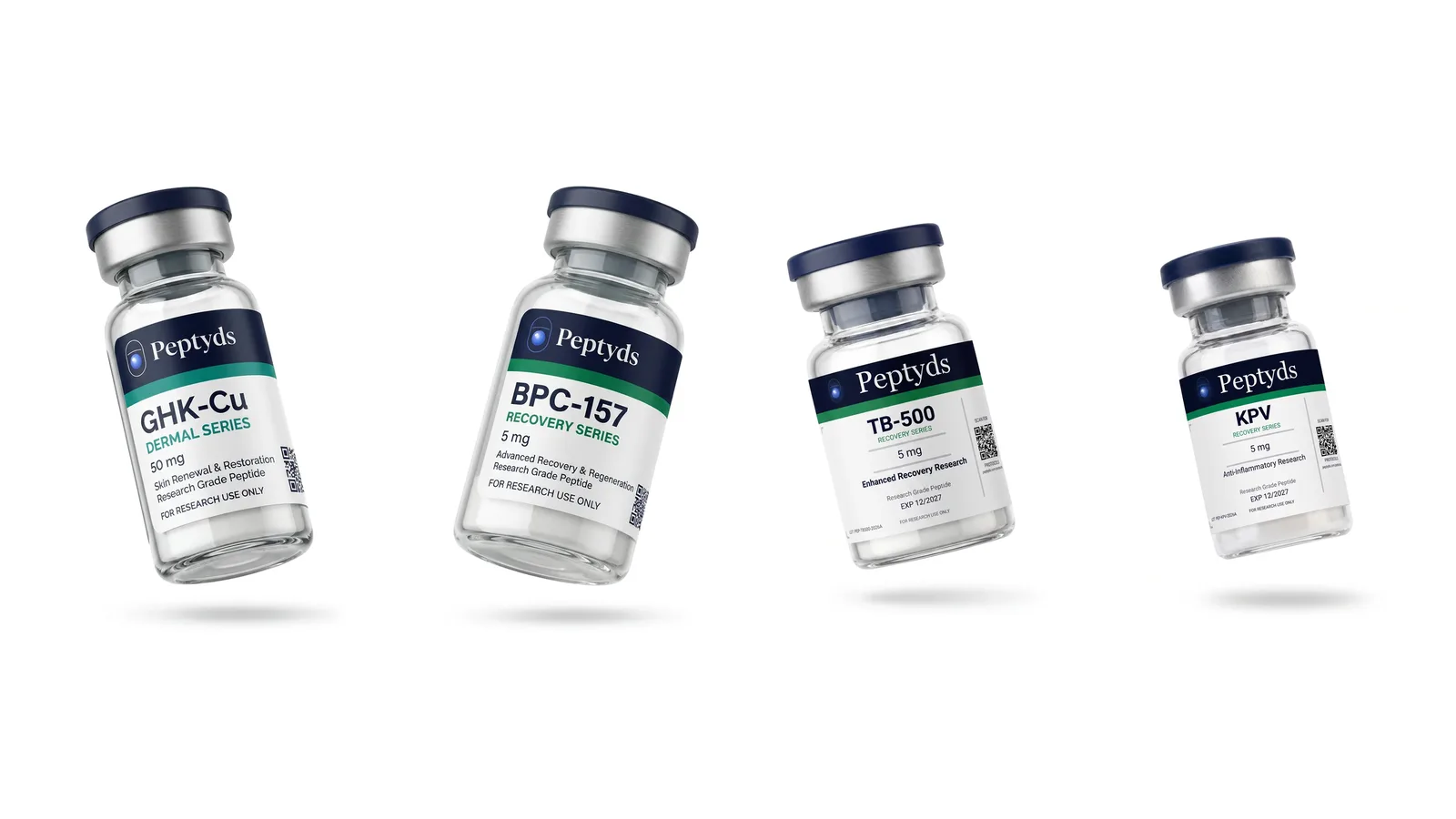
Peptyds GHK-Cu, BPC-157, TB-500 and KPV research vials in a row: the four peptides named in the KLOW blend.
Jump to section
  1. 01What is the KLOW peptide blend?
  2. 02What is KPV, and what does it add to GLOW?
  3. 03What does KPV research show on inflammation, and not show?
  4. 04What does KPV research show beyond the gut?
  5. 05Is there any research on GHK-Cu, BPC-157, TB-500 and KPV together?
  6. 06What does a four-peptide blend change for a laboratory?
  7. 07What is the regulatory status of KPV?
  8. 08How Peptyds approaches KLOW
  • KLOW is an informal online name for the GLOW combination (GHK-Cu, BPC-157, TB-500) plus a fourth tripeptide, KPV — not an authorised medicine or a standard formula.
  • KPV is the C-terminal tripeptide of α-MSH (residues 11-13). Several papers report that it keeps most of α-MSH's anti-inflammatory activity without binding the melanocortin receptors that cause α-MSH's pigmentation effect.
  • KPV's own literature is mostly cell and mouse work: PepT1-mediated uptake and colitis models, plus more recent hydrogel-delivery and skin/wound studies.
  • We found no published study of all four GLOW-plus-KPV components together: a September 2026 PubMed search returned zero records, and only two records mention KPV alongside any single component, both broad reviews.
  • The FDA states it has not identified human exposure data for KPV and lacks information on whether it would cause harm if administered to humans.
  • A four-peptide blend multiplies the verification problem: identity and quantity need confirming for each peptide separately, and there is no published stability data for the four stored together.

Discussed in this guide

  • BPC-157 ComplexA recovery-focused peptide studied for its role in supporting the body's natural repair response — tendons, soft tissue, and gut-lining integrity.5 mg · 10 mg€4.90 / mg
  • GHK-CuA copper-peptide complex studied for skin barrier support, collagen signalling, and visible texture renewal.10 mg · 20 mg · 50 mg€0.78 / mg
  • TB-500Thymosin Beta-4 fragment studied for tendon, ligament, and soft-tissue repair — a recovery-specialist peptide for high-demand training and rehabilitation routines.5 mg · 10 mg€8.90 / mg
  • KPVAn alpha-MSH-derived tripeptide studied for its anti-inflammatory properties across gut, skin, and systemic inflammatory signalling pathways.5 mg · 10 mg€7.50 / mgOut of stock

What is the KLOW peptide blend?

KLOW is an informal name that circulates online for a four-peptide research combination: GHK-Cu, BPC-157 and TB-500 — together already known as the GLOW blend — plus a fourth tripeptide, KPV. As with GLOW, there is no published reference formula for KLOW, so the name alone does not say how much of each peptide a vial contains, or whether a given product contains all four.

The fourth component comes from a different corner of biology than the other three. GHK-Cu, BPC-157 and TB-500 are explained in depth in our GLOW article; KPV is the C-terminal tripeptide of the hormone α-MSH, delineated as an anti-inflammatory fragment that is separate from α-MSH's pigmentation activity.[5]

What KLOW does not have is evidence of its own: no published study has tested GHK-Cu, BPC-157, TB-500 and KPV together. The sections below cover what KPV's own research shows, then what — if anything — is known about combining it with the other three.[1]

Continue reading:GLOW peptide blend explained

What is KPV, and what does it add to GLOW?

KPV takes its name from its three amino acids, lysine-proline-valine. It is the C-terminal tripeptide of α-melanocyte-stimulating hormone (α-MSH), corresponding to residues 11–13 of the full hormone, and is sometimes written as α-MSH(11-13) in the literature.[3]

That positioning matters because α-MSH signals mainly through the melanocortin-1 receptor (MC-1R), which is also what gives it a pigmentation effect. A 2010 review states that KPV lacks the sequence motif needed to bind any known melanocortin receptor, yet retains almost all of α-MSH's anti-inflammatory activity without the pigmentary action — one reason it is studied separately from receptor-agonist peptides such as the melanotans.[5]

In human keratinocyte cell cultures, KPV did not raise cyclic AMP the way α-MSH does through MC-1R, and produced a measurable calcium response only when the cells were also treated with an adenosine-pathway compound. The authors concluded it was not yet clear whether KPV signals through MC-1R at all.[3]

What does KPV research show on inflammation, and not show?

The clearest evidence that KPV acts independently of melanocortin receptors comes from a 2003 study in mice. Systemic KPV reduced immune-cell accumulation in a model of crystal-induced peritonitis, and that effect was not blocked by a melanocortin-3/4 receptor antagonist and still occurred in mice with a non-functional MC-1 receptor. In the same study, KPV — unlike α-MSH — did not increase cyclic AMP or suppress cytokine release from macrophages in cell culture; the authors concluded KPV was more likely to act through inhibition of interleukin-1β activity than through melanocortin receptors.[4]

The largest body of KPV research is in the gut. A 2008 study found that human intestinal epithelial cell lines and T cells took up KPV via PepT1, a transporter also induced in the colon during inflammatory bowel disease, and that nanomolar concentrations of KPV inhibited NF-κB and MAP-kinase inflammatory signalling. In the same study, mice given KPV in their drinking water had less colitis after two different chemical triggers (DSS and TNBS), measured by tissue damage and pro-inflammatory gene expression.[6]

A separate 2008 study tested KPV in two further mouse models of colitis and in mice bred with a non-functional MC-1 receptor. KPV-treated mice recovered body weight faster and had less inflammation on tissue and enzyme measures in both colitis models; in the receptor-deficient mice, KPV treatment kept every treated animal alive through an otherwise fatal course of colitis. The authors described the effect as at least partly independent of MC-1R signalling.[7]

What does KPV research show beyond the gut?

A 2025 review of tripeptides in wound healing describes KPV mainly in hydrogel form: KPV-loaded hydrogels are reported to reduce inflammation, support tissue regeneration and act against MRSA in the studies it surveyed. The same review covers GHK-based formulations separately, as a different tripeptide with its own wound-healing literature — the two are discussed side by side, not as a tested combination.[8]

The newest KPV research points somewhere unrelated to inflammation or skin. A study published in August 2026 treated mouse pre-adipocyte cells with KPV and reported dose-dependent suppression of fat-cell differentiation, cutting lipid accumulation by about 55% at the highest concentration tested. It is a single cell-culture study with no animal or human follow-up yet, so it shows a research direction rather than an established effect.[9]

Continue reading:GHK-Cu skin research in depth

Is there any research on GHK-Cu, BPC-157, TB-500 and KPV together?

Not as a four-peptide combination. A PubMed search combining GHK or copper peptide, BPC-157, thymosin beta-4 or TB-500, and KPV, run in September 2026, returned zero records. Widening the search to KPV alongside any single one of the other three components returns only two records, and both are broad reviews — one surveying compounding-safety standards for many research peptides, the other the wound-healing tripeptide review already cited above — rather than a test of any two of the four together.[1][8]

Our GLOW article covers the one published controlled test that combined two of the three shared components; we found no study that added KPV, or any fourth peptide, to that combination.[1][2]

Continue reading:What the BPC-157 + TB-500 research shows

What does a four-peptide blend change for a laboratory?

Every additional peptide in a mixture adds another identity to confirm and another quantity to measure. A single HPLC purity percentage for a four-peptide blend cannot describe any one component on its own; mass-spectrometry identity testing has to resolve four separate molecules, and each needs its own concentration figure. The verification burden documented for the three-peptide GLOW blend does not shrink when a fourth peptide is added — it grows.

Stability is a second unknown that also compounds. GLOW's own stability question — how GHK-Cu, BPC-157 and TB-500 behave stored together — has no published answer; we found no published data on a four-peptide mixture that also includes KPV, freeze-dried or in solution.[1]

Continue reading:Read the quality protocol

What is the regulatory status of KPV?

The regulatory status of GHK-Cu, BPC-157 and TB-500 — including their absence from EMA-authorised medicines and their place on WADA's Prohibited List — is covered in our GLOW article; we have not repeated that research here. For KPV specifically, the clearest sourced fact is from the FDA.

The FDA's list of bulk drug substances that may present significant safety risks includes an entry for KPV. It states that the FDA has not identified human exposure data for drug products containing KPV via any route of administration, and that the agency lacks information on whether the substance would cause harm if administered to humans.[10]

How Peptyds approaches KLOW

Peptyds does not sell a pre-mixed KLOW blend. GHK-Cu, BPC-157, TB-500 and KPV are supplied as separate lyophilised research compounds for in-vitro laboratory work, each with its own batch certificate for identity and purity, linked from its product page.

That mirrors the evidence above: three of the four components already have a dedicated article on this site, KPV has a separate and mostly preclinical literature of its own, and no published research has tested the four together. Nothing on this page is guidance for personal use.[1]

Sources

  1. [02]
  2. [03]
  3. [04]
  4. [05]
  5. [06]
  6. [07]
  7. [08]
  8. [09]
  9. [10]

Questions

What is in the KLOW peptide blend?

The name is used online for GLOW (GHK-Cu, BPC-157 and TB-500) with a fourth peptide, KPV, added. There is no reference formula for any of the four combinations, so only a certificate that reports identity and quantity for each peptide separately shows what a given vial actually contains.[1]

What does KPV add to GLOW?

KPV is the C-terminal tripeptide of α-MSH, studied mostly for anti-inflammatory activity that several papers report as independent of classical melanocortin receptors — unlike receptor-agonist peptides such as the melanotans. Its own research is concentrated in gut and colitis models, with newer work on skin, wound and metabolic cell models.[5][7]

Is there research on the KLOW blend as a four-peptide combination?

No. A September 2026 PubMed search for all four components together returned zero records, and a search pairing KPV with any single one of the other three returned only two records, both broad reviews rather than tests of a combination.[1][2]

Is KLOW the same as GLOW?

No. GLOW is the three-peptide combination of GHK-Cu, BPC-157 and TB-500; KLOW is an informal name for GLOW with KPV added. Neither combination, nor the four-peptide version, has been tested together in a published study.[1]

Is KPV safe?

There is no published human safety data for KPV that we found. Its research base is mostly cell cultures and mouse models, and the FDA states it has not identified human exposure data for KPV or information on whether it would cause harm if administered to humans.[10]

Does KPV cause the tanning effect associated with melanotan peptides?

No published data support that. Research describes KPV as lacking the sequence motif needed to bind the melanocortin receptors responsible for α-MSH's pigmentation effect, which is why it is studied for anti-inflammatory activity separately from receptor-agonist peptides such as the melanotans.[5]

Is the KLOW peptide blend approved anywhere?

No component is sold by Peptyds as a pre-mixed blend, and we have not independently verified KLOW-specific EMA or WADA status here — GHK-Cu, BPC-157 and TB-500's status is covered in our GLOW article. For KPV, the FDA lists it among bulk substances for which it has not identified human exposure data.[10]

Educational content. Not medical advice.

Next step

Choose the route that matches how you read.