

Research notes

GLOW Peptide Blend Explained: What GHK-Cu, BPC-157 and TB-500 Research Shows

The GLOW peptide blend is an informal name used online for a combination of three research peptides: GHK-Cu (a copper-binding tripeptide studied in skin and fibroblast models), BPC-157 (a gastric-derived peptide studied almost entirely in animals) and TB-500 (a fragment of the actin-binding peptide thymosin beta-4). Each component has its own research literature, mostly cell and animal work with little controlled human data. We found no published study that tested the three together; the only controlled test of two of them, a 2026 rat tendon study, found no added benefit from combining BPC-157 with TB-500.

10 min readUpdated 22 Sept 2026Reviewed by Independent EU laboratory (ISO/IEC 17025)
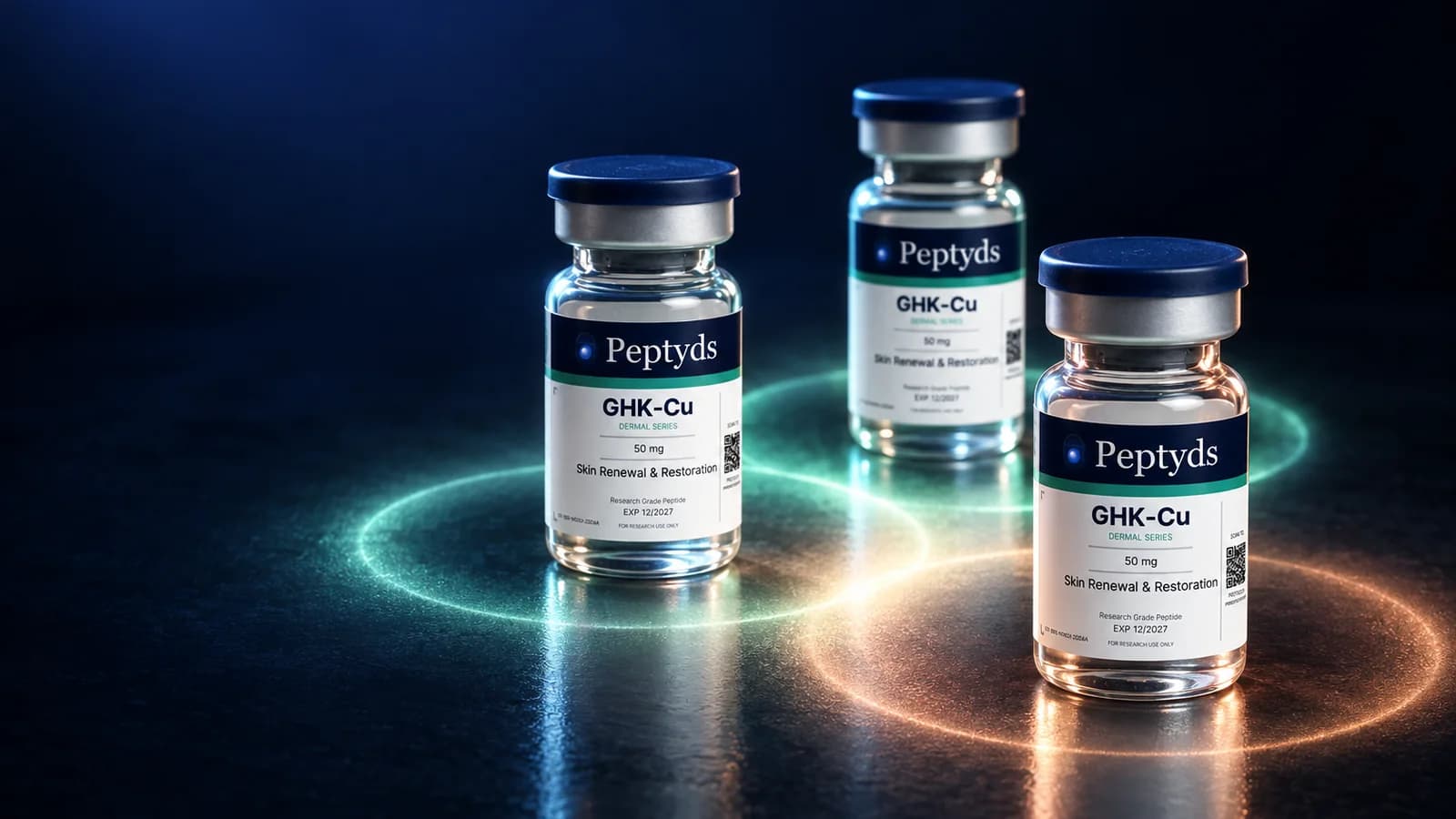
Three sealed Peptyds GHK-Cu research vials standing inside intersecting rings of mint and amber light on a dark surface.
Jump to section
  1. 01What is the GLOW peptide blend?
  2. 02What does GHK-Cu research show, and not show?
  3. 03What does BPC-157 research show, and not show?
  4. 04What does TB-500 research show, and not show?
  5. 05Is there any research on GHK-Cu, BPC-157 and TB-500 together?
  6. 06Why are the three combined, and what does 'complementary' mean?
  7. 07What does a pre-mixed blend change for a laboratory?
  8. 08What is the regulatory status of the GLOW components?
  9. 09How Peptyds approaches GLOW
  • GLOW is an informal online name for a GHK-Cu, BPC-157 and TB-500 combination, not an authorised medicine or a standard formula.
  • We found no published study of the three together: a September 2026 PubMed search returned only review articles.
  • The one controlled test of two components, BPC-157 plus TB-500 in rat tendon repair, found no added benefit from combining them.
  • Each component's evidence is mostly cell or animal work: GHK-Cu in fibroblast and skin models, BPC-157 in rodents, TB-500 through thymosin beta-4 animal studies.
  • WADA's 2026 list prohibits BPC-157 (S0) and TB-500 (S2.3) at all times; GHK-Cu is not named, which does not by itself make it permitted.
  • A blend needs identity and quantity verified for each peptide separately; one purity number for the mixture does not do that.

Discussed in this guide

  • BPC-157 ComplexA recovery-focused peptide studied for its role in supporting the body's natural repair response — tendons, soft tissue, and gut-lining integrity.5 mg · 10 mg€4.90 / mg
  • GHK-CuA copper-peptide complex studied for skin barrier support, collagen signalling, and visible texture renewal.10 mg · 20 mg · 50 mg€0.78 / mg
  • TB-500Thymosin Beta-4 fragment studied for tendon, ligament, and soft-tissue repair — a recovery-specialist peptide for high-demand training and rehabilitation routines.5 mg · 10 mg€8.90 / mg

What is the GLOW peptide blend?

The GLOW peptide blend is an informal name that circulates online for a combination of three research peptides: GHK-Cu, BPC-157 and TB-500. It is not the name of an authorised medicine, and there is no published reference formula, so the name alone does not tell you how much of each peptide a vial contains, or whether it contains all three.[21][1]

The three components come from unrelated corners of biology. GHK-Cu is the copper complex of glycyl-histidyl-lysine, a tripeptide identified in serum in the 1970s. BPC-157 is a synthetic peptide studied mostly in rodent models of tissue repair. TB-500, in doping-control analysis, is the acetylated 17–23 fragment of thymosin beta-4.[3][9][12]

What the blend does not have is evidence of its own. A PubMed search for the three together, run in September 2026, returned six records, and all six were review articles rather than studies that tested the combination. The sections below take each ingredient in turn, then look at what is known about combining them.[1]

What does GHK-Cu research show, and not show?

GHK was identified as a growth-modulating tripeptide in serum, and it has an affinity for copper(II) ions, so research usually studies it as the copper complex GHK-Cu. In fibroblast cultures, GHK-Cu stimulated collagen synthesis from very low concentrations, independently of any change in cell number.[3][4]

A 2015 review describes wider activity: faster wound healing in rats, mice and pigs, attraction of immune and endothelial cells to injury sites, and effects on the turnover of collagen and glycosaminoglycans. That review is by Loren Pickart, a co-author of the 1970s identification paper, so independent replication is worth checking claim by claim.[5][3]

Human evidence for visible skin effects is thin. Copper applied as GHK-Cu permeated dermatomed human skin over 48 hours in a diffusion-cell study, while another laboratory study found almost no peptide or copper crossing intact human skin within nine hours unless the skin was first pretreated with microneedles. In a small randomised trial after CO2 laser resurfacing (13 completers), GHK-Cu skin care produced no objective difference in redness, wrinkles or skin quality, although patients using it reported higher satisfaction.[6][7][8]

Continue reading:GHK-Cu skin research in depthGHK-Cu vs BPC-157 for skin

What does BPC-157 research show, and not show?

BPC-157 has a large preclinical literature and very little human data. A 2025 systematic review of its musculoskeletal research included 36 studies, 35 of them preclinical and one clinical. In animal models it improved functional, structural and biomechanical outcomes in muscle, tendon, ligament and bone injuries, and the reviewers found no clinical safety data.[9]

The human reports are small and uncontrolled. A retrospective chart review from one clinic surveyed 16 patients by phone after intra-articular knee injections of BPC-157, four of whom had also received thymosin beta-4; there was no control group and no standard outcome measure. A 2025 pilot gave intravenous BPC-157 to two adults and reported no measurable changes in the blood markers tested. A 2026 orthopaedic primer described the reported benefits as largely unvalidated in human trials.[10][11][17]

What does TB-500 research show, and not show?

TB-500 is linked to thymosin beta-4, a 43-amino-acid peptide that binds actin, but when a doping-control laboratory analysed TB-500 it found the acetylated 17–23 fragment, Ac-LKKTETQ. That seven-residue actin-binding motif matched full-length thymosin beta-4 in endothelial-cell migration and vessel-sprouting assays.[12][14]

The repair evidence is mostly animal work with full-length thymosin beta-4: in a rat skin-wound model it increased re-epithelialisation and collagen deposition. The FDA states that it has identified no human exposure data for the TB-500 fragment, and a 2026 scoping review found human evidence for this group of peptides limited and mostly lacking robust controls.[13][18][16]

Continue reading:TB-500: the complete guideCompare TB-500 and GHK-Cu

Is there any research on GHK-Cu, BPC-157 and TB-500 together?

Not on all three. A PubMed search combining GHK or copper peptide, BPC-157, and thymosin beta-4 or TB-500, run in September 2026, returned six records. All six were reviews, including sports-medicine overviews that discuss the peptides side by side without testing them together. No cell, animal or human study of the three-peptide combination appeared.[1][16][17]

Two of the three have been combined in one controlled animal study. In a 2026 rat Achilles-tendon repair model (32 rats, eight per group), BPC-157 and TB-500 were each associated with better tendon histology than controls, but combining them conferred no additional benefit over either agent alone. The authors suggested the peptides may converge on shared downstream pathways, a hypothesis they said still needs testing.[15]

GHK-Cu has not been tested alongside either of the others: a second search pairing GHK with BPC-157 or thymosin beta-4 returned seven records, all reviews. The only human report involving two GLOW components is the uncontrolled knee-pain chart review above, in which four patients received BPC-157 with thymosin beta-4.[2][10]

Continue reading:What the BPC-157 + TB-500 research shows

Why are the three combined, and what does 'complementary' mean?

The case made for GLOW is mechanistic: each ingredient is linked to a different step of repair. GHK-Cu stimulated collagen synthesis in fibroblast cultures; BPC-157 is associated in animal studies with angiogenesis-related pathways and lower inflammatory cytokines; the TB-500 motif drove endothelial-cell migration and vessel sprouting in laboratory assays.[4][9][14]

Each of those links comes from a separate literature, in different models and at different concentrations. Adding them together assumes the effects add up without interfering, and that assumption has been tested once for two of the three peptides, in rats, where the combination added nothing measurable. 'Complementary' describes a hypothesis, not an outcome.[15]

What does a pre-mixed blend change for a laboratory?

For research use, the practical problem with any blend is verification. An HPLC purity figure reports the share of the target peak in the analysed sample, so one percentage for a three-peptide mixture cannot describe each component on its own. Identity testing by mass spectrometry has to confirm three separate molecules, and the amount of each one needs its own measurement.

Stability is a second unknown. GHK binds copper(II) ions, and we found no published data on how GHK-Cu, BPC-157 and TB-500 behave together in one vial, whether freeze-dried or in solution. Data gathered on each peptide alone cannot simply be assumed to hold for the mixture.[4][1]

Continue reading:Read the quality protocol

What is the regulatory status of the GLOW components?

None of the three is an authorised medicine through the EMA: no GHK-Cu, BPC-157 or thymosin beta-4 product appears in the EMA's medicines data, checked in September 2026. In the United States, the FDA's page on compounding substances that may present significant safety risks lists BPC-157, injectable GHK-Cu and the TB-500 fragment among substances previously placed in category 2 whose nominations were withdrawn, each with a note on possible immunogenicity and peptide-related impurities.[21][18]

In sport, WADA's 2026 Prohibited List names BPC-157 under S0 (non-approved substances) and 'thymosin-β4 and its derivatives e.g. TB-500' under S2.3; both classes are prohibited at all times. GHK-Cu is not named on the List, and WADA notes that a substance's absence from the List does not by itself mean it is permitted.[19][20]

How Peptyds approaches GLOW

Peptyds does not sell a pre-mixed GLOW blend. GHK-Cu, BPC-157 and TB-500 are supplied as separate lyophilised research compounds for in-vitro laboratory work, each with its own batch certificate for identity and purity, linked on the product page.

That choice follows from the evidence above: each molecule has a literature that can be read on its own terms, and the combination has none. Nothing on this page is guidance for personal use.[1]

Sources

  1. [02]
  2. [03]
  3. [04]
  4. [05]
  5. [06]
  6. [07]
  7. [08]
  8. [09]
  9. [10]
  10. [11]
  11. [12]
  12. [13]
  13. [14]
  14. [15]
  15. [16]
  16. [17]
  17. [18]
  18. [19]
  19. [20]
  20. [21]

Questions

What is in the GLOW peptide blend?

The name is used online for a combination of GHK-Cu, BPC-157 and TB-500. There is no reference formula, so the amounts, and even which molecule 'TB-500' refers to, depend on the product. Only a certificate that reports identity and quantity for each peptide shows what a vial contains.[1][12]

Is there research on the GLOW blend?

Not as a blend. A September 2026 PubMed search for the three peptides together returned six records, all reviews. The closest evidence is a 2026 rat tendon study of BPC-157 and TB-500, in which the combination added no benefit over either peptide alone.[1][15]

Is GLOW the same as the Wolverine stack?

No. 'Wolverine stack' is the online name for BPC-157 with TB-500; GLOW adds GHK-Cu. Neither combination has been tested in a published controlled human study; the only human report is an uncontrolled chart review in which four patients received BPC-157 with thymosin beta-4.[1][10]

Is the GLOW peptide blend approved anywhere?

No. None of its components is an authorised medicine through the EMA, and the FDA lists BPC-157, injectable GHK-Cu and the TB-500 fragment on its page of compounding substances that may present significant safety risks. In sport, WADA's 2026 list names BPC-157 (S0) and TB-500 (S2.3).[21][18][19]

Is GLOW peptide safe?

There are no safety data for the combination. A 2025 systematic review found no clinical safety data for BPC-157, the FDA has identified no human exposure data for the TB-500 fragment, and human GHK-Cu studies are small topical ones. A mixture adds the unknowns of each component.[9][18][8]

Why does GHK-Cu contain copper?

GHK is a tripeptide with an affinity for copper(II) ions, and most of its research uses the copper complex. In fibroblast cultures, the GHK-copper complex stimulated collagen synthesis.[4]

Educational content. Not medical advice.

Next step

Choose the route that matches how you read.