

Research notes

Epitalon (Epithalon): Complete Guide to the Telomerase and Lifespan Research

Epitalon (also spelled epithalon) is a synthetic tetrapeptide, Ala-Glu-Asp-Gly, designed from the amino-acid composition of epithalamin, a bovine pineal-gland extract. In cell cultures it has been reported to switch on telomerase and lengthen telomeres, and in flies and rodents it modestly extended lifespan in some experiments. Nearly all of that work comes from one St Petersburg research network, and independent replication is limited to a handful of cell and oocyte studies. There is no registered clinical trial of epitalon, the long-term human mortality reports concern the extract epithalamin rather than the synthetic peptide, and epitalon is not an authorised medicine in the EU or the US.

10 min readUpdated 22 Sept 2026Reviewed by Independent EU laboratory (ISO/IEC 17025)
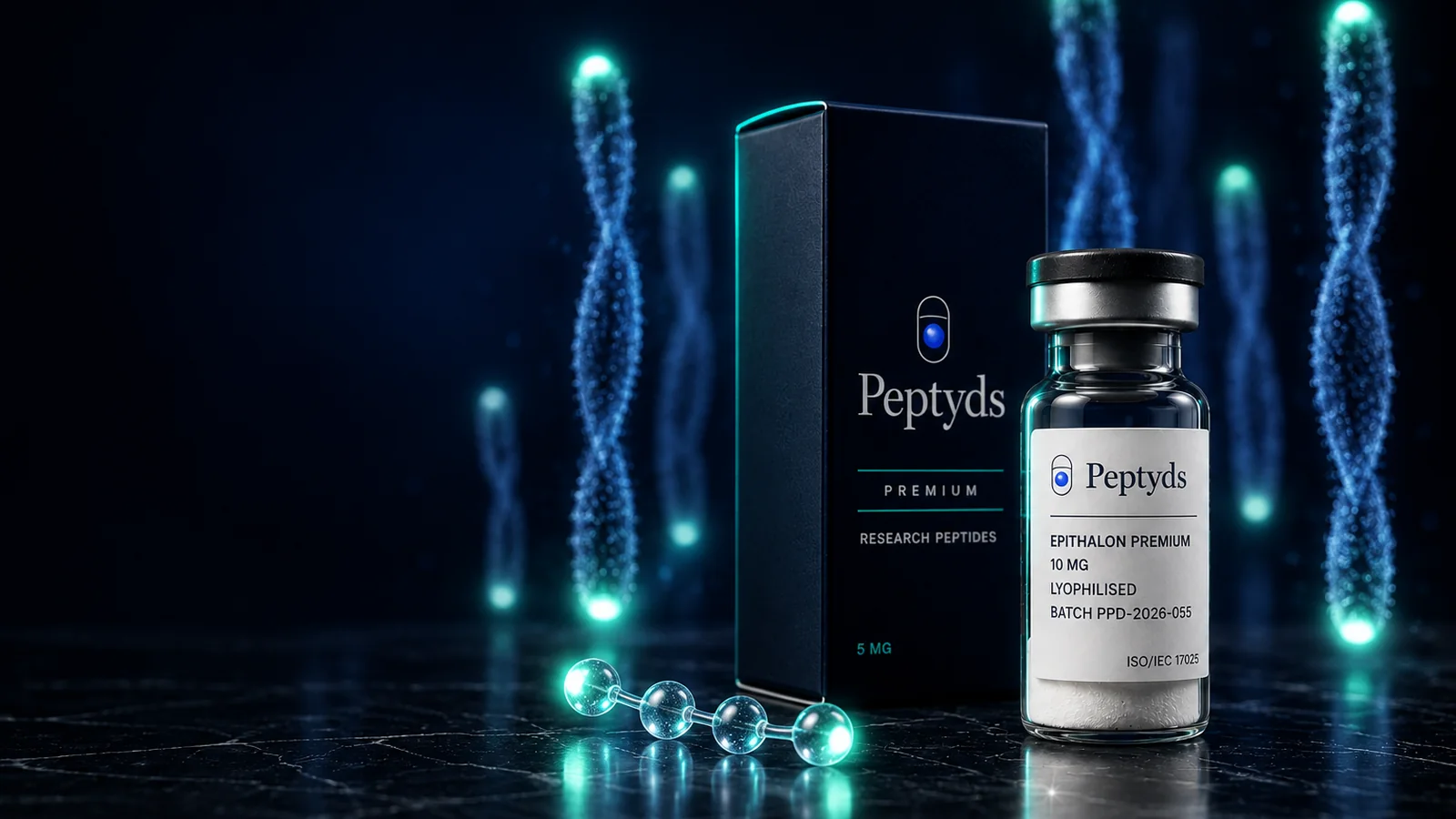
A sealed Peptyds Epithalon Premium research vial and its black carton on dark stone, flanked by glowing blue helices and a short chain of glass beads.
Jump to section
  1. 01What is epitalon (epithalon)?
  2. 02Does epitalon activate telomerase? What the cell studies show
  3. 03Does epitalon extend lifespan? The fly and mouse studies
  4. 04Does epitalon affect melatonin and the pineal gland?
  5. 05Has epitalon been tested in humans?
  6. 06How is epitalon thought to work?
  7. 07Is epitalon an approved medicine in the EU or US?
  8. 08Which epitalon claims are unsupported?
  • Epitalon (epithalon, AEDG) is a synthetic tetrapeptide, Ala-Glu-Asp-Gly, designed from the composition of the bovine pineal extract epithalamin.
  • Telomerase activation and telomere lengthening have been reported in cultured cells, including one independent 2025 study that also saw telomere lengthening in cancer cell lines via ALT.
  • Fly and mouse lifespan results are modest and inconsistent: mean lifespan rose in some experiments and was unchanged in others.
  • The human mortality reports concern epithalamin, not epitalon; there is no registered clinical trial of the synthetic peptide.
  • Nearly all epitalon research comes from one St Petersburg network, and independent replication is limited to a few cell and oocyte studies.
  • Epitalon is not an authorised medicine in the EU or US; Peptyds supplies it for laboratory research only.

Discussed in this guide

  • Epithalon PremiumA tetrapeptide studied for its role in supporting telomerase activity and circadian rhythm — framed for long-horizon routines.10 mg€6.90 / mgOut of stock

What is epitalon (epithalon)?

Epitalon — also spelled epithalon or epithalone, and abbreviated AEDG — is a synthetic tetrapeptide: four amino acids, alanine, glutamic acid, aspartic acid and glycine, in the sequence Ala-Glu-Asp-Gly. It was designed from the amino-acid composition of epithalamin, a bovine pineal-gland extract that the primate literature describes as a pharmacopoeia drug.[1][3]

The order of discovery matters. The tetrapeptide was built first, from composition data, and only later did the same group report detecting AEDG among the tetrapeptides of the pineal polypeptide complex by mass spectrometry. That 2017 analysis found the extract to be mostly di- and tripeptides, with tetrapeptides making up about a fifth of the mixture.[2][1]

Almost all published epitalon research traces back to one network: Khavinson's St Petersburg Institute of Bioregulation and Gerontology and close collaborators, including Anisimov's group at the Petrov oncology institute and the Institute of Gerontology in Kyiv. A 2025 review from Warsaw notes that after 25 years of work, physico-chemical and structural studies of the peptide remain limited. Independent replication is the exception, and this guide flags it where it exists.[4][10][17][1]

Continue reading:Epithalon Premium vials and batch report

Does epitalon activate telomerase? What the cell studies show

The claim epitalon is best known for starts with a three-page report from 2003. Adding the peptide to telomerase-negative human fetal fibroblasts in culture induced expression of telomerase's catalytic subunit, measurable telomerase activity and longer telomeres, which the authors read as reactivation of the telomerase gene.[4]

A 2004 follow-up used fetal lung fibroblasts that stopped dividing at the 34th passage. Cells exposed to epitalon regained telomere length comparable to early passages and reached 44 passages — ten extra divisions beyond the controls — which the authors presented as overcoming the Hayflick limit.[5]

Later human-cell work is less tidy. In a 2019 study of blood lymphocytes from 11 men, incubation with AEDG changed relative telomere length significantly in seven: five increased and two decreased. The authors described the pattern as a tendency toward normalisation rather than uniform lengthening.[6]

The first substantial independent test came in 2025 from Brunel University London. Epitalon lengthened telomeres in two normal human cell lines through hTERT and telomerase upregulation. In two breast-cancer cell lines it also lengthened telomeres, but through a different mechanism, alternative lengthening of telomeres (ALT). The authors name the in-vitro, two-dimensional culture design as their main limitation.[7]

Does epitalon extend lifespan? The fly and mouse studies

In fruit flies, adding epitalon to the culture medium only during the larval stage extended adult lifespan by 11–16%, and the size of the effect did not depend on how much was added.[8]

Mouse results are mixed. In female CBA mice, mean survival rose by 5.3%. In female SHR mice (54 per group), epitalon did not change mean lifespan: it extended the lifespan of the last 10% of survivors by 13.3% and maximum lifespan by 12.3%, cut chromosome aberrations in bone-marrow cells by 17.1%, and left total tumour incidence unchanged, although leukaemia was less frequent.[9][10]

The cancer-model data point the same way. In HER-2/neu transgenic mice, which develop breast tumours spontaneously, epitalon reduced the cumulative number and maximum size of mammary tumours and lowered HER-2/neu mRNA in the tumours 3.7-fold. An Israeli group working with Anisimov reported fewer malignant tumours and no metastases in treated C3H/He mice, against metastases in three of nine tumour-bearing controls.[11][12]

Read together, these are modest and inconsistent effects on average lifespan, obtained in small groups of short-lived animals by one collaborating network. They justify further research; they do not show that epitalon slows ageing in people.[10][9][8]

Does epitalon affect melatonin and the pineal gland?

Because epitalon was modelled on a pineal extract, much of the research looks at melatonin. In old rhesus monkeys, epitalon was reported to stimulate evening melatonin synthesis and normalise the daily cortisol rhythm. A 2005 primate study found that it lowered basal glucose and insulin and raised night-time melatonin in old animals, with no effect in young ones.[13][3]

A laboratory in Paris tested the direct effect and found none. In perifused pineal glands from young and old rats, the tetrapeptide did not change melatonin secretion at any concentration tested, nor did it alter melatonin release stimulated by isoproterenol. Khavinson and Anisimov were co-authors of that paper.[14]

Human melatonin data are thin. A 2007 Russian-language report stated that epithalamin and epitalon raised night-time melatonin in elderly people with reduced pineal function. Its English abstract gives no group sizes or control design, so the result cannot be weighed properly from the published record.[15]

Has epitalon been tested in humans?

Much of what circulates as human evidence for epitalon is about a different product. The long-term mortality reports concern epithalamin, the pineal extract. In one, 266 older people followed for six to eight years had mortality 1.6–1.8 times lower with epithalamin than controls; in a randomised study of 79 coronary patients with 15 years of follow-up, added epithalamin courses were associated with lower mortality. Both come from the same St Petersburg–Kyiv collaboration.[16][17]

Direct human data on synthetic AEDG are scarcer still. A 2002 report on patients with retinal degeneration claimed a positive clinical effect in 90% of cases without giving group sizes in its abstract. Other human-derived work used cells: lymphocytes from people aged 76–80 showed ribosomal-gene activation and loosening of condensed heterochromatin after exposure to epitalon in culture.[18][19]

A search of ClinicalTrials.gov in September 2026 returned no registered trial of epitalon, and we found no randomised, placebo-controlled trial of the synthetic peptide published by an independent group.[27]

Continue reading:How to separate peptide evidence from hype

How is epitalon thought to work?

The St Petersburg group's hypothesis is that short peptides act on gene regulation directly. In one experiment, binding AEDG lowered the melting temperature of a synthetic DNA duplex from 69.5 °C to 28 °C; in cultured lymphocytes from older donors, epitalon was reported to decondense heterochromatin and release repressed genes. These are laboratory observations, and the step from them to effects in a whole organism has not been demonstrated.[20][19]

Groups outside that network have tested narrower, antioxidant-type effects. A Chinese team found that epitalon reduced reactive oxygen species and spindle defects in ageing mouse oocytes in vitro, and a Korean team reported better maturation of bovine oocytes and improved hatching of thawed embryos, which it linked to telomerase activation.[21][22]

The fairest summary comes from the 2025 Warsaw review: epitalon has reported effects on melatonin synthesis, interleukin-2 expression and several enzymes, telomerase among them, but it remains uncertain whether these are the only mechanisms involved.[1]

Continue reading:NAD+ vs Epithalon comparedNAD+ complete guide

Is epitalon an approved medicine in the EU or US?

No. Epitalon has no entry in the European Medicines Agency's medicines database (checked September 2026), and it does not appear in Drugs@FDA, the US database of approved drug products.[26][25]

The FDA has looked at it in one narrow context, pharmacy compounding. Its page on bulk substances that may present significant safety risks lists epitalon in the table of substances once placed in category 2 whose nominations were later withdrawn. The entry says compounded epitalon may pose a risk of immunogenicity through aggregation and peptide-related impurities, and that the agency lacks sufficient information to know whether it would cause harm in humans.[24]

Epitalon also circulates outside regulated channels. In 2015 Belgium's public-health laboratory identified it in two illegal pharmaceutical preparations — a reminder that identity and purity have to be shown by testing, not assumed from a label.[23]

Continue reading:Read the Peptyds quality protocol

Which epitalon claims are unsupported?

Claims that epitalon extends human lifespan or reverses ageing have no support from a controlled trial of the synthetic peptide. The human mortality figures that get quoted come from epithalamin studies run by the developers' own network, and no registered trial of epitalon exists.[16][27]

Claims that it lengthens telomeres in people rest on cell cultures; we found no controlled study measuring telomere length in humans given epitalon. Telomere maintenance is not automatically benign either: in the independent 2025 study, breast-cancer cell lines lengthened their telomeres too, through ALT activation.[7][6]

Peptyds supplies epitalon as a lyophilised research peptide in a sealed vial, with a batch-traceable certificate of analysis, for laboratory research only — not for human or veterinary use. We do not present it as an anti-ageing treatment, and the evidence summarised above is the reason.

Continue reading:View Epithalon PremiumExplore the longevity research goal

Sources

  1. [01]
  2. [02]
  3. [03]
  4. [04]
  5. [05]
  6. [06]
  7. [07]
  8. [08]
  9. [09]
  10. [10]
  11. [11]
  12. [12]
  13. [13]
  14. [14]
  15. [15]
  16. [16]
  17. [17]
  18. [18]
  19. [19]
  20. [20]
  21. [21]
  22. [22]
  23. [23]
  24. [24]
  25. [25]
  26. [26]
  27. [27]

Questions

What is epitalon used for in research?

Epitalon has been studied mainly in ageing research: telomerase activity and telomere length in cultured cells, lifespan and spontaneous tumours in flies and rodents, and melatonin rhythms in old monkeys. Most of these studies come from one St Petersburg research network, and independent replication is limited.[4][10][13]

Is epitalon the same as epithalamin?

No. Epithalamin is a polypeptide extract of bovine pineal gland; epitalon is a single synthetic tetrapeptide, Ala-Glu-Asp-Gly, designed from the extract's amino-acid composition. The long-term human mortality reports concern epithalamin, not epitalon.[1][16]

Does epitalon lengthen telomeres?

In cultured cells, yes: in fetal fibroblasts in the original 2003 report, and in two normal human cell lines in an independent 2025 study that also saw telomere lengthening through ALT in breast-cancer cell lines. We found no controlled study showing telomere lengthening in people.[4][7]

Has epitalon been tested in clinical trials?

No registered trial appears on ClinicalTrials.gov. The published human reports on the synthetic peptide are small, partly Russian-language, give few design details in their abstracts, and come from the developers' own network.[27][18][15]

Is epitalon approved by the EMA or FDA?

No. It has no entry in the EMA's medicines database or in Drugs@FDA. The FDA lists it among compounding substances once placed in category 2 whose nominations were withdrawn, noting a possible immunogenicity risk and insufficient information on harm in humans.[26][25][24]

What is the difference between epitalon and NAD+?

They are different kinds of molecule — NAD+ is a coenzyme, epitalon a synthetic four-amino-acid peptide — and they are studied for different questions. The NAD+ vs Epithalon comparison on Peptyds sets the two side by side.[1]

Educational content. Not medical advice.

Next step

Choose the route that matches how you read.