

Science

Peptide Supplements vs Research Peptides: What Is the Difference?

Peptide supplements are usually foods: hydrolysed collagen or other protein digests containing a mixture of many short peptides, sold in the EU as food supplements. Research peptides such as BPC-157 are single, defined synthetic sequences made by solid-phase synthesis, supplied as freeze-dried powder and checked batch by batch with HPLC and mass spectrometry for laboratory research, not for consumption. Most swallowed peptides are digested, although some collagen fragments such as Pro-Hyp reach the blood. The evidence differs too: collagen has many randomised trials of mixed quality, while research peptides like BPC-157 rest mostly on animal studies.

7 min readUpdated 22 Sept 2026Reviewed by Independent EU laboratory (ISO/IEC 17025)
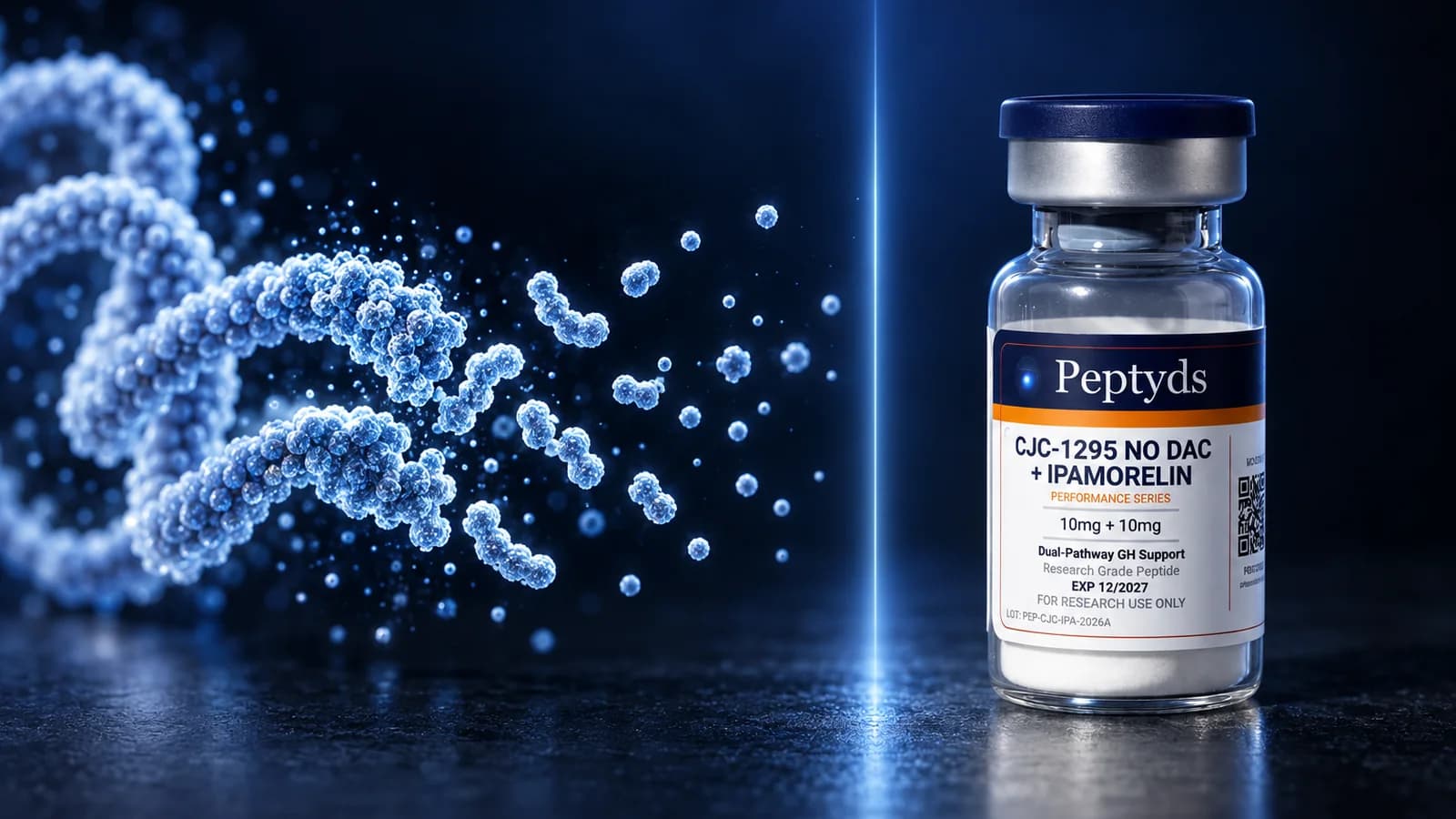
Strands of blue molecular beads breaking into loose particles on one side of a beam of light, and a sealed Peptyds research vial on the other.
Jump to section
  1. 01What are peptide supplements?
  2. 02What are research peptides?
  3. 03Collagen peptides vs research peptides: what are the key differences?
  4. 04What happens to peptides taken by mouth?
  5. 05Do collagen peptide supplements work?
  6. 06Is BPC-157 a supplement or a research peptide?
  7. 07How to tell which kind of peptide product you are looking at
  • 'Peptide supplements' usually means food products such as hydrolysed collagen: mixtures of many short peptides, regulated in the EU as food supplements.
  • Research peptides are single synthetic sequences, made by solid-phase synthesis and verified by HPLC and mass spectrometry, supplied for laboratory research.
  • Most swallowed peptides are broken down; some collagen fragments such as Pro-Hyp reach the blood, and oral peptide medicines need absorption enhancers.
  • Collagen trials look positive overall, but a 2025 meta-analysis found no effect in trials without pharmaceutical-company funding or in high-quality trials.
  • BPC-157 is sometimes discussed as a 'peptide supplement', but it is a single research sequence with mostly animal evidence and WADA S0 status.

Discussed in this guide

  • BPC-157 ComplexA recovery-focused peptide studied for its role in supporting the body's natural repair response — tendons, soft tissue, and gut-lining integrity.5 mg · 10 mg€4.90 / mg

What are peptide supplements?

Peptide supplements, in the everyday sense, are foods. Most are hydrolysed collagen or other food-protein digests, in which a protein has been broken down into a mixture of many shorter peptides. In the EU they fall under food law: Directive 2002/46/EC defines food supplements as foodstuffs that supplement the normal diet, are concentrated sources of nutrients or other substances with a nutritional or physiological effect, and are sold in dose form such as capsules, tablets or sachets of powder.[1][5]

The term is also used more loosely. A 2026 scoping review in sports medicine put 'peptide supplements' in its title while covering unapproved synthetic peptides such as BPC-157, TB-500 and GHK-Cu, and another 2026 review described a 'gray market' of unapproved peptides marketed directly to patients. Those are not food-derived peptide mixtures, yet the same word now covers both.[13][14]

Continue reading:What are peptides? The basics

What are research peptides?

Research peptides are single, defined amino-acid sequences made by chemical synthesis. The standard method, solid-phase peptide synthesis, was introduced by R. B. Merrifield in 1963: the chain is built one amino acid at a time while anchored to a solid support.[10]

They are supplied as lyophilised (freeze-dried) powder and checked batch by batch: an HPLC purity result reports the share of the target peak in the analysed sample, and mass spectrometry confirms that the molecule has the expected mass. They are sold for laboratory research, not as food, cosmetics or medicines.

Continue reading:Lyophilised peptides: storage and handlingHPLC purity explained

Collagen peptides vs research peptides: what are the key differences?

Composition is the first difference. A collagen supplement is a mixture of many peptides of different lengths, produced by breaking down a food protein, and its make-up depends on the source and the process. A research peptide is meant to be one sequence, and a batch is judged by how close it comes to that single molecule.[5][4]

Regulation is the second. In the EU, a product presented as treating or preventing disease, or used to restore, correct or modify physiological functions through a pharmacological, immunological or metabolic action, meets the definition of a medicinal product, while a food supplement is regulated as a food. Research peptides are supplied for laboratory research and are not presented as either.[3][1]

Evidence is the third. Collagen supplements have been tested in more than 20 randomised trials in people, of mixed quality, while research peptides such as BPC-157 have been studied mostly in cells and animals.[9][12]

What happens to peptides taken by mouth?

Protein and peptide medicines have generally required parenteral, that is non-oral, administration, because the gut is built to break proteins down: digestive enzymes degrade peptides, and the gut lining lets few of them through intact.[6][7]

Oral semaglutide, a landmark approval in this field, shows how much engineering the route takes: the peptide is absorbed in the stomach only when co-formulated with the absorption enhancer SNAC, which protects it locally from enzymatic breakdown.[7][6]

Food peptides are not all digested down to single amino acids, though. After volunteers ingested gelatin hydrolysates, collagen-derived peptides, mainly the dipeptide Pro-Hyp, appeared in their blood, peaking one to two hours later. How much of any peptide survives depends on its size, charge, hydrophobicity and sequence, and reaching the blood is not the same as having an effect.[4][5]

Do collagen peptide supplements work?

Pooled trials look positive at first. A 2021 meta-analysis of 19 randomised, double-blind trials with 1,125 participants found that hydrolysed collagen improved skin hydration, elasticity and wrinkles compared with placebo.[8]

Funding and study quality change the picture. A 2025 meta-analysis of 23 randomised trials with 1,474 participants found the same overall benefit, but trials not funded by pharmaceutical companies showed no effect on hydration, elasticity or wrinkles, and high-quality trials showed no significant effect in any category. The authors concluded that there is currently no clinical evidence to support collagen supplements for preventing or treating skin ageing.[9]

In the EU, health claims on foods are prohibited unless they are authorised and included in the EU lists of permitted claims under Regulation (EC) No 1924/2006.[2]

Is BPC-157 a supplement or a research peptide?

BPC-157 is a stable gastric pentadecapeptide: a single 15-amino-acid sequence studied as a research compound, not a food-derived peptide mixture. Because unapproved peptides like it are marketed directly to consumers, sports-medicine reviews now discuss it under the 'peptide supplement' label.[11][14][13]

Its evidence base looks nothing like collagen's. A 2025 systematic review of BPC-157's musculoskeletal research found 35 preclinical studies and one clinical study, and no clinical safety data; a 2026 scoping review concluded that the claimed musculoskeletal benefits of such peptides remain unsubstantiated by human trials.[12][13]

On status: BPC-157 has no EU marketing authorisation via the EMA, it appears on the FDA's page of compounding substances that may present significant safety risks, and WADA's 2026 Prohibited List names it under S0 (non-approved substances), prohibited at all times. Peptyds supplies it as a lyophilised research compound for in-vitro laboratory work, not as a food supplement.[17][15][16]

Continue reading:View BPC-157 Complex

How to tell which kind of peptide product you are looking at

Four checks separate the categories. The category: a food supplement is sold as a food in dose form, while a research compound is labelled for laboratory research. The contents: one named sequence, or a hydrolysate described by its protein source. The documentation: a research peptide should come with a batch certificate showing HPLC purity and a mass-spectrometry identity result. The claims: health claims on foods must be authorised, and a research compound makes none.[1][2]

Continue reading:Read the quality protocol

Sources

  1. [01]
  2. [02]
  3. [03]
  4. [04]
  5. [05]
  6. [06]
  7. [07]
  8. [08]
  9. [09]
  10. [10]
  11. [11]
  12. [12]
  13. [13]
  14. [14]
  15. [15]
  16. [16]
  17. [17]

Questions

Are collagen peptides the same as research peptides?

No. Collagen peptides are a food-derived mixture made by breaking down collagen and sold as food supplements. A research peptide is one synthetic sequence, verified batch by batch and supplied for laboratory research.[1][5]

Do peptide supplements work?

For collagen, pooled trials show modest skin benefits overall, but a 2025 meta-analysis found no effect in trials not funded by pharmaceutical companies and none in high-quality trials. For unapproved synthetic peptides sold as supplements, a 2026 scoping review found the claimed benefits unsubstantiated by human trials.[8][9][13]

Are oral peptides absorbed?

Mostly not intact. Digestive enzymes and the gut lining break down or block most peptides; small collagen fragments such as Pro-Hyp do reach the blood, and an oral peptide medicine such as oral semaglutide needs an absorption enhancer.[4][7][6]

Is BPC-157 a food-derived peptide like collagen?

No. BPC-157 is a single 15-amino-acid sequence, a stable gastric pentadecapeptide studied as a research compound, mostly in animals. It has no EU marketing authorisation via the EMA, and WADA's 2026 list names it under S0.[11][12][17][16]

What does 'research use only' mean for a peptide?

It means the compound is supplied for laboratory research, such as in-vitro experiments, rather than as a food, cosmetic or medicine. It says nothing about safety or efficacy in people.

How are peptide supplements regulated in the EU?

As foods. Directive 2002/46/EC covers food supplements, and health claims on foods must be authorised under Regulation (EC) No 1924/2006. A product presented as treating or preventing disease meets the EU definition of a medicinal product instead.[1][2][3]

Educational content. Not medical advice.

Next step

Choose the route that matches how you read.