

Research notes

PT-141 (Bremelanotide): Complete Guide to the Research and Safety Data

PT-141 is bremelanotide, a synthetic cyclic seven-amino-acid analogue of alpha-melanocyte-stimulating hormone that activates several melanocortin receptors, most potently MC1R and MC4R. The US FDA approved it in 2019, as Vyleesi, only for premenopausal women with acquired, generalised hypoactive sexual desire disorder (HSDD); it has no EMA authorisation. In the two RECONNECT phase 3 trials it produced statistically significant but small gains on desire and distress scores, while 40% of treated women reported nausea, 18% stopped because of adverse reactions, and the label documents transient blood-pressure rises and focal skin darkening.

13 min readUpdated 22 Sept 2026Reviewed by Independent EU laboratory (ISO/IEC 17025)
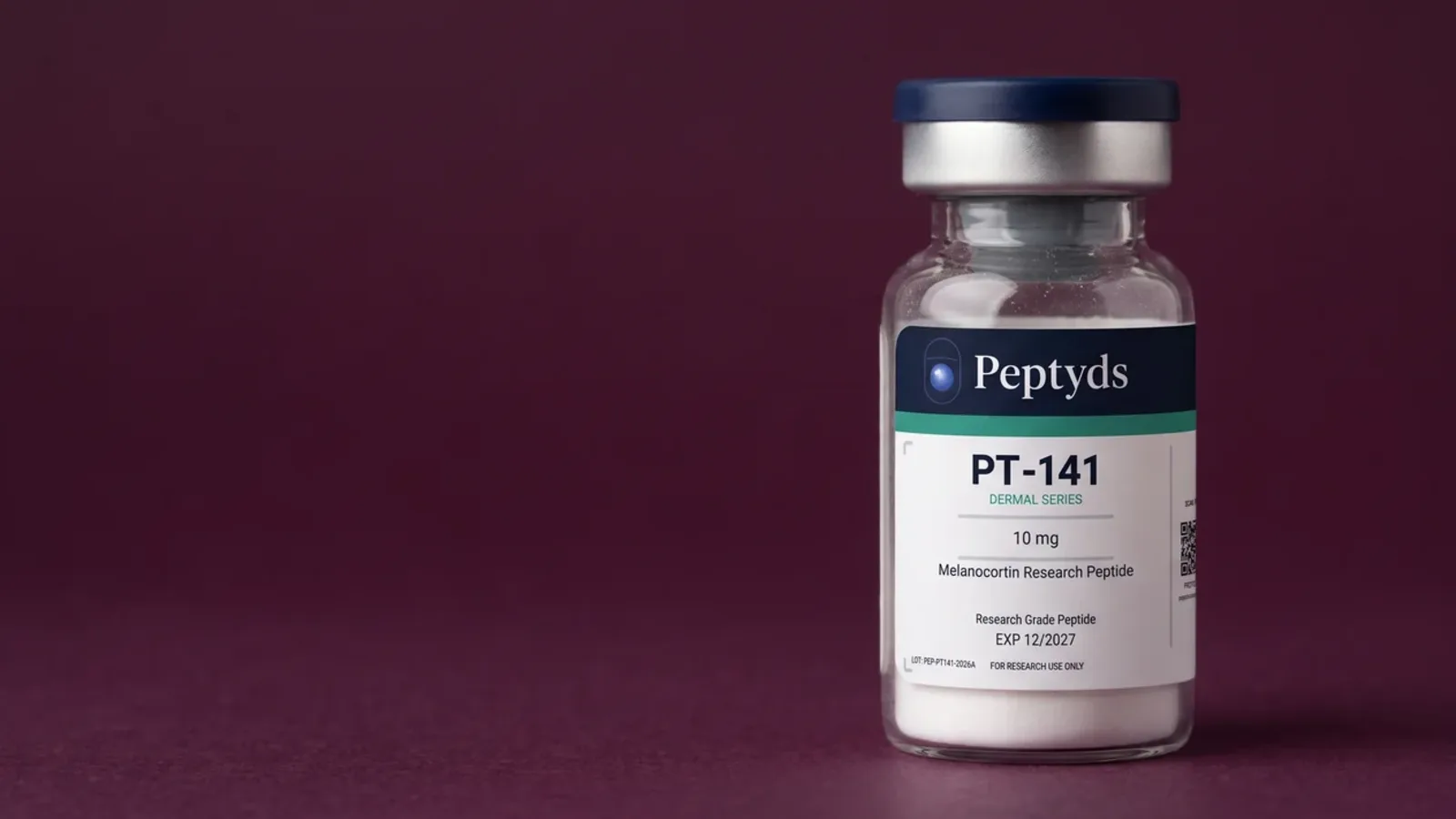
A sealed Peptyds PT-141 research vial standing against a deep plum studio background.
Jump to section
  1. 01What is PT-141 (bremelanotide)?
  2. 02How does PT-141 work?
  3. 03What did early PT-141 research in animals and men find?
  4. 04What did the RECONNECT phase 3 trials show?
  5. 05How big is the benefit? The published critique
  6. 06What side effects were documented in the PT-141 trials?
  7. 07Blood pressure, skin darkening and other documented risks
  8. 08Is PT-141 approved in the EU or the US?
  9. 09How Peptyds frames PT-141: research material, not a libido product
  • PT-141 is the development code for bremelanotide, a cyclic seven-residue alpha-MSH analogue that grew out of Melanotan II chemistry.
  • The FDA label describes a non-selective melanocortin agonist, most potent at MC1R and then MC4R, and states that its mechanism in low sexual desire is unknown.
  • FDA approval (2019) covers one indication, acquired and generalised HSDD in premenopausal women; there is no EMA authorisation and no EPAR.
  • The RECONNECT phase 3 trials (1,267 women) met their co-primary endpoints, but the effect was small and its clinical meaning is disputed.
  • Documented adverse findings include nausea (40%), flushing (20%), headache (11%), transient blood-pressure rises and focal hyperpigmentation in 38% of participants given it daily for eight days in one study.
  • Peptyds supplies PT-141 for in-vitro laboratory research only; it is no substitute for the prescription medicine or its screening.

Discussed in this guide

  • PT-141Bremelanotide — a melanocortin receptor agonist studied for its role in sexual arousal pathways through central nervous system signalling rather than vascular mechanisms.10 mg€5.90 / mgOut of stock

What is PT-141 (bremelanotide)?

PT-141 is the development name of bremelanotide, a synthetic peptide analogue of alpha-melanocyte-stimulating hormone (alpha-MSH) that acts on the body's melanocortin receptors. The FDA label describes it as a cyclic heptapeptide, Ac-Nle-cyclo-(Asp-His-D-Phe-Arg-Trp-Lys-OH), with an acetylated N-terminus, a free acid at the C-terminus and a molecular weight of 1025.2 for the free base.[14][1]

It comes from the same melanocortin chemistry as the tanning peptides. A 2006 review of melanocortin therapeutics describes PT-141 as a Melanotan II analogue developed by Palatin Technologies. The first published work tested it on erectile function in rats, non-human primates and men; development later moved to premenopausal women with low sexual desire.[10][11][9]

That history gives PT-141 something most research peptides lack: an approved form with a phase 3 dataset and a detailed prescribing label, which is also the most complete public record of the molecule's effects on blood pressure, pigmentation and the gut.[1][2]

Continue reading:PT-141 research notes and batch documentationPT-141 vs Melanotan II compared

How does PT-141 work?

According to the FDA label, bremelanotide non-selectively activates several melanocortin receptor subtypes, in this order of potency: MC1R, MC4R, MC3R, MC5R, MC2R. At clinical exposures, binding at MC1R and MC4R is considered most relevant. The label states plainly that the mechanism by which it improves low sexual desire is unknown, and notes that MC1R on melanocytes drives melanin production and pigmentation.[1]

The working hypothesis centres on MC4R in the hypothalamus. A 2022 review summarises animal evidence that bremelanotide activates presynaptic MC4R on neurons of the medial preoptic area, increasing dopamine release in a region tied to sexual motivation. Structural work supports direct receptor engagement: cryo-electron microscopy structures published in 2021 show bremelanotide bound to MC4R in complex with its Gs protein.[16][17]

The evidence points to a central rather than a blood-flow effect. In an 18-woman crossover study of a single intranasal dose, more women reported moderate or high sexual desire after bremelanotide than after placebo, yet vaginal vasocongestion measured during an erotic video did not change significantly.[14]

MC4R also regulates appetite. In two small phase 1 trials in premenopausal women with obesity, repeated daily bremelanotide cut calorie intake by roughly 400 kcal a day and, over 16 days, body weight by 1.3 kg more than placebo. It is not approved for weight management.[18][1]

What did early PT-141 research in animals and men find?

In female rats, PT-141 selectively increased solicitation, the appetitive behaviours a female uses to initiate mating, without changing lordosis, pacing or general motor activity; the authors framed this as a model of desire rather than reflex. Earlier work had shown erections in male rats and non-human primates, and activation of hypothalamic neurons after systemic dosing.[15][11]

The first human studies were in men. Intranasal PT-141 in healthy men and in men with mild-to-moderate erectile dysfunction produced statistically significant erectile responses versus placebo, with a median time to peak concentration of 30 minutes and a half-life of about two hours; flushing and nausea were the most common adverse events. A subcutaneous study also reported erectile responses in men who had responded inadequately to sildenafil.[12][13]

Two 2008 bremelanotide trials from a single investigator should be set aside. The Journal of Sexual Medicine retracted one, in women with arousal disorder, after the author did not supply original data to answer reviewers' concerns about its methods and statistics. The Journal of Urology has placed an expression of concern on the other, in men who had not responded to sildenafil.[23][24]

What did the RECONNECT phase 3 trials show?

RECONNECT was two identical 24-week, randomised, double-blind, placebo-controlled trials (studies 301 and 302) in premenopausal women with hypoactive sexual desire disorder. Of 1,267 women randomised, most were white (85.6%) and enrolled at US sites (96.6%), with a mean age of 39. Participants self-administered 1.75 mg of bremelanotide or placebo under the skin as needed, before anticipated sexual activity.[4][1]

Both trials met their two co-primary endpoints. Compared with placebo, scores on the desire domain of the Female Sexual Function Index rose by 0.30 and 0.42 points, and distress about low desire fell by 0.37 and 0.29 points on a single 0-to-4 questionnaire item. For scale, the desire domain runs from 1.2 to 6.0, and the label reports mean changes of 0.5 to 0.6 on bremelanotide against 0.2 on placebo.[4][1]

Retention was a problem. The label reports that 40% of bremelanotide patients versus 13% on placebo left study 1 early, and 39% versus 25% left study 2. In the 52-week open-label extension, 684 of 856 eligible women enrolled and 272 completed it; the investigators reported no new safety signals and sustained score improvements, although that phase had no control group.[1][5]

How big is the benefit? The published critique

The size and meaning of the effect are contested in peer-reviewed journals. A 2021 re-analysis built on the FDA application data found results similar to the published trials, but highlighted what had not been reported: discontinuation for adverse events was far higher on bremelanotide (odds ratio 11.98, number needed to harm 6), and on a measure combining trial completion with entry into the extension, participants preferred placebo. The trial investigators published a rebuttal.[19][20]

A 2024 follow-up argued that the desire and distress measures have little validity evidence in women with HSDD, and that previously unpublished trial outcomes showed effects ranging from nil to small. The phase 2b trial's primary endpoint, satisfying sexual events, rose by 0.7 a month against 0.2 on placebo in the pooled higher-dose groups, but it was not a primary endpoint in phase 3. A 2021 Drug and Therapeutics Bulletin analysis of the approval data concluded that bremelanotide led to no additional enjoyable sexual experiences.[21][8][22]

What is not in dispute: the phase 3 gains on the co-primary questionnaires were statistically significant and modest, tolerability (above all nausea) drove many dropouts, and none of the data concern men, postmenopausal women or healthy people seeking enhancement. Online claims of dramatic libido effects are not what the controlled trials show.[4][1][19]

Continue reading:Research evidence versus hype

What side effects were documented in the PT-141 trials?

The label's pooled phase 3 table lists nausea in 40.0% of bremelanotide patients versus 1.3% on placebo, flushing in 20.3% versus 0.3%, injection-site reactions in 13.2% versus 8.4%, headache in 11.3% versus 1.9% and vomiting in 4.8% versus 0.2%. Most events were mild (31%) or moderate (40%) and transient; serious adverse reactions were reported in 1.1% versus 0.5%.[1]

Nausea was the defining problem. It usually began within an hour and lasted about two hours, affected 21% of patients after the first dose and about 3% after later doses, led 13% to need an anti-nausea drug and caused 8% to leave the trials. In a phase 4 study of 228 healthy women, pre-treatment with ondansetron did not reduce it. Overall, 18% of bremelanotide patients versus 2% on placebo stopped because of adverse reactions.[1]

A 2022 review of the full development programme, covering 3,500 subjects in 43 completed studies with phase 3 exposure of up to 18 months, reported no deaths and a few serious adverse events, and confirmed nausea as the most common reason for stopping.[6]

Blood pressure, skin darkening and other documented risks

Bremelanotide raises blood pressure after each dose. The label reports maximal increases of 6 mmHg systolic and 3 mmHg diastolic, peaking two to four hours after dosing, with heart rate falling by up to 5 beats per minute and values usually back to baseline within 12 hours. An ambulatory-monitoring trial in 397 women found systolic rises of roughly 2 to 3 mmHg over placebo in the first four hours. The label contraindicates it in uncontrolled hypertension or known cardiovascular disease.[1][7]

Skin darkening follows from MC1R activity. In phase 3, focal hyperpigmentation of the face, gums or breasts occurred in 1% of patients using up to eight doses a month and in no placebo patients. In a separate study, 38% developed it after daily dosing for eight days and a further 14% after eight more days; darker skin carried higher risk, and resolution was not confirmed in every case after stopping.[1][6]

The label also records one case of acute hepatitis in the open-label extension, with liver enzymes above 40 times the upper limit of normal, in which a role for the drug could not be excluded. Bremelanotide may slow gastric emptying and significantly lowers exposure to oral naltrexone; indomethacin levels were also reduced. It caused fetal harm in dogs and developmental delays in mice, human pregnancy data are too few to judge, and two-year rodent studies found no significant increase in tumours.[1][6]

Is PT-141 approved in the EU or the US?

The FDA approved bremelanotide injection (Vyleesi, NDA 210557) on 21 June 2019 for premenopausal women with acquired, generalised hypoactive sexual desire disorder that is not due to a co-existing medical or psychiatric condition, relationship problems or the effects of a medication. The label states it is not indicated for postmenopausal women, for men, or to enhance sexual performance.[2][1]

It was the second FDA-approved drug for this diagnosis, after flibanserin in 2015. In the European Union there is no EMA authorisation: a September 2026 search of the European Medicines Agency's medicines database returned no entry for bremelanotide, whether authorisation, application or European Public Assessment Report (EPAR).[22][3]

Outside regulated channels, bremelanotide circulates alongside Melanotan II. A forensic toxicology study used high-resolution mass spectrometry to identify both peptides in samples seized by police together with anabolic steroids and other performance- and image-enhancing drugs, a reminder that the contents of an unregulated vial cannot be assumed.[25]

How Peptyds frames PT-141: research material, not a libido product

Peptyds supplies PT-141 as a lyophilised research peptide for in-vitro laboratory research only, documented with a batch-specific certificate of analysis under the same quality protocol as the rest of the catalogue. We do not present it as a treatment for low desire, an enhancement product or a stand-in for the prescription medicine.[1][3]

For laboratories, the published record points to practical checks: confirm identity by mass spectrometry and purity by HPLC on the batch document, because bremelanotide and Melanotan II are close structural relatives that turn up in the same unregulated supply.[25][10]

Anyone weighing personal use should keep the documented facts in view: a narrow approved indication that excludes men and postmenopausal women, small average benefits, frequent nausea, blood-pressure effects and pigmentation that may not reverse. Decisions about clinical use belong with a qualified prescriber.[1][6]

Continue reading:View PT-141Read PT-141 vs Melanotan IIExplore the sexual health goalHow to read a certificate of analysis

Sources

  1. [01]
  2. [02]
  3. [03]
  4. [04]
  5. [05]
  6. [06]
  7. [07]
  8. [08]
  9. [09]
  10. [10]
  11. [11]
  12. [12]
  13. [13]
  14. [14]
  15. [15]
  16. [16]
  17. [17]
  18. [18]
  19. [19]
  20. [20]
  21. [21]
  22. [22]
  23. [23]
  24. [24]
  25. [25]

Questions

Is PT-141 the same as bremelanotide?

Yes. PT-141 is the development code for bremelanotide. The FDA-approved prescription product containing it is Vyleesi, an injection approved in 2019 for one indication in premenopausal women. Research-grade PT-141 is the same molecule but not the same product: no marketing authorisation, label or prescriber screening stands behind it.[14][1][2]

Is PT-141 FDA approved?

Bremelanotide is FDA-approved as Vyleesi (June 2019) only for premenopausal women with acquired, generalised hypoactive sexual desire disorder that is not caused by another condition, relationship problems or a medication. The label excludes postmenopausal women and men and states it is not indicated to enhance sexual performance. Research-grade PT-141 is not an approved product.[2][1]

Is PT-141 approved in Europe?

No. Bremelanotide has no EMA authorisation: a September 2026 search of the European Medicines Agency's medicines database found no marketing authorisation, application or EPAR for it.[3]

What are the side effects of PT-141?

In the phase 3 trials, bremelanotide caused nausea in 40% of women (against 1.3% on placebo), flushing in 20%, injection-site reactions in 13%, headache in 11% and vomiting in about 5%, and 18% stopped because of adverse reactions. The label also documents transient blood-pressure rises with a slower heart rate, focal hyperpigmentation (38% of participants dosed daily for eight days in one study) and one case of acute hepatitis in which a drug role could not be excluded.[1][6]

How long does PT-141 stay in the body?

For the approved subcutaneous product, the label reports a median time to peak plasma concentration of about one hour, bioavailability of about 100% and a mean terminal half-life of about 2.7 hours (range 1.9 to 4.0). The peptide is broken down by hydrolysis of its amide bonds; about 65% of a radiolabelled dose is recovered in urine and 23% in faeces. Blood-pressure effects usually resolve within 12 hours.[1]

Does PT-141 work in men?

Early trials in men found statistically significant erectile responses versus placebo, including in men who had responded inadequately to sildenafil. That work did not lead to an approval for men: the current label states the product is not indicated for them. One 2008 trial in men now carries a journal expression of concern.[12][13][1][24]

Educational content. Not medical advice.

Next step

Choose the route that matches how you read.