

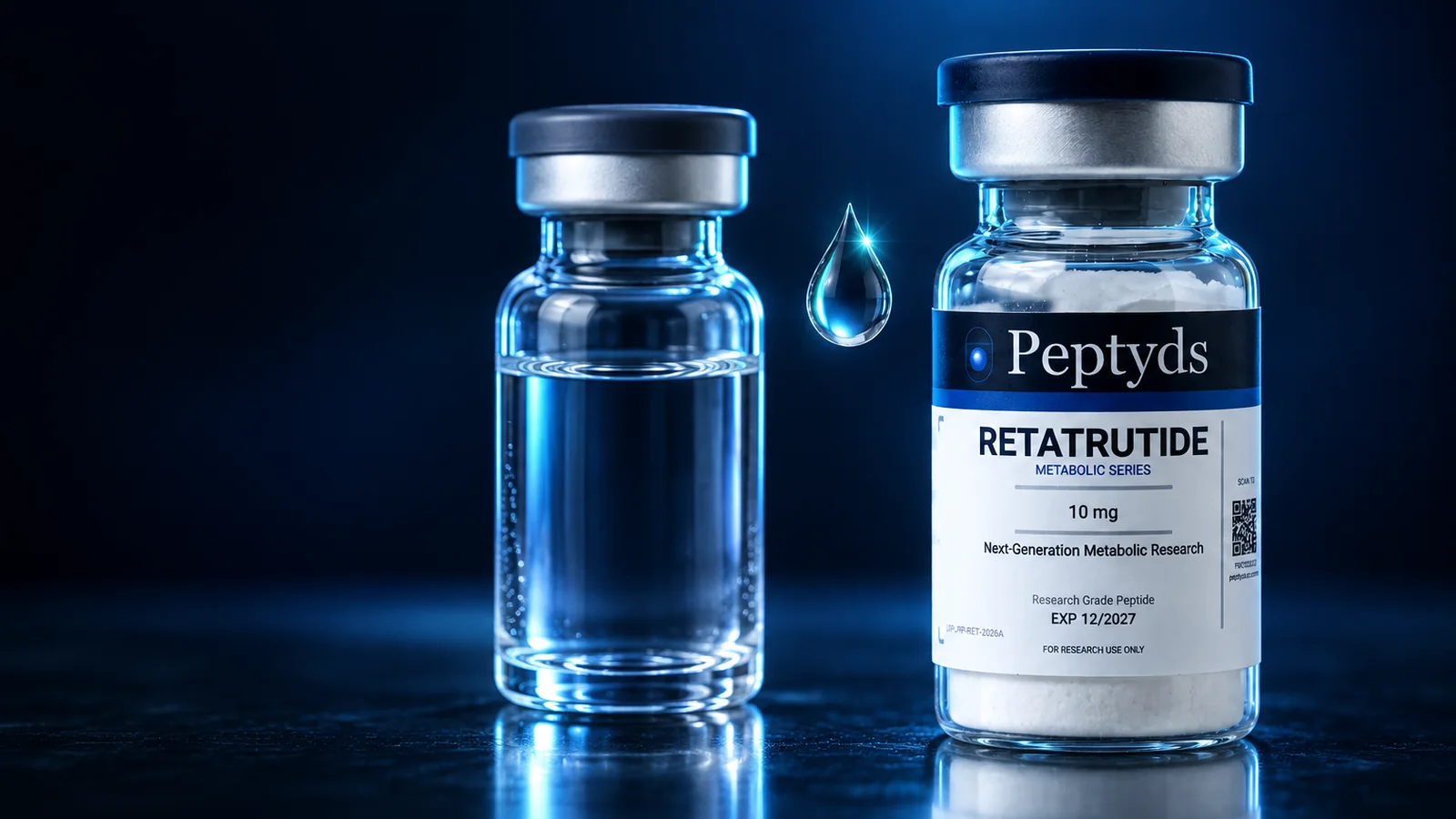
What is bacteriostatic water?
Bacteriostatic water — often shortened to 'BAC water' — is sterile water for injection that contains one or more antimicrobial agents added to suppress the growth of microbial contaminants. That is how the United States Pharmacopeia (USP) monograph for Bacteriostatic Water for Injection describes it, with a specified pH range of 4.5 to 7.0.[1]
The agent is usually benzyl alcohol. Formulation scientists describe 0.9% (w/v) benzyl alcohol in water as a 'bacteriostatic amount', and a 2023 review of licensed protein and peptide products found that among freeze-dried products supplied for dissolving in bacteriostatic water, benzyl alcohol was the most common preservative (12 products), followed by m-cresol (6). Concentrations are not identical everywhere: the review cites one supplied diluent containing 1.1% benzyl alcohol.[3][2]
Bacteriostatic water contains no buffer. It therefore has very low ionic strength and no buffering capacity — which makes its pH slow and noisy to measure reproducibly, and means it cannot be expected to hold a dissolved compound at any particular pH.[1]
Continue reading:Read the peptide reconstitution guide