

Research notes

Melanotan 2 (Melanotan II): Complete Research Guide and Documented Risks

Melanotan 2 (melanotan II, MT-II) is a synthetic cyclic heptapeptide analogue of α-melanocyte-stimulating hormone, designed at the University of Arizona in the late 1980s, that activates the MC1, MC3, MC4 and MC5 melanocortin receptors without selectivity. That breadth explains what its small 1990s human studies recorded: skin pigmentation alongside spontaneous erections, nausea, yawning and reduced appetite. It has never been authorised as a medicine — EMA lists no melanotan II product — and case reports after unregulated use describe changing and new moles, melanoma, priapism, rhabdomyolysis and kidney injury. Its regulated relatives are separate molecules: afamelanotide (EU-authorised for erythropoietic protoporphyria) and bremelanotide (FDA-approved for a form of low sexual desire).

11 min readUpdated 22 Sept 2026Reviewed by Independent EU laboratory (ISO/IEC 17025)
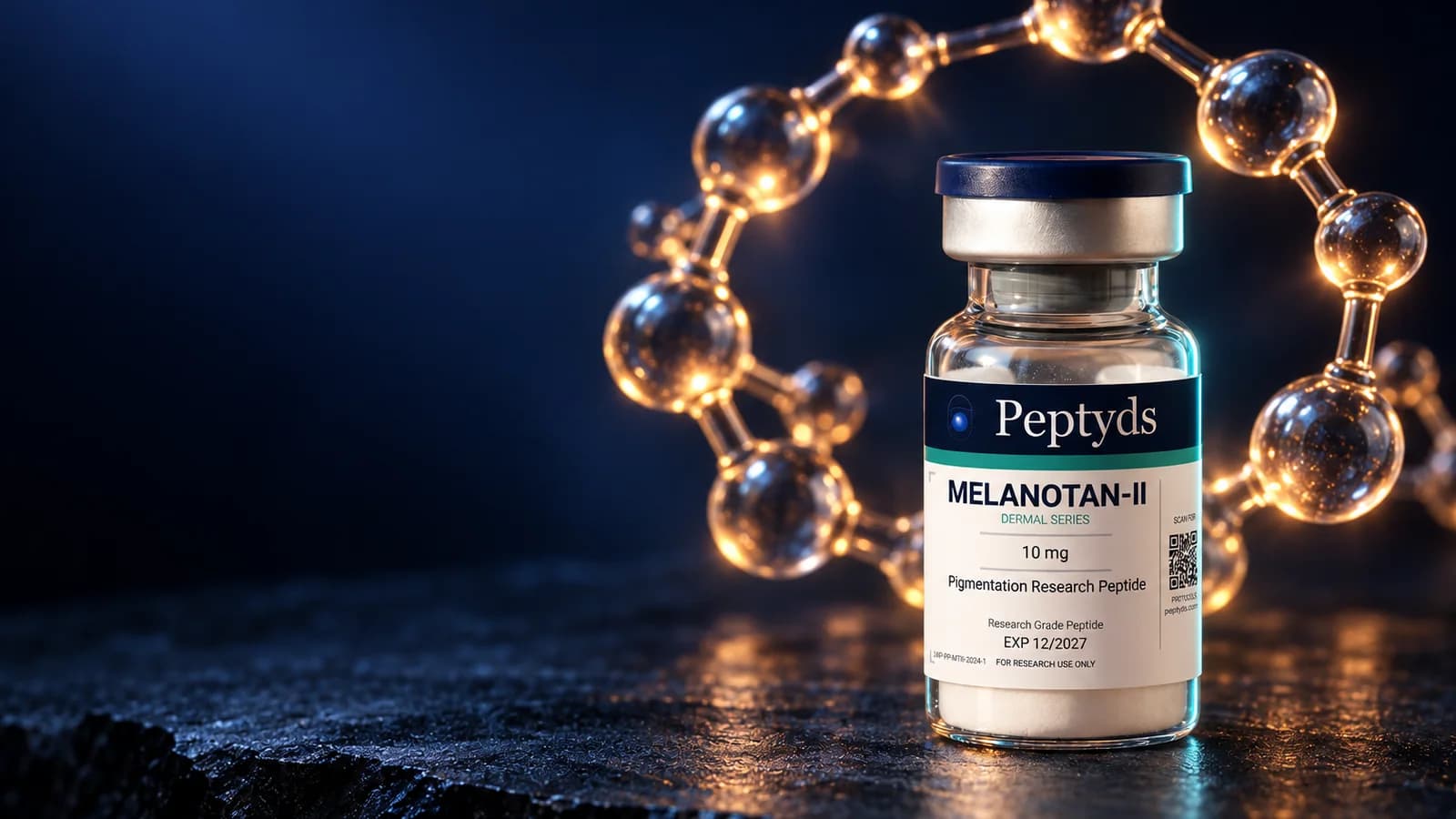
A sealed Peptyds melanotan II research vial framed by a glowing amber ring of glass molecular beads on a dark stone surface.
Jump to section
  1. 01What is melanotan 2 (melanotan II)?
  2. 02How does melanotan II work? The melanocortin receptors
  3. 03What did human studies of melanotan II find?
  4. 04Melanotan II vs afamelanotide and bremelanotide: what is the difference?
  5. 05Is melanotan II safe? Documented adverse effects
  6. 06Does melanotan II cause melanoma?
  7. 07Is melanotan II approved anywhere? Regulatory status
  8. 08How Peptyds supplies melanotan II for research
  • Melanotan II is Ac-Nle-cyclo[Asp-His-D-Phe-Arg-Trp-Lys]-NH2, a lactam-bridged α-MSH fragment about 90 times more potent than α-MSH in the original skin bioassay.
  • It activates MC1R, MC3R, MC4R and MC5R, so pigmentation, sexual, appetite and nausea effects arrive together rather than separately.
  • Its controlled human data are a three-man pilot study and small crossover trials in about 20 men with erectile dysfunction, all from the 1990s.
  • Case reports link unregulated use to eruptive and darkening moles, melanoma, priapism, rhabdomyolysis, renal infarction and PRES; causation is unproven but the pattern is consistent.
  • EMA lists no melanotan II product; afamelanotide (EU, 2014) and bremelanotide (US, 2019) are distinct regulated molecules.
  • Online vials analysed by LC-MS/MS held 43–88% of their labelled content plus unidentified impurities, so identity and purity must be verified per batch.

Discussed in this guide

  • Melanotan IIA melanocortin receptor agonist studied for its effects on melanogenesis, sexual function, and appetite regulation through MC1R–MC4R pathway activation.10 mg€3.90 / mgOut of stock

What is melanotan 2 (melanotan II)?

Melanotan 2 — also written melanotan II, MT-II or MT2 — is a synthetic analogue of α-melanocyte-stimulating hormone (α-MSH), the 13-amino-acid melanocortin peptide derived from the pro-opiomelanocortin (POMC) precursor. It was first described in 1989 by a University of Arizona team designing cyclic 'lactam' fragments of α-MSH. Its structure is Ac-Nle4-cyclo[Asp5-His6-D-Phe7-Arg8-Trp9-Lys10]-α-MSH(4-10)-NH2: seven amino acids, closed into a ring.[1][3][4]

Each design choice has a purpose. The molecule keeps only α-MSH's core residues 4–10, carries over the norleucine and D-phenylalanine substitutions of the earlier superpotent analogue [Nle4, D-Phe7]-α-MSH, and uses a lactam bridge between aspartic acid and lysine to form a 23-membered ring. In the original lizard-skin bioassay it was about 90 times as potent as α-MSH, with prolonged, residual activity — the superpotent, enzymatically resistant profile its developers were aiming for.[1][2]

The programme took two analogues into the clinic: the linear melanotan I for skin tanning, and the cyclic melanotan II, whose pilot study showed tanning but whose later trials targeted male erectile dysfunction. In laboratories, MT-II became a reference melanocortin agonist. Feeding studies pair it with SHU9119, an antagonist built on the same cyclic template in which D-phenylalanine at position 7 is replaced by the bulkier D-naphthylalanine — a single swap that turns the scaffold into an MC4 receptor antagonist.[2][10][8][9]

Continue reading:Melanotan II research vials and batch documentation

How does melanotan II work? The melanocortin receptors

The body has five melanocortin receptors. MC2R, the adrenal ACTH receptor, responds essentially only to ACTH; the other four — MC1R, MC3R, MC4R and MC5R — all recognise α-MSH and superpotent analogues such as melanotan II. MT-II is therefore a non-selective agonist, and the receptors it switches on serve very different systems, from pigmentation and energy balance to sexual function and exocrine gland secretion.[8][3][7]

MC1R sits on melanocytes, where activation increases melanin production — the basis of MT-II's tanning effect. MC3R and MC4R are mainly expressed in the brain. In mice, MT-II delivered into the brain suppressed feeding in four different models of overeating, an effect completely blocked by SHU9119. Genetic, pharmacological and receptor-mapping work in mice, rats and human tissue shows that MC4R also modulates erectile function through spinal and penile nerve pathways.[12][8][10][11]

The practical consequence is that MT-II cannot act on skin alone. The same molecule that darkens skin also reaches the receptors behind appetite, nausea and arousal — which is exactly the combination of effects the human studies recorded.[4][5][3]

What did human studies of melanotan II find?

The first human study, published in 1996, was a single-blind pilot phase I trial in three healthy men, alternating MT-II and saline days over two weeks at low, weight-based doses. Mild nausea occurred at most dose levels, and one volunteer had grade II sleepiness and fatigue at the top dose. A stretching-and-yawning complex tracked with spontaneous erections lasting one to five hours, and two of the three men had measurably increased pigmentation of the face, upper body and buttocks a week after the last administration.[4]

Two small placebo-controlled crossover trials in men with erectile dysfunction followed. In ten men with psychogenic ED, eight developed clinically apparent erections on MT-II, with a mean 38 minutes of more than 80% tip rigidity against 3 minutes on placebo. In ten men with organic risk factors, erections followed 12 of 19 MT-II administrations versus 1 of 21 on placebo and sexual desire rose — but 4 of the 19 caused severe nausea.[5][6][7]

Across the combined 20 men, nausea and yawning were the characteristic side effects. These studies — around two dozen men, each exposed for a single session or up to two weeks, with no women and no long-term follow-up — form the core of MT-II's controlled human data. Development then moved to its derivative PT-141 rather than to larger MT-II trials, and clinicians reviewing later misuse describe the drug as unlicensed and incompletely tested.[7][2][18]

Melanotan II vs afamelanotide and bremelanotide: what is the difference?

Melanotan I, now called afamelanotide, is the linear 13-amino-acid analogue [Nle4, D-Phe7]-α-MSH — the programme's regulated success. The EMA authorised it in December 2014, under exceptional circumstances, as an implant (Scenesse) to prevent or reduce light-induced symptoms in erythropoietic protoporphyria, a rare disease of light intolerance.[1][2][13]

Bremelanotide (PT-141) is MT-II's closest regulated relative: the same acetylated cyclic heptapeptide, but ending in a free carboxylic acid instead of an amide. The FDA approved it in 2019 (Vyleesi) for acquired, generalised hypoactive sexual desire disorder in premenopausal women. Its label documents the class effects under controlled conditions: nausea in 40% of patients, transient rises in blood pressure, and focal hyperpigmentation of the face, gums and breasts.[12][4][2]

The contrast is the point. Afamelanotide and bremelanotide went through controlled development and regulatory review for one indication each; melanotan II did not. Their safety data describe those molecules, not MT-II, and a dermatology review draws the same line between thoroughly tested afamelanotide and unregulated 'melanotans'.[13][12][17]

Continue reading:Melanotan I vs melanotan IIPT-141 vs melanotan IIGHK-Cu vs melanotan I compared

Is melanotan II safe? Documented adverse effects

Outside trials, melanotan II circulates as an unregulated product bought online, in tanning salons and in gyms, so most adverse-event evidence comes from case reports. The frequent effects mirror the trials: nausea, flushing, yawning, reduced appetite and spontaneous erections. UK regulators have also warned about blood-borne virus transmission through shared needles and about product impurity.[16][24][5]

The serious reports are rarer but specific. A 39-year-old man developed sympathomimetic toxicity and rhabdomyolysis after an overdose of internet-bought MT-II — identity confirmed by mass spectrometry — and spent three days in intensive care. A renal infarction was judged most likely attributable to MT-II. Ischaemic priapism has followed melanotan use, in one MT-II case needing surgical decompression and in another leaving erectile function unrecovered four weeks later. Posterior reversible encephalopathy syndrome (PRES) has also been reported.[23][24][25][26][27][15]

Pigment changes go beyond a tan. Reports describe eruptive new moles and darkening of existing ones within 24 hours of a single MT-II administration, transverse bands of pigment in the nails with melanotan use, and pigmentation of the gums and cheeks, with the gum changes still visible three months after one user stopped.[20][21][22]

Does melanotan II cause melanoma?

The honest answer is that nobody knows. A 2017 dermatology review counted four case reports of melanoma emerging from existing moles during or shortly after melanotan use, alongside a larger set of reports of changing and newly appearing, sometimes dysplastic, moles — and concluded that conclusive evidence linking the two is lacking.[17]

Individual cases show why the question is hard. A 20-year-old woman with fair, type II skin was diagnosed with melanoma three months after a three- to four-week course of MT-II self-injections combined with sunbed tanning; the peptide and the UV exposure cannot be separated. In a man with previous melanoma and dysplastic naevi, a self-administered α-MSH analogue produced crops of new atypical moles that faded after he stopped — evidence that these peptides can drive proliferation of susceptible melanocytes.[18][19]

The counter-hypothesis — that a melanin tan from these peptides might protect against melanoma — remains unproven. Dermatologists add a practical problem: rapidly darkening moles in unexpectedly tanned patients complicate the clinical assessment of pigmented lesions.[19][16]

Is melanotan II approved anywhere? Regulatory status

No. Melanotan II has never been authorised as a medicine. EMA's published medicines data, checked on 22 September 2026, contain no product with melanotan II — afamelanotide does appear, as Scenesse — and case reports from 2014 to 2026 consistently describe MT-II as unlicensed.[14][22][18]

In the United States, the FDA assessed melanotan II when it was nominated as a bulk substance for pharmacy compounding and placed it in category 2 — substances that may present significant safety risks — before the nomination was withdrawn. The agency's summary cites a potential immunogenicity risk from aggregation or peptide-related impurities, and published case reports of melanoma, PRES, sympathomimetic toxidrome and priapism.[15]

Its regulated relatives are separate molecules with single-indication approvals of their own: afamelanotide for erythropoietic protoporphyria in the EU (2014) and bremelanotide for hypoactive sexual desire disorder in premenopausal women in the US (2019).[13][12]

How Peptyds supplies melanotan II for research

Peptyds supplies melanotan II strictly for in-vitro laboratory research, where it serves as a potent reference agonist in melanocortin receptor and signalling assays. It is not sold as a tanning product, a sexual-function aid or an appetite suppressant, and nothing on this page is guidance for human use.[8][10]

The case literature doubles as a quality lesson. When researchers analysed melanotan II vials bought from three online shops using liquid chromatography with UV and tandem mass spectrometry, every vial held only 43–88% of the labelled amount, and vials from two of the shops carried 4.1–5.9% unidentified impurities.[28]

That is why every Peptyds batch is documented with a certificate of analysis, and why a high-risk compound like MT-II gets the same documentation standard as the rest of the catalogue. Identity and purity have to be demonstrated per batch, not assumed from a label.

Continue reading:Read the Peptyds quality protocol

Sources

  1. [01]
  2. [02]
  3. [03]
  4. [04]
  5. [05]
  6. [06]
  7. [07]
  8. [08]
  9. [09]
  10. [10]
  11. [11]
  12. [12]
  13. [13]
  14. [14]
  15. [15]
  16. [16]
  17. [17]
  18. [18]
  19. [19]
  20. [20]
  21. [21]
  22. [22]
  23. [23]
  24. [24]
  25. [25]
  26. [26]
  27. [27]
  28. [28]

Questions

What is melanotan 2 used for in research?

In laboratories, melanotan II serves as a potent, non-selective melanocortin receptor agonist — for example in receptor-pharmacology assays and in feeding studies, where it is often paired with the antagonist SHU9119. Outside research it circulates as an unlicensed 'tanning injection', a use that has never been authorised.[8][10][16][22]

Is melanotan 2 the same as melanotan 1?

No. Melanotan I (afamelanotide) is a linear 13-amino-acid α-MSH analogue that became an EU-authorised medicine (Scenesse, 2014) for erythropoietic protoporphyria. Melanotan II is a shorter, cyclic seven-amino-acid analogue that was tested for erectile dysfunction and never authorised.[2][1][13]

Is melanotan 2 approved in Europe?

No. EMA's medicines data list no product containing melanotan II, and case reports describe it as unlicensed. The related molecule afamelanotide is EU-authorised as Scenesse for erythropoietic protoporphyria only.[14][22][13]

Does melanotan 2 cause melanoma?

That has not been shown either way. A 2017 review counted four case reports of melanoma arising in existing moles during or soon after melanotan use but found conclusive evidence lacking. Better documented is that these analogues can darken existing moles and trigger new, sometimes atypical, ones.[17][18][19][20]

What is the difference between melanotan 2 and PT-141?

PT-141 (bremelanotide) is the same cyclic heptapeptide with a free acid instead of an amide at the C-terminus. It went through controlled trials and was FDA-approved in 2019 (Vyleesi) for a form of low sexual desire in premenopausal women; melanotan II never completed that path.[12][4][2]

Why does melanotan 2 cause nausea and spontaneous erections?

Because it is not selective. Beyond MC1R in the skin, it activates MC3R and MC4R, which are mainly neural and involved in appetite and sexual function. In the 1990s trials, nausea, yawning and spontaneous erections were the characteristic effects, and about 13% of subjects had severe nausea in one analysis.[8][11][10][7]

Educational content. Not medical advice.

Next step

Choose the route that matches how you read.