

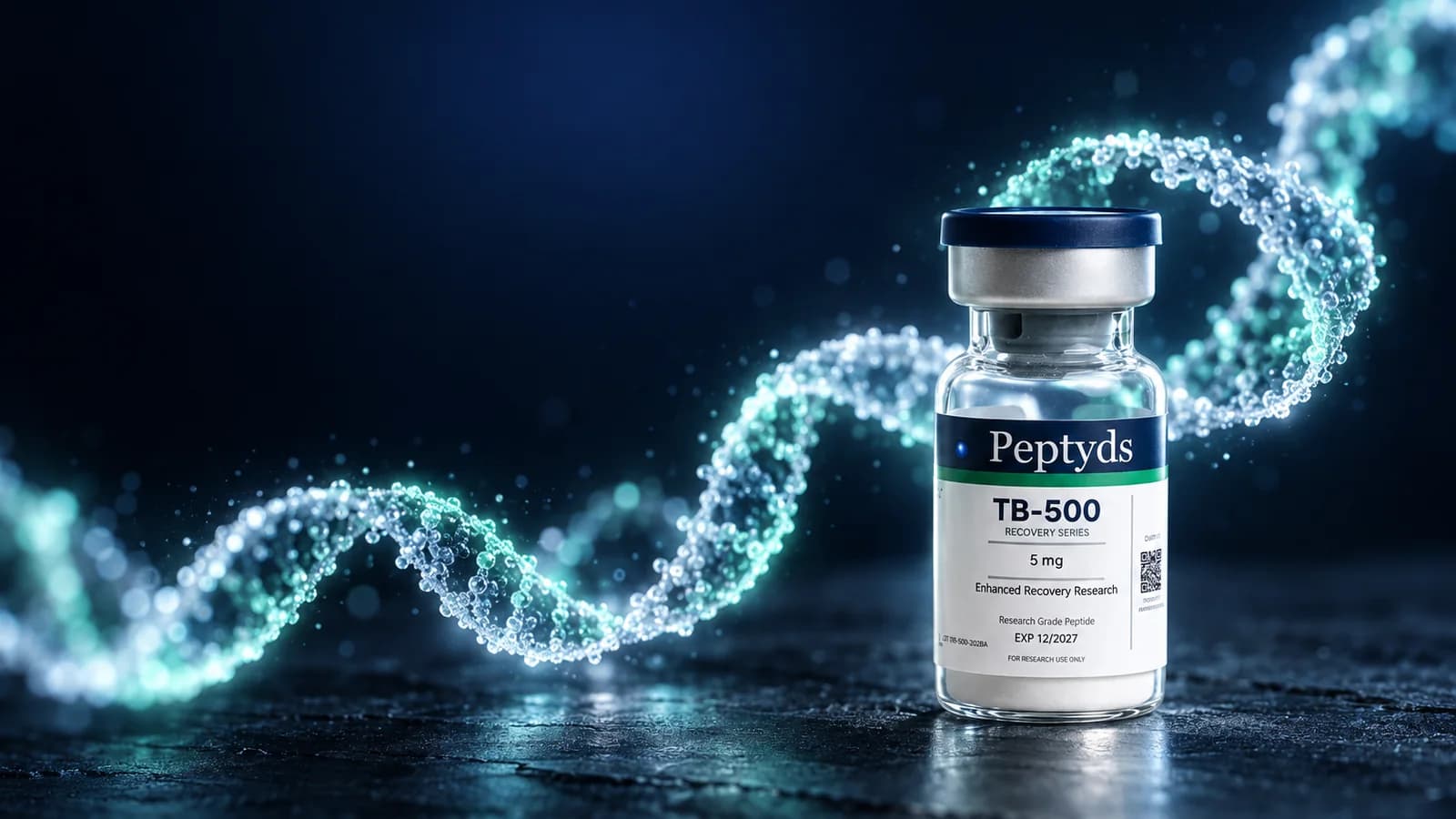
What is TB-500?
TB-500 is the name the research-peptide market uses for a synthetic peptide related to thymosin beta-4 (Tβ4). Tβ4 itself is a 43-amino-acid peptide whose N-terminus is blocked by an acetyl group; its full sequence was published in 1981 from calf thymus, where it was first studied as a possible thymic hormone. Today it is understood mainly as the most abundant beta-thymosin in mammalian tissue and the main peptide that holds unpolymerised actin inside cells.[1][2][3]
Which molecule 'TB-500' refers to is less settled than the label suggests. When a doping-control laboratory in Ghent analysed TB-500, a product it described as suspected of doping potential, it identified the N-terminally acetylated 17–23 fragment of human Tβ4, the seven-residue sequence Ac-LKKTETQ. A Hong Kong racing laboratory described the same acetylated LKKTETQ peptide as the key ingredient of a veterinary preparation called TB-500, and the FDA's compounding safety page lists 'thymosin beta-4, fragment (LKKTETQ), also known as TB-500'.[5][6][25]
The name is not used consistently, though. A 2026 rat tendon study describes its test compound as 'synthetic thymosin beta-4 (TB-500)', so the term is applied to both the seven-residue fragment and the 43-residue parent. Those are different molecules with very different masses, and research on one does not automatically transfer to the other.[11][1]
Continue reading:TB-500 research vials and batch documentation