

Quality

How to Reconstitute Peptides: BAC Water Math, Insulin-Syringe Units, Shelf Life

Reconstitution is the procedure of dissolving a sterile lyophilised (freeze-dried) peptide powder in bacteriostatic water to produce an injectable research solution. The core variables are: volume of bacteriostatic water (which sets the final concentration in mg/mL), insulin-syringe unit math (100 IU = 1 mL on a standard U-100 syringe), reconstitution technique (room-temperature equilibration, slow drip down the vial wall, gentle swirl rather than shake), and post-reconstitution storage (2-8 °C protected from light, with shelf life ranging from ~14 days for fragile peptides to ~28-30 days for stable ones — never freeze a reconstituted vial). Bacteriostatic water is sterile water with 0.9% benzyl alcohol as an antimicrobial preservative, suitable for multi-dose vials over the in-use period. Plain sterile water has no preservative and is for single-use only.

11 min readUpdated 14 May 2026Reviewed by Independent EU laboratory (ISO/IEC 17025)
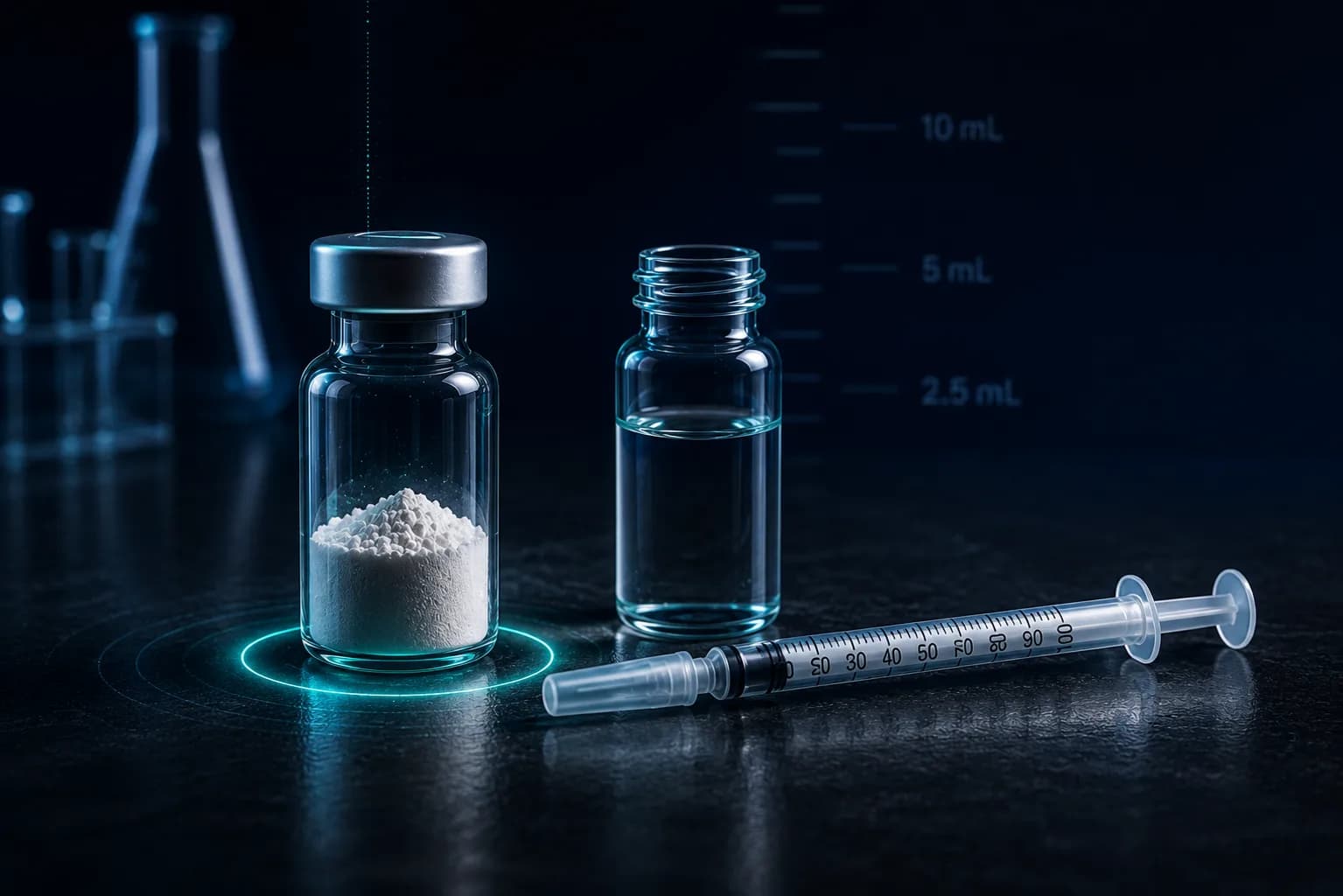
An editorial overhead view of a lyophilised peptide vial, a sealed bacteriostatic water bottle, and an insulin syringe arranged on a navy laboratory surface — illustrating a clean reconstitution protocol.
Jump to section
  1. 01What reconstitution actually is
  2. 02Equipment: what you need on the bench
  3. 03The math: mg ÷ mL = mg/mL final concentration
  4. 04Insulin-syringe units: reading the U-100 scale
  5. 05Technique: equilibrate, vent, drip, swirl
  6. 06Post-reconstitution storage and stability
  7. 07Common reconstitution mistakes and how to avoid them
  • Bacteriostatic water (sterile water with 0.9% benzyl alcohol) is for multi-dose vials; plain sterile water is single-use only.
  • Final concentration math: mg of peptide ÷ mL of bacteriostatic water = mg/mL. Pick volume to make your target dose convenient on an insulin syringe.
  • On a standard U-100 insulin syringe, 100 IU = 1 mL. So 10 IU = 0.1 mL = 100 µL — the scale is linear.
  • Technique: equilibrate cold vial to room temperature first, drip BAC water slowly down the inner glass wall, swirl gently, never shake — peptides are denaturation-sensitive.
  • Store reconstituted vial at 2-8 °C, protected from light, and never freeze — most peptides have a 14-28 day post-reconstitution shelf life depending on the compound.

What reconstitution actually is

Reconstitution is the technical term for dissolving a freeze-dried (lyophilised) peptide powder in a liquid solvent — typically bacteriostatic water — to produce a usable solution. Research peptides are shipped as lyophilised powder because the dry state is dramatically more stable than the wet state: most peptides degrade within hours to days in solution at room temperature, but remain stable for years as a properly stored dry powder.[3][7]

The peptide vial you receive contains a small amount of solid material — sometimes visible as a white pellet or fluffy cake at the bottom, sometimes a thin film that is barely visible. Both forms are normal. The vial is sealed under inert gas or vacuum to protect the peptide from oxidation and moisture during shipping and storage.[5][6]

Reconstitution is a one-way operation: once the peptide is in solution, the clock starts on stability. The goal of good technique is to preserve as much of the molecule as possible through that transition and through the subsequent in-use period.[3][7]

Equipment: what you need on the bench

A clean reconstitution requires: the lyophilised peptide vial, a sealed multi-dose vial of bacteriostatic water for injection, an alcohol pad or sterilising wipe, and a sterile single-use syringe (typically a 1 mL or 3 mL standard syringe with a 21-25 G needle for drawing bacteriostatic water, plus a U-100 insulin syringe for subsequent dosing). Bacteriostatic water is sterile water with 0.9% benzyl alcohol as an antimicrobial preservative — the FDA-labelled designation for multi-dose injectable use.[2][1]

Bacteriostatic water is the standard solvent for research-peptide reconstitution because the benzyl alcohol allows the same vial to be drawn from over an in-use period of weeks without microbial growth, whereas plain sterile water has no preservative and is intended for single-use reconstitution only. Sodium chloride 0.9% solution is occasionally used for compounds where benzyl alcohol compatibility is uncertain.[2][1]

The U-100 insulin syringe is the workhorse tool for dosing reconstituted peptides because its fine gradation (1 IU = 0.01 mL = 10 µL on a standard 100 IU/mL scale) allows accurate small-volume measurement that a 1 mL or 3 mL syringe cannot match. Needle gauge 29-31 G keeps subcutaneous injection comfortable.[4][1]

The math: mg ÷ mL = mg/mL final concentration

The single piece of arithmetic that drives reconstitution is: total mg of peptide in the vial ÷ total mL of bacteriostatic water added = final concentration in mg/mL. You get to choose the bacteriostatic-water volume; that choice sets the concentration; that concentration sets the syringe-volume needed for your target dose.[5][7]

Worked example for a 5 mg vial reconstituted to a 5 mg/mL solution: add 1.0 mL of bacteriostatic water. A 250 µg target dose then equals 0.05 mL = 5 IU on a U-100 insulin syringe. Worked example for a 5 mg vial reconstituted to a 2.5 mg/mL solution: add 2.0 mL of bacteriostatic water. A 250 µg target dose then equals 0.1 mL = 10 IU on a U-100 insulin syringe.[5][4]

Worked example for a 10 mg vial reconstituted to 5 mg/mL: add 2.0 mL of bacteriostatic water. A 500 µg target dose equals 0.1 mL = 10 IU. Worked example for a 10 mg vial reconstituted to 2 mg/mL: add 5.0 mL of bacteriostatic water — a research-friendly dilution for precise low-dose work, with the trade-off of higher in-use volume per injection.[5][7]

Insulin-syringe units: reading the U-100 scale

A standard U-100 insulin syringe is calibrated assuming 100 international units (IU) of insulin per 1 mL of solution — meaning the entire syringe reads 100 IU at full volume. For peptide reconstitution, that calibration becomes a pure volumetric scale: 100 IU = 1.0 mL; 50 IU = 0.5 mL; 10 IU = 0.1 mL; 1 IU = 0.01 mL = 10 µL.[4][1]

The IU number on the syringe has no biological meaning for peptide research — it is a volume marker borrowed from insulin convention. To convert: every mark on the syringe represents 10 µL of solution. To find the dose-in-IU for a given mass dose: (target mass in µg ÷ concentration in µg/mL) × 100 = IU on syringe.[4]

Practical tip: pre-calculate the IU mark for your target dose before you draw, and write it on the vial label with a fine marker. Calculating mid-procedure is where mistakes happen.[1]

Technique: equilibrate, vent, drip, swirl

Step one is temperature equilibration. A peptide vial stored at 2-8 °C should be brought to room temperature before reconstitution — typically 15-30 minutes on a clean bench, out of direct light. Cold-shocking lyophilised peptide with room-temperature bacteriostatic water can produce localised foaming and incomplete dissolution; warm-shocking room-temperature peptide with refrigerated water has the same problem in reverse.[6][7]

Step two is the vent. After wiping both vial septa with an alcohol pad, draw the calculated volume of bacteriostatic water into the syringe. Some practitioners insert a small-gauge vent needle through the peptide vial septum to allow displaced air to escape during the injection — this prevents pressure build-up that can drive the BAC water back out around the syringe seal.[1]

Step three is the slow drip. Tilt the peptide vial at a slight angle and direct the syringe needle so the bacteriostatic water flows slowly down the inner glass wall of the vial, not directly onto the dry peptide cake. The goal is to bathe the peptide gradually rather than blast a jet onto it — the gradual approach minimises foaming and protects fragile peptide chains from shear stress.[6][3]

Step four is the swirl. Cap the vial, rotate it gently between thumb and forefinger, or invert it slowly several times. Do not shake. Most peptides will dissolve within 30-60 seconds; some larger or more hydrophobic peptides take 2-3 minutes. The fully reconstituted solution should be optically clear with no visible particulates. Cloudiness or visible precipitate after a full wait time usually indicates either a peptide solubility issue (try a different solvent) or a degraded starting material.[6][7]

Post-reconstitution storage and stability

Once reconstituted, a peptide vial should be stored at 2-8 °C in the household refrigerator — protected from light, ideally in the original carton or a small opaque container, and well away from the freezer compartment to avoid accidental freezing. Most reconstituted research peptides are stable for 14-30 days under these conditions, with the exact window depending on the peptide.[7][5][3]

Approximate stability windows for orientation: BPC-157 and TB-500 — typically 28-30 days reconstituted at 2-8 °C; GHRH analogues (sermorelin, CJC-1295 no-DAC, tesamorelin) — typically 14-21 days; ipamorelin and other GHRPs — typically 21-28 days; semaglutide and tirzepatide — generally 21-28 days. These are research-context ranges, not regulatory shelf lives; treat them as caution windows rather than guarantees.[7][3]

Reconstituted peptide solutions should not be frozen. Freezing introduces ice-crystal damage to the peptide backbone, and subsequent thawing produces aggregation and loss of biological activity. If long-term storage of unused reconstituted material is needed, the only reliable option is to discard the unused volume and reconstitute a fresh aliquot from a new dry vial.[5][3]

Common reconstitution mistakes and how to avoid them

Mistake one: shaking the vial. Vigorous shaking introduces shear stress and foam, both of which denature peptides. The fix is to swirl gently or invert slowly — patience produces the cleaner solution.[6][3]

Mistake two: using plain sterile water for a multi-dose vial. Plain sterile water has no preservative; without benzyl alcohol the in-use shelf life drops to single-use only because microbial growth becomes a real risk. Bacteriostatic water is the correct choice for any vial that will be drawn from more than once.[2][1]

Mistake three: reconstituting in too small a volume. A 5 mg vial reconstituted in 0.5 mL produces a 10 mg/mL solution where small dosing errors translate to large mass differences — a 1 IU misread (0.01 mL) equals 100 µg of peptide. Choose a volume that puts your target dose at 5-20 IU on the syringe scale for readability.[4][7]

Mistake four: freezing the reconstituted solution. Even one freeze-thaw cycle damages peptide integrity. The refrigerator door, where temperature swings are largest, is also a bad storage location — use a middle shelf away from the freezer.[5][3]

Mistake five: skipping the room-temperature equilibration. Reconstituting a cold vial with cold water often produces incomplete dissolution and visible cloudiness that takes longer to clear; reconstituting a room-temperature vial with room-temperature water produces a clean solution faster and with less foam.[6]

Continue reading:Read storage mistakes guideRead lyophilised storage guideRead quality protocolShop all peptides

Sources

  1. [01]
  2. [02]
  3. [03]
  4. [04]
  5. [05]
  6. [06]
  7. [07]
  8. [08]

Questions

Sterile water vs bacteriostatic water — which one?

For multi-dose research peptide vials that will be drawn from more than once, use bacteriostatic water (sterile water with 0.9% benzyl alcohol as a preservative). For single-use reconstitution where the entire vial will be consumed in one session, plain sterile water can be used. Bacteriostatic water is the operational default for almost all research-peptide workflows because the in-use period typically spans days to weeks.[2][1]

Can I shake the vial to dissolve the peptide faster?

No. Shaking introduces shear stress and foam, both of which mechanically denature peptide chains and reduce yield of biologically active material. The correct technique is gentle swirling or slow inversion — even peptides that take 2-3 minutes to dissolve will give a cleaner solution than a shaken vial that dissolves in 10 seconds.[6][3]

How long does reconstituted peptide stay good?

Most reconstituted research peptides are stable for 14-30 days when stored at 2-8 °C protected from light, with the exact window varying by compound. BPC-157 and TB-500 tend toward the longer end (~28-30 days); GHRH analogues such as sermorelin and tesamorelin are typically on the shorter end (~14-21 days). Never freeze reconstituted peptides and never store at room temperature.[3][7][5]

Why room-temperature equilibration before mixing?

Reconstituting cold lyophilised peptide with cold bacteriostatic water produces incomplete dissolution and visible cloudiness, and reconstituting room-temperature peptide with cold water (or vice versa) introduces thermal-shock that can locally damage peptide structure. A 15-30 minute equilibration on the bench produces a faster, cleaner, more complete reconstitution.[6][7]

How do I read insulin-syringe units for a peptide dose?

On a standard U-100 insulin syringe, 100 IU = 1 mL. So 10 IU = 0.1 mL = 100 µL, and 1 IU = 0.01 mL = 10 µL — the scale is linear. To find your dose-in-IU: (target mass in µg ÷ peptide concentration in µg/mL) × 100 = IU on the syringe. The IU number is a volume marker borrowed from insulin convention and has no biological meaning for the peptide itself.[4][1]

Educational content. Not medical advice.

Next step

Choose the route that matches how you read.