

Quality

Pharma-Grade Peptides vs Research-Grade: What the Labels Mean

Pharma-grade peptides are made under good manufacturing practice (GMP) to a pharmacopoeial or authorised specification and released as a medicine or active substance; research-grade peptides are sold for laboratory use, and their quality is only as well established as their batch documentation. The difference is not simply a higher purity number. A 99% HPLC purity result measures peptide-related impurities, while a pharmaceutical specification also controls peptide content, counter-ions such as trifluoroacetate, water, endotoxins and microbial quality. Whatever the label, check the batch certificate: batch match, named method, mass-spectrometry identity and chromatogram.

9 min readUpdated 22 Sept 2026Reviewed by Independent EU laboratory (ISO/IEC 17025)
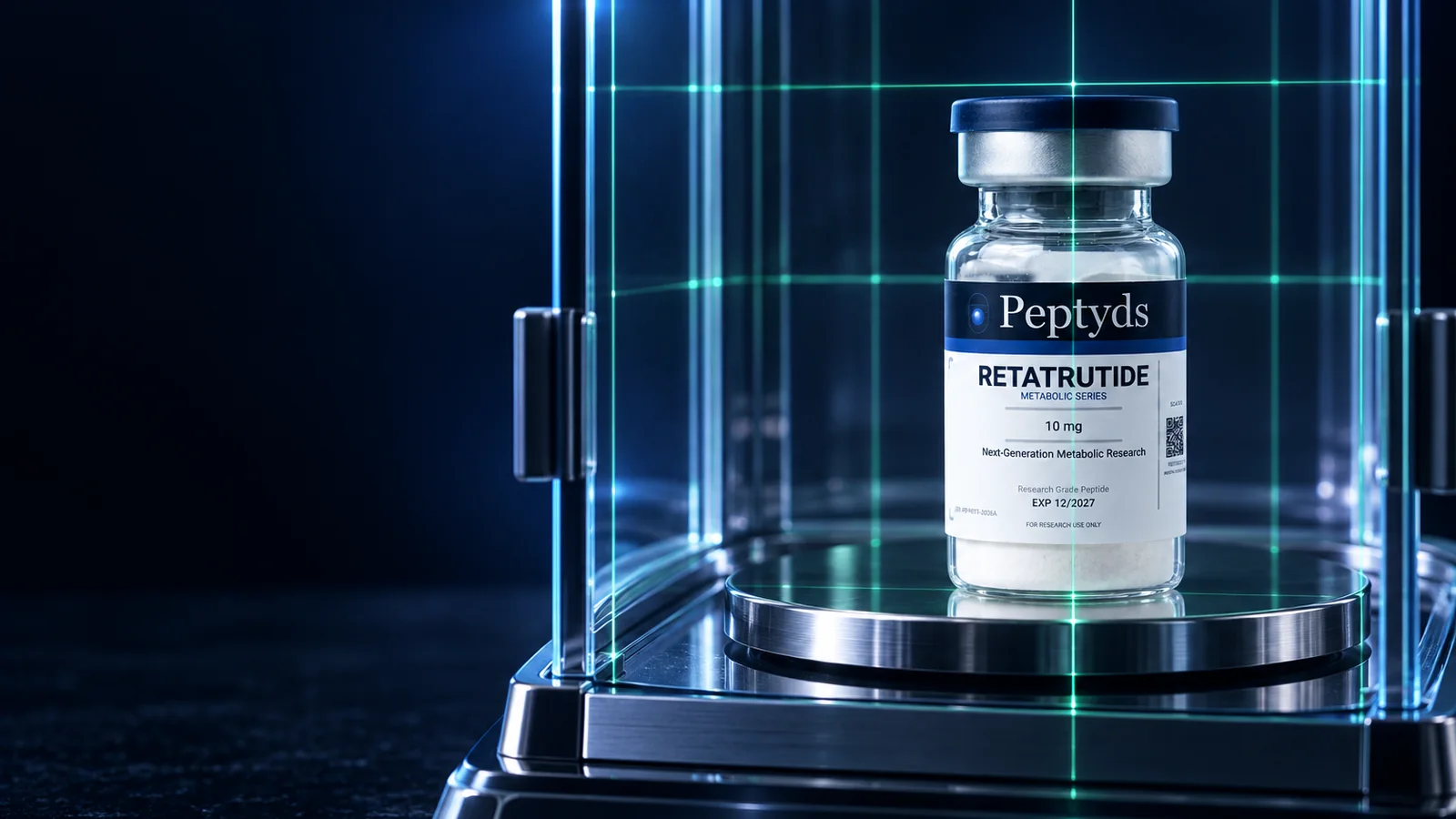
A sealed Peptyds research vial on the weighing pan of an analytical balance, inside its glass draught shield, lit by a mint grid.
Jump to section
  1. 01What does 'pharma grade' mean for peptides?
  2. 02What does 'research grade' mean?
  3. 03What does 99% purity actually mean?
  4. 04What is in the other 1% of a 99% pure peptide?
  5. 05Is pharma grade just a higher purity number?
  6. 06What do 'certified' and 'verified' peptides mean?
  7. 07What documentation should a research-grade peptide come with?
  • 'Pharma grade' means made under GMP to a pharmacopoeial or authorised specification — a system of documents, not a label.
  • 'Research grade' describes intended use; what a research vial contains is only as well established as its batch documentation.
  • A 99% HPLC purity result measures peptide-related impurities, not peptide content, counter-ions, water or endotoxin.
  • Pharmaceutical specifications for synthetic peptides report individual impurities from 0.1% and test content, counter-ion, water and endotoxin separately.
  • Whatever the grade, check the batch match, the named method, mass-spectrometry identity and the chromatogram.

What does 'pharma grade' mean for peptides?

In medicines regulation, pharma-grade quality is a system rather than a word on a label. Good manufacturing practice (GMP) is the minimum standard a medicines manufacturer must meet, and it requires medicines to be of consistent high quality, appropriate for their intended use and in line with their marketing or clinical-trial authorisation. Manufacturers of active substances must comply with GMP as well.[2]

The quality yardstick is a pharmacopoeia. USP monographs set out a medicine's expected identity, strength, purity and performance, together with the tests that demonstrate them. The European Pharmacopoeia provides the legal and scientific basis for quality control of medicines in its signatory states, and producers of medicines and substances for pharmaceutical use must apply its standards to market their products there.[3][4]

Synthetic peptides get dedicated attention because they sit at the interface of small molecules and proteins. The EMA's guideline on the development and manufacture of synthetic peptides, legally effective since 1 June 2026, sets out what a peptide medicine's dossier must control. In the United States, the FDA published 17 revised draft product-specific guidances for peptide products in July 2026, with impurity thresholds among the topics.[1][10]

What does 'research grade' mean?

'Research grade' describes intended use rather than a pharmacopoeial standard: the pharmacopoeias write their standards for medicines and substances for pharmaceutical use. What a research-grade vial contains is therefore exactly as well established as the documentation for that batch — no more and no less.[4]

The two terms are not interchangeable. After buying semaglutide vials labelled 'research use only' from online sellers, the authors of a 2024 test-purchase study concluded that research-grade 99% purity and pharmaceutical-grade product quality are distinctly different, and that buyers are likely to be misled by purity statements.[9]

Continue reading:Buying peptides online in Europe

What does 99% purity actually mean?

On most certificates, '99%' is chromatographic purity: the target peptide's share of the peak area detected by HPLC under a stated method. It measures peptide-related impurities. Pharmacopoeial practice treats that as one attribute among several — USP's work on peptide reference standards lists chromatographic purity separately from strength (how much peptide is present), acetic acid and trifluoroacetic acid content, residual solvents, inorganic residue and water.[8]

A lyophilised peptide is rarely just peptide. Synthetic peptides are cleaved from the resin and purified with trifluoroacetic acid, so cationic peptides are obtained as trifluoroacetate salts unless the counter-ion is exchanged, often for acetate. Peptides are also frequently very hygroscopic. That is why a pharmaceutical specification controls assay or content, counter-ion and water content as separate lines.[6][1]

A 2024 test-purchase study shows the gap in practice. Three semaglutide vials sold online as 'research use only' came with claims of at least 99% purity, and their chromatograms showed a single semaglutide peak — yet semaglutide made up only 7.7–14.4% of the powder, the amount per vial exceeded the label by 29–39%, and bacterial endotoxin was found in every vial. Three vials are a small sample, but the lesson is general: one clean peak is not a quality profile.[9]

Continue reading:What HPLC purity means for peptidesStoring lyophilised peptides

What is in the other 1% of a 99% pure peptide?

Most peptides are made by solid-phase peptide synthesis, and the process leaves characteristic by-products: deletion sequences missing one or more amino acids after incomplete coupling or deprotection, truncated sequences, insertion sequences where an amino acid was coupled twice, diastereomers from racemisation, side-chain protection adducts, oxidised forms and aggregates. Some are close enough to the target to co-elute with it, which is why regulators may require more than one independent analytical method.[1][5]

Medicines regulation tracks this fraction peak by peak. For synthetic peptides, methods must meet the European Pharmacopoeia reporting threshold of 0.1%; the identification threshold is 0.5%; and above the 1.0% qualification threshold a safety justification for the impurity is expected. A single total-purity figure on a certificate says nothing about how the remaining percentage is distributed.[1]

For in-vitro work this is not academic. A review of impurities in peptide medicines warns that they can strongly influence early functional studies and lead to erroneous conclusions. In one cell-culture study, trifluoroacetate at 10⁻⁸ to 10⁻⁷ M reduced osteoblast proliferation, and the trifluoroacetate salts of amylin, amylin-(1-8) and calcitonin gave less proliferation than their hydrochloride salts — enough to miss a proliferative effect or wrongly report an anti-proliferative one.[5][7]

Is pharma grade just a higher purity number?

No. The EMA guideline lists what a synthetic peptide active substance specification may include: appearance, identification, total and individual impurities, high-molecular-weight impurities such as aggregates, assay or content, counter-ion identity and content, residual trifluoroacetate, water, residual solvents, elemental impurities, bacterial endotoxins and microbiological purity.[1]

HPLC purity answers only part of that list. It cannot detect bacterial endotoxin — the contaminant the 2024 test-purchase study found in all three vials despite their clean chromatograms. The real difference between the grades is less about the size of the purity figure than about how many of these questions have been answered for the batch in front of you.[1][9]

What do 'certified' and 'verified' peptides mean?

'Certified' can refer to very different documents. A GMP certificate is issued by an EU competent authority to a manufacturing site after an inspection, and it is recorded in EudraGMDP, a public EU database that also lists manufacturing authorisations and non-compliance statements. A certificate of analysis is a test report for one batch: it describes a lot, not a factory.[2]

'Verified' or 'third-party tested' is only as strong as the report behind it. Pharmaceutical laboratories anchor identity, purity and strength results to well-characterised reference standards. For a research certificate, the practical checks are whether the batch code matches the vial, whether the laboratory and method are named, whether identity was confirmed by mass spectrometry and whether the chromatogram is shown.[8]

Continue reading:How to read a peptide certificate of analysis

What documentation should a research-grade peptide come with?

At minimum: a batch-specific certificate that names the laboratory, the method and the test date; identity confirmed by mass spectrometry; purity by HPLC with the chromatogram; and storage guidance for the specific product. Where the counter-ion matters for an experiment — trifluoroacetate in cell-based work, for example — it is worth asking whether it was measured.[6][7]

Peptyds publishes a batch certificate for every release covering identity, lab-verified purity and composition, with the named methods and per-batch results linked on the product page and a batch code on the vial that matches the report. Identity is checked against the expected mass by mass spectrometry, and purity is reported by HPLC as the percentage of the target peak. Orders are packed with thermal packs and a temperature logger.

Our quality page states the limits just as plainly: an HPLC result does not measure water content, residual salts or non-UV-absorbing impurities, and a batch certificate does not, on its own, prove safety or fitness for any specific person. Peptyds peptides are research materials, not medicines authorised by the EMA or any national authority, and we do not describe them as pharmaceutical grade.

Continue reading:Read the Peptyds quality protocol

Sources

  1. [01]
  2. [02]
  3. [03]
  4. [04]
  5. [05]
  6. [06]
  7. [07]
  8. [08]
  9. [09]
  10. [10]

Questions

Are research-grade peptides lower quality than pharma-grade peptides?

Not necessarily in their purity figure — a research-grade batch can show high HPLC purity. The difference is the framework: pharmaceutical material is made under GMP to a specification that also covers content, counter-ions, water, endotoxins and microbial quality. For research material, only the batch documentation shows what was actually tested.[2][1]

What does 99% purity mean on a peptide certificate?

Usually that the target peptide accounts for 99% of the peak area detected by HPLC under the stated method. It describes peptide-related impurities, not the full contents of the vial: counter-ions, water and non-peptide contaminants are measured separately, if at all.[8][6]

Is pharma grade the same as GMP?

Not quite. GMP is the manufacturing standard; the quality yardstick is a specification, usually built on a monograph from the European Pharmacopoeia or the USP. Pharmaceutical material meets both, and a medicine also needs its marketing authorisation.[2][4][3]

Why do peptide certificates mention TFA or acetate?

Because synthetic peptides are usually isolated as salts. Trifluoroacetic acid is used for cleavage and purification, so many peptides are obtained as trifluoroacetate salts, while most peptide medicines are acetate salts. Trifluoroacetate can interfere with cell-based experiments, so its level matters for in-vitro work.[6][7]

What is the difference between a GMP certificate and a certificate of analysis?

A GMP certificate is issued by a competent authority to a manufacturing site after inspection and is listed in the EudraGMDP database. A certificate of analysis reports test results for one batch. One describes how a site operates; the other describes what one lot contained.[2]

Does high purity mean a peptide vial is free of endotoxin?

No. HPLC purity does not detect bacterial endotoxin, which pharmaceutical specifications test separately. In a 2024 test-purchase study, all three 'research use only' semaglutide vials contained endotoxin even though their chromatograms showed a single peak.[1][9]

Educational content. Not medical advice.

Next step

Choose the route that matches how you read.