

Quality

Grey Market Peptides: How to Tell a Real Supplier From a Risky One

Grey market peptides are peptide products sold outside regulated medicine supply chains, often online and labelled for research. The label says nothing about quality: published test purchases have found vials with 7.7–14.4% purity against a claimed 99%, content up to 39% above the label, endotoxin, and arsenic or lead. A supplier is verifiable when every batch has a lot-matched certificate with mass-spectrometry identity, an HPLC chromatogram and method, content data, a named laboratory, and documented temperature-controlled handling.

9 min readUpdated 22 Sept 2026Reviewed by Independent EU laboratory (ISO/IEC 17025)
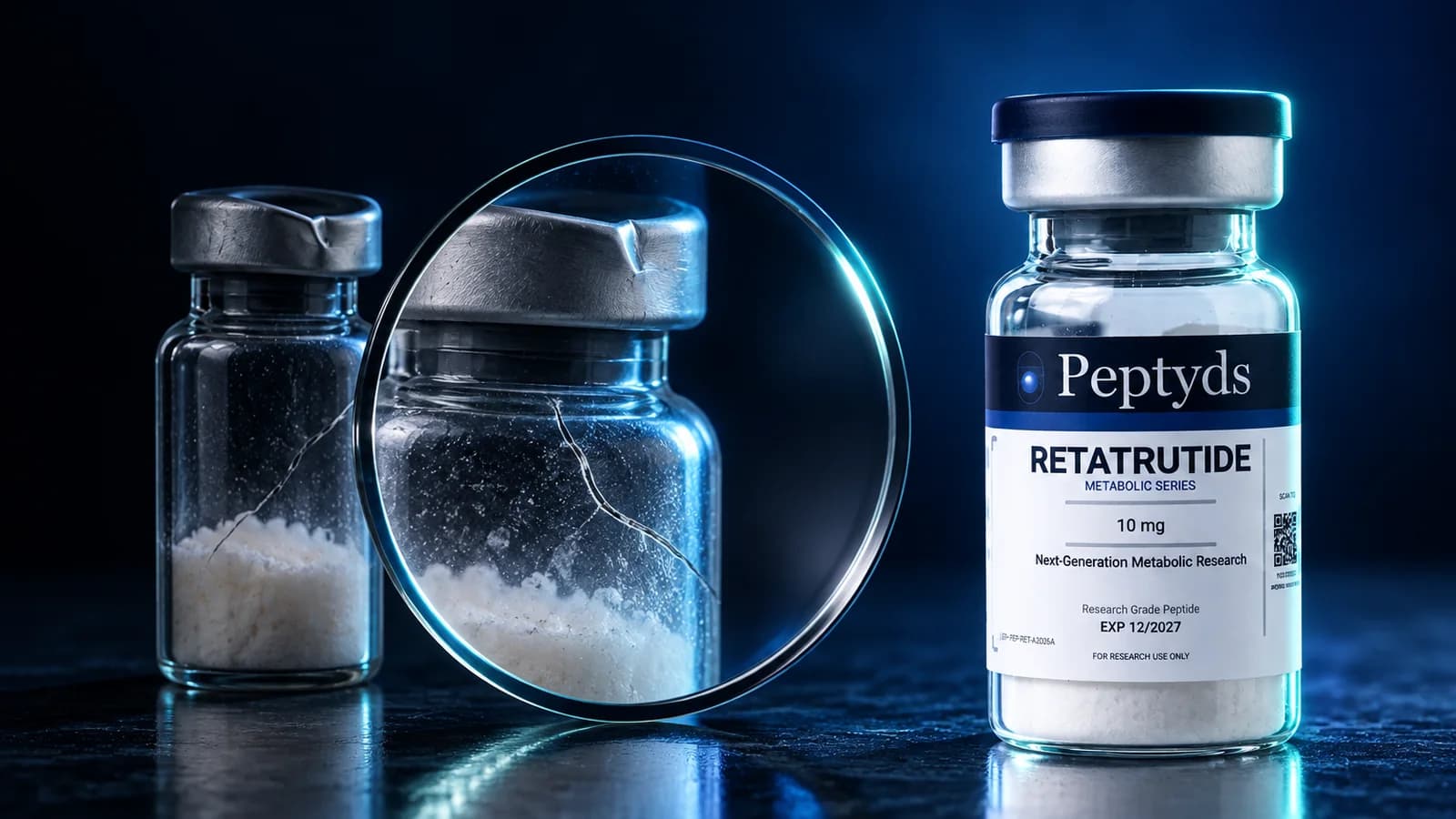
A cracked, unlabelled vial magnified through a glass lens beside an intact, sealed Peptyds retatrutide research vial on a dark bench.
Jump to section
  1. 01What are grey market peptides?
  2. 02What have tests found inside unverified peptide products?
  3. 03How do you tell a real peptide supplier? Five checks on the certificate
  4. 04What should you check beyond the certificate?
  5. 05What are the red flags of a fake or unverifiable supplier?
  6. 06How does Peptyds answer this checklist?
  • 'Grey market peptides' describes a sales channel outside regulated medicine supply chains, not a quality grade.
  • A 2024 test-purchase study found 7.7–14.4% purity against a claimed 99%, content 29–39% above the label, and endotoxin in every delivered semaglutide vial.
  • A Belgian screen of ten falsified peptide products found wide variation per unit, purities as low as 5% for some peptides, and arsenic or lead.
  • Check identity by mass spectrometry, purity by chromatogram, content per vial and contaminants by dedicated tests — all on a lot-matched certificate.
  • Documented temperature-controlled handling and an identifiable seller complete the check; missing documentation is itself an answer.

What are grey market peptides?

'Grey market peptides' is the informal name for peptide products sold outside regulated medicine supply chains — typically online, as freeze-dried powders labelled for research. A 2026 review in Sports Medicine describes a parallel 'gray market' of unapproved peptides operating largely outside regulatory oversight, and notes that rigorous human safety data for many of them are scarce.[1][5][8]

The term describes a sales channel, not a quality grade. It covers sellers that publish batch-level analytical data and sellers that publish nothing, so the useful question is never 'grey market or not?' but 'can this batch be verified?'. Published test purchases and seizure analyses show what the answer looks like when it cannot.[2][4]

The evidence has limits. The studies below are small — three delivered vials in one, ten products in another — and concentrate on products bought online or seized, so they document failure modes rather than how common each failure is across all suppliers.[2][4][7]

Continue reading:Read the EU peptide buying checklist

What have tests found inside unverified peptide products?

The clearest recent example is a 2024 test-purchase study of semaglutide sold online without a prescription. Of six orders, the three prefilled pens never arrived. The three freeze-dried vials that did arrive all contained semaglutide, but at a measured purity of 7.7–14.4% against the 99% printed on their labels, and with 29–39% more semaglutide than labelled. None contained viable microorganisms, yet endotoxin was detected in all three.[2][3]

A Belgian public-health laboratory screened the ten falsified peptide products most often encountered on the Belgian market, bought from three websites. It found high variation in the amount of peptide per unit, purities of only 5–75% for the cysteine-containing peptides, and toxic elemental impurities: one sample contained lead, and several carried arsenic at up to ten times the ICH limit for parenteral products.[4]

Identity can be wrong in subtler ways. Anti-doping analysts examining black-market 'growth-promoting' products found versions of GHRP-6, GHRP-2 and ipamorelin each extended by one extra glycine residue, and a growth hormone carrying an extra alanine — structures resolved by high-resolution mass spectrometry. Across 337 black-market products analysed in Cologne between 2010 and 2013, 12.8% contained peptide hormones or growth factors, including thymosin β4 and a fusion protein of unknown biological activity.[6][7]

How do you tell a real peptide supplier? Five checks on the certificate

1. A certificate that matches the vial. The lot number on the certificate should match the lot on the label, with a test date and the laboratory named. Because the amount of peptide varied widely between units in the Belgian screen, a certificate for one batch says nothing about another.[4]

2. Identity by mass spectrometry. A purity percentage cannot show that the main peak is the right molecule; mass spectrometry compares the measured mass with the expected one. Official control laboratories pair the two — mass spectrometry for identity, UV detection for quantity — and the glycine-extended analogues above show why identity cannot be assumed from a name.[5][6]

3. A chromatogram, not a bare percentage. The semaglutide vials were labelled 99% pure and measured at 7.7–14.4%. Synthetic peptides carry characteristic related impurities — deletion and insertion sequences, diastereomers, oxidation products, dimers and counter-ion residues such as trifluoroacetate — and a chromatogram shows the peaks behind a purity figure instead of asking for trust in a number. For research use this matters: related impurities can distort early functional studies and lead to erroneous conclusions.[2][9]

4. Content, not only purity. Purity is the share of the main peak; content is how much peptide the vial actually holds. The two can diverge: the same semaglutide vials were both impure and overfilled, and the Belgian products varied widely in amount per unit.[2][4]

5. Contaminants that a purity figure does not cover. The endotoxin in the semaglutide vials and the arsenic and lead in the Belgian products were each found with dedicated tests, separate from the chromatography behind a purity number. A certificate that is silent on endotoxin or elemental impurities tells you nothing about them either way.[2][4]

Continue reading:Read how to read a certificate of analysisRead what an HPLC purity figure measures

What should you check beyond the certificate?

6. A named laboratory and a validated method. Analytical procedures are expected to be validated for their purpose — ICH Q2(R2) sets out the general framework — and official control laboratories, such as the Belgian one behind several studies cited here, validate their peptide methods to ISO/IEC 17025 requirements. After Selank and Semax turned up in seized preparations, that laboratory built an LC-MS/MS screen for ten peptides sold online, following the European OMCL network's recommendation for identifying unknown peptides by mass spectrometry.[10][8][5]

7. Handling that is documented, not implied. A certificate describes the sample on the day it was tested; storage and transit afterwards are a separate question. EU Good Distribution Practice guidelines, written for medicines, are a useful benchmark: they expect qualified thermal packaging for temperature-sensitive products, the ability to demonstrate that products were not exposed to conditions that compromise their quality, and a procedure for investigating temperature excursions.[11][12]

8. A seller who can be identified and asked. A named company, a working contact channel before checkout, and published shipping and returns policies make the other seven checks possible — documents are only useful when someone stands behind them.

Continue reading:Read the cold-chain shipping guide

What are the red flags of a fake or unverifiable supplier?

The same headline purity on every product, with no chromatogram behind it. In the semaglutide study, 99% on the label corresponded to 7.7–14.4% in the laboratory.[2]

Requests for extra payments after ordering. The three sellers that never delivered in the semaglutide study asked for additional payments of US$650–1,200 to 'clear customs'; customs agencies confirmed these were fraudulent.[3]

Packaging and labelling that fall short of basic standards. The delivered semaglutide vials failed 59–63% of the criteria in a structured visual inspection.[2]

Promises of proven personal outcomes. For many unapproved peptides the favourable findings come from animal models while rigorous human safety data are scarce, so a page that promises outcomes is claiming more than the literature supports.[1]

How does Peptyds answer this checklist?

The same questions apply to us. Peptyds publishes a batch certificate per release covering identity, lab-verified purity and a composition test, linked on the product page with named methods and per-batch results. Identity is checked by mass spectrometry against the expected mass, and batch documents are reviewed for identity, purity and method clarity before a product is published.

Our quality page also states the limits of those documents: an HPLC purity figure does not measure water content, residual salts or non-UV-absorbing impurities, and a batch certificate does not, on its own, prove safety or fitness for any specific person. Products enter the catalogue only when the molecule, format and supplier documentation can be reviewed.

Orders are kept cold in transit with thermal packs and a temperature logger, tracked end to end and shipped from EU operations, and questions can be asked on WhatsApp before checkout. Peptyds supplies these materials for laboratory research only; they are not sold for human or veterinary use.

Continue reading:Read the Peptyds quality protocol

Sources

  1. [01]
  2. [02]
  3. [03]
  4. [04]
  5. [05]
  6. [06]
  7. [07]
  8. [08]
  9. [09]
  10. [10]
  11. [11]
  12. [12]

Questions

What are grey market peptides?

Peptide products sold outside regulated medicine supply chains, usually online as freeze-dried powders labelled for research. A 2026 review describes this 'gray market' as operating largely outside regulatory oversight. The term describes where a product is sold, not its quality.[1][5]

How can you tell if a peptide is fake?

Not by looking at it. Identity needs mass spectrometry — the technique analysts used to find glycine-extended versions of GHRP-2, GHRP-6 and ipamorelin in black-market products. Ask for a lot-matched certificate that shows the mass result and the chromatogram.[6][5]

Is a 99% purity claim enough?

No. Vials labelled 99% measured 7.7–14.4% in a 2024 test-purchase study. A purity figure means something only with its chromatogram, method, lot number and test date — and it says nothing about content or contaminants.[2][10]

What should a peptide certificate of analysis include?

The lot number matching the vial, the test date, the named laboratory, a mass-spectrometry identity result, an HPLC chromatogram with its method and, ideally, content per vial. Endotoxin and elemental impurities need separate tests; if those results are absent, the certificate is silent on them.[5][2][4]

What contaminants have been found in unverified peptides?

Published analyses report endotoxin in all three delivered vials of online semaglutide, and arsenic — at up to ten times the ICH parenteral limit — and lead in falsified peptide products from the Belgian market.[2][4]

Does third-party testing guarantee quality?

It verifies the sample that was tested. Its value depends on the lot matching the vial in hand, a validated method, and handling after testing — which EU distribution guidelines treat as a quality question in its own right.[10][11]

Educational content. Not medical advice.

Next step

Choose the route that matches how you read.