

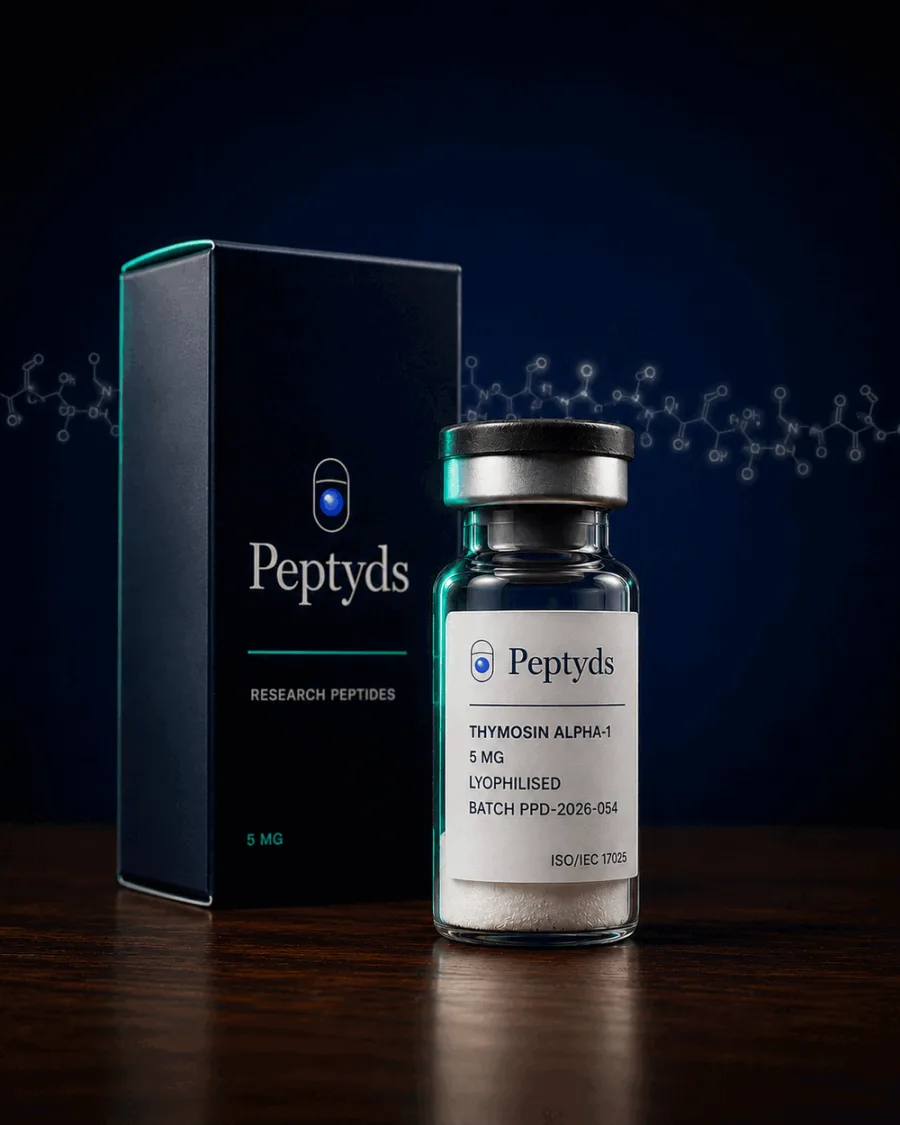
Thymosin Alpha-1
Thymosin Alpha-1 is a naturally occurring immunomodulator of 28 amino acids derived from the thymus gland, studied in immune regulation research for its role in modulating TLR2/9 signalling and shifting T-helper cell polarisation.
A 28-amino-acid peptide studied for its role in modulating T-cell response — framed as a clinician-led input into immune support, not a daily supplement.
For Research Use Only — Not for Human Consumption.
Sold strictly for in vitro laboratory research purposes.
In stock now
Thymosin Alpha-1 is out of stock. These are in stock.
Different compounds, matched on shared research goal and comparable cost per mg. They are not substitutes for one another — read the research on each page before you order.
Why it is not stocked
The 1.6 mg Thymosin Alpha-1 vial is out of stock. The pharmacology, research notes and FAQ on this page stay published as the compound reference.
- NAD+Cellular Energy & Redox ResearchSame goal · €0.69 / mgfrom €69
- CJC-1295 No DACPulsatile Growth Hormone ResearchSame goal · €4.00 / mgfrom €40
- SelankNootropic & Anxiolytic ResearchSame goal · €7.00 / mgfrom €35
Email me when this batch returns
- Availability
- Delivered in 3–7 days (EU)
- Storage
- Store 2–8 °C. Reconstitute before use.
- Ships from
- European fulfilment centre, tracked express
Lab proof, by batch
- Tested independently, by batch
- Certificate of analysis available
- Purity and identity on record
Immunomodulatory Pathway Research.
Thymosin Alpha-1 is a naturally occurring peptide derived from the thymus. Research has focused on its role in dendritic and T-cell signalling, with clinical investigation across hepatitis, sepsis, and post-infective recovery contexts. Use under clinical guidance.
- — Goldstein — thymic peptides and T-cell signalling
- — Wu et al. — clinical studies in immune-modulated recovery contexts
Research context only. Not medical advice. Consult a qualified clinician before use.
- 1.6 mg lyophilised powder per vial
- Reconstitute with bacteriostatic water before use
- Store lyophilised vial at 2–8 °C, keep from light
- Once reconstituted, refrigerate and use within 7 days
- One 1.6 mg lyophilised Thymosin Alpha-1 vial
- Tamper-evident cap with batch-coded label
- Storage card and clinician-consultation note
What the research reports about this molecule.
Classic parameters from peer-reviewed literature. Not human dosing guidance — read alongside the PubMed references on /learn.
- Sequence
- 28-amino-acid immunomodulator
- Molecular weight
- 3108 Da
- Half-life
- ~2 hours
- Mechanism
- Acts on TLR2/9, shifts T-helper polarisation
- Research domain
- Immune regulation
- Reconstitution
- Bacteriostatic water, USP
- Storage
- Long-term -20°C lyophilised; -80°C for >12 months; reconstituted 2-8°C, ≤4 weeks
Simple, deliberate steps — not a protocol.
These are practical handling notes. Dosing decisions stay between you and your clinician.
- 1
Reconstitute with 1 mL bacteriostatic water — swirl gently
- 2
Follow your clinician's protocol; do not self-prescribe dosing
- 3
Refrigerate the reconstituted vial; use within 7 days
How-to-use guide
Read the research protocol
Concise reconstitution, dosing, and handling instructions.
Reconstitution calculator
Research use onlySyringe
Peptide in vial
Bacteriostatic water
Concentration0.8 mg/mL
Target dose
Pull syringe to
31.3
units · 0.313 mL
Concentration
0.8
mg/mL
Doses per vial
6
doses
U-50 15.6 · U-40 12.5 units
For laboratory research calculation only. Not medical or dosing advice, and not for human or veterinary use.
Others researching Immune Support also compare
- Thymosin Alpha-1This pageSizes: 1.6 mgPrice / mg: €49.38 / mg
- NAD+Sizes: 100 mgPrice / mg: €0.69 / mg
- CJC-1295 No DACSizes: 10 mgPrice / mg: €4.00 / mg
- SelankSizes: 5 mgPrice / mg: €7.00 / mg
Each release is matched with quality documentation through a documented verification path. Identity, purity, and composition test results sit on the product page before you buy.
Every batch is verified by an ISO/IEC 17025-accredited laboratory before release. Identity, purity, and documentation travel with the product — not behind a form.
Sensitive peptides ship in insulated cold packaging with gel packs sized for a 48-hour transit window, tracked door to door.
Everything worth asking before you order.
Shipping, storage, quality, and when to speak to a clinician — without the runaround.
What proof of quality comes with my order?
Every batch ships with a batch code printed on the vial. The matching independent lab report — showing identity, purity, and composition — is linked on the product page and stays on your order page after purchase.
How much scientific detail is on each product page?
Each page opens with a clear purpose line and the testing behind it, then expands into research notes, dosing specifications, and linked peer-reviewed studies for readers who want more depth. You decide how deep you go.
Should I speak to a clinician before using a peptide?
We recommend it — especially if you are pregnant, nursing, managing a medical condition, or combining peptides with prescribed medication. Our product pages are educational. They are not medical advice and they do not replace a conversation with a qualified practitioner.
What dosing has been studied for thymosin alpha-1?
Published clinical research on thymalfasin (the synthetic form of thymosin alpha-1, marketed as Zadaxin in 35+ countries) has typically used 1.6 mg subcutaneously twice weekly for chronic viral hepatitis, with loading protocols up to 3.2 mg daily for seven days in severe immune-suppression contexts.
What's the difference between a prescription peptide and a research peptide?
A prescription peptide (e.g. Wegovy, Mounjaro, Vyleesi, Zadaxin in the relevant jurisdictions) has been through EMA or national-authority review, carries an authorised indication, and is dispensed by a pharmacy against a script. A research peptide is a reference-grade compound sold for laboratory use only.
How do I reconstitute a lyophilised peptide vial?
Bring both the lyophilised vial and the bacteriostatic water to room temperature, equalise pressure with a sterile vented needle, then inject the solvent slowly down the side of the vial. Swirl gently — never shake — until clear, and refrigerate at 2–8 °C.
How much bacteriostatic water should I add to my peptide vial?
The calculation is peptide mass (mg) ÷ desired concentration (mg/mL) = volume of bacteriostatic water in mL. For example, a 5 mg vial at 1 mg/mL needs 5 mL; at 2 mg/mL, 2.5 mL. Every Peptyds product page carries a suggested reconstitution volume tuned to the vial size.
How long does a reconstituted peptide stay stable in the fridge?
Most lyophilised peptides reconstituted with bacteriostatic water remain stable for 28–30 days at 2–8 °C, protected from light. A handful of short, fragile sequences — Epithalon among them — drop to roughly 14 days. Never freeze a reconstituted vial.
What side effects are most commonly reported across peptide research?
Across published trials and case series, the most frequent reported events are injection-site reactions (redness, induration, transient discomfort), headache, mild nausea, and temporary fatigue. GLP-1 and dual-agonist class peptides add dose-dependent gastrointestinal effects.
Who should not use peptides?
Peptides are not appropriate for anyone who is pregnant, nursing, planning conception, under 18, managing active cancer, or on immunosuppressants — and competitive athletes governed by WADA must avoid every peptide on the prohibited list. Anyone with a personal or family history of melanoma should specifically avoid melanocortin-receptor agonists.