

Research notes

GHK-Cu Side Effects: What the Published Research Shows

GHK-Cu's side-effect evidence differs sharply by route. The one identified randomised human trial of topical GHK-Cu, run on skin recovering from CO2 laser resurfacing, found no added adverse reaction from the GHK-Cu regimen and no measurable advantage for redness resolution, though satisfaction scores were higher. Separate laboratory research found GHK-Cu was not cytotoxic to skin cells and did not raise irritation biomarkers, unlike two ionic copper compounds tested for comparison. For the injectable, research-only form Peptyds supplies, no published controlled human safety trial was identified: the FDA's own review of nominated compounding substances cites limited human data and a possible immunogenicity risk, and as of its most recent update that nomination is recorded as withdrawn rather than active.

10 min readUpdated 24 Sept 2026Reviewed by Independent EU laboratory (ISO/IEC 17025)
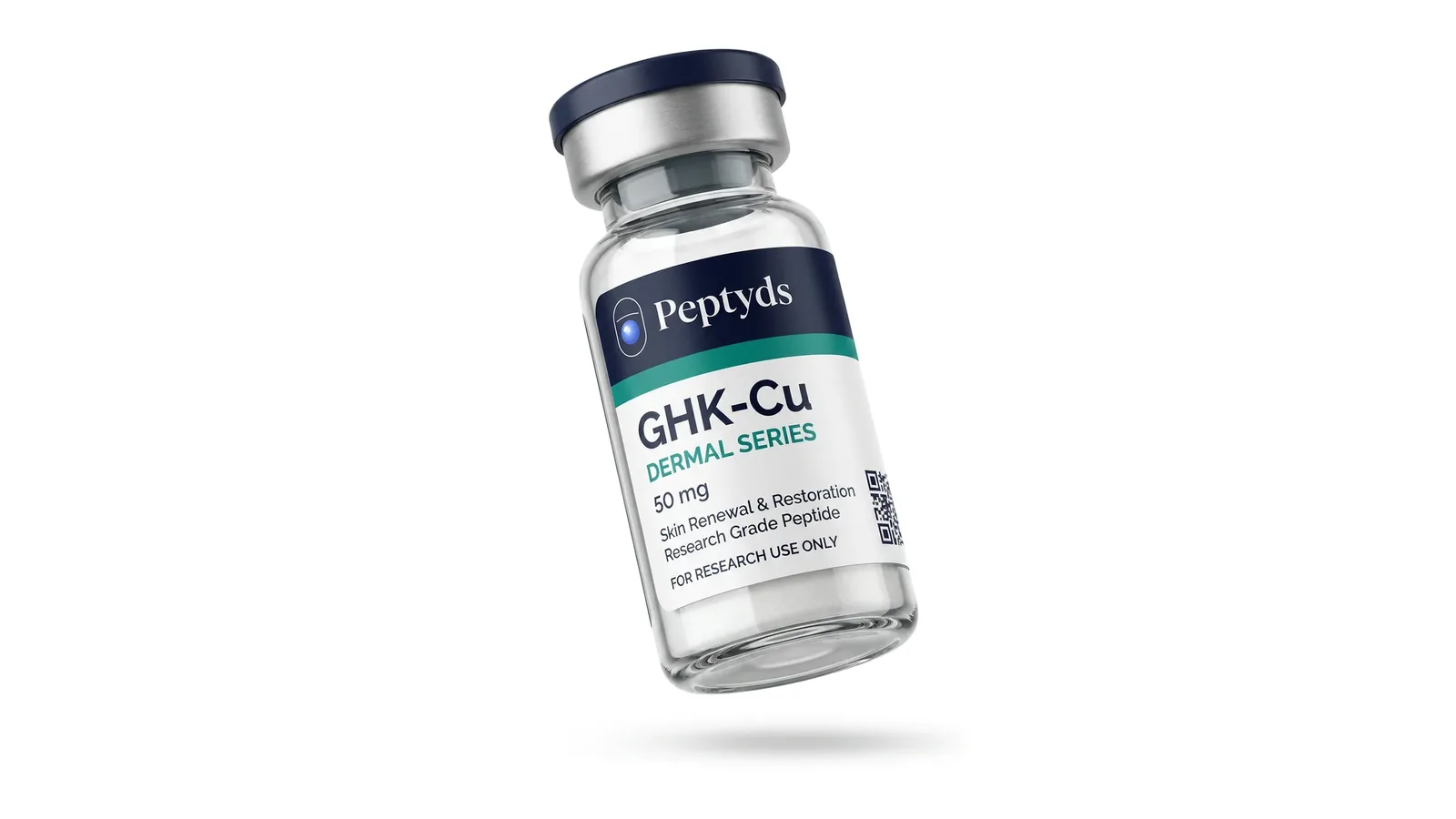
A Peptyds GHK-Cu research vial photographed on a white background.
Jump to section
  1. 01Does GHK-Cu have side effects?
  2. 02What GHK-Cu is, and why the copper matters
  3. 03What topical and cosmetic human studies report
  4. 04Copper itself: what the laboratory evidence shows
  5. 05What is — and is not — known about injected GHK-Cu
  6. 06Where Peptyds' research vial sits in this picture
  • The clearest published human evidence for GHK-Cu is topical: a randomised trial on post-laser skin found no added adverse reaction from a GHK-Cu regimen, alongside no measurable advantage for redness resolution.
  • A 2016 laboratory study found GHK-Cu was not cytotoxic to human keratinocytes and did not raise skin-irritation biomarkers, unlike two ionic copper compounds tested alongside it at higher concentrations.
  • No published controlled human safety trial for injected GHK-Cu was identified for this article; the FDA's own review of nominated compounding substances describes limited human data for that route.
  • The FDA's note on injectable GHK-Cu, current as of 22 April 2026, cites a possible immunogenicity risk from aggregation and peptide-related impurities; the nomination itself is currently recorded as withdrawn, not as an active safety listing.
  • Peptyds supplies GHK-Cu as a lyophilised vial for laboratory research only — a different route, and a different evidence base, from the topical serums the cited studies tested.

Discussed in this guide

  • GHK-CuA copper-peptide complex studied for skin barrier support, collagen signalling, and visible texture renewal.10 mg · 20 mg · 50 mg€0.78 / mg

Does GHK-Cu have side effects?

Searching for "GHK-Cu side effects" surfaces two different evidence bases, and conflating them is the biggest source of confusion online. One is topical: GHK-Cu formulated into creams and serums, tested on skin, and sold as a cosmetic ingredient. The other is research-grade GHK-Cu supplied as a lyophilised vial for laboratory use; where that form is discussed as an injectable, the published human-safety record is far thinner and the regulatory picture is entirely different. This article keeps the two apart rather than borrowing reassurance from one to answer questions about the other.

Peptyds supplies GHK-Cu for laboratory research only. Nothing on this page describes how to use it, and none of it should be read as guidance for a person. It summarises what the published record actually says about tolerability and safety for each form, and it says plainly where that record runs out.

The distinction matters because the two forms are tested, sold, and regulated differently. A cosmetic cream is designed and studied for use on intact skin; the research-only compound Peptyds lists is designed to be handled in a laboratory setting, not applied to or administered in a person. Evidence gathered on one should not be read as if it settled a question about the other, and the sections below are organised to keep that boundary visible.

Continue reading:View GHK-Cu

What GHK-Cu is, and why the copper matters

GHK is a naturally occurring tripeptide of three amino acids, glycyl-histidyl-lysine, with a strong binding affinity for copper(II) ions; bound together, the complex is written GHK-Cu. A 2018 review in the International Journal of Molecular Sciences catalogued a wide range of proposed biological actions for the peptide across cell-based and animal research, from tissue-repair and blood-vessel signalling to antioxidant and DNA-repair gene expression.[1]

That catalogue is a mechanism review, not a safety trial, and cataloguing a molecule's proposed actions is a different exercise from establishing what happens when people are exposed to it. It is background for why the same peptide turns up in both skincare formulations and injectable research contexts, and why its bound copper is the recurring question in both settings.[1]

The rest of this article works through that question route by route: what topical human studies report, what laboratory work says about copper itself, and what remains unverified for injected GHK-Cu.

Continue reading:Read the GHK-Cu skin research overview

What topical and cosmetic human studies report

The clearest published human data on topical GHK-Cu comes from a randomised trial in people recovering from CO2 laser skin resurfacing — skin that is freshly injured and unusually reactive, which makes it a demanding tolerability test rather than a gentle one. Thirteen patients completed the protocol, split between a post-procedure skin-care regimen that included a GHK-Cu copper-tripeptide product and one that did not, with outcomes assessed at 12 weeks.[2]

Computer analysis and blinded evaluators found no statistically significant difference between the two groups in how quickly post-laser redness resolved, and both groups showed comparable improvement in wrinkles and overall skin quality. The published results describe no additional adverse reaction tied to the GHK-Cu regimen specifically; the one measured difference between groups was that patients using the GHK-Cu products reported significantly higher satisfaction, despite the objective measurements coming out even.[2]

Read narrowly, that is a tolerability signal from a single trial of one product format, on patients whose skin was already compromised by a procedure — not a broad safety verdict for every GHK-Cu cream or serum sold as a cosmetic, and not evidence about any other route of exposure.[2]

Continue reading:Explore the skin and anti-aging goal

Copper itself: what the laboratory evidence shows

Because GHK-Cu carries a bound copper ion, a reasonable question is whether the copper itself, rather than the peptide backbone, is what could irritate skin. A 2016 laboratory study tested GHK-Cu alongside two ionic copper compounds, copper chloride and copper acetate, on human keratinocyte cells, measuring cell viability and the expression of several skin-irritation biomarkers, including IL-1α, IL-8, HSPA1A and FOSL1.[3]

GHK-Cu was not cytotoxic at the concentrations tested and did not significantly change expression of those irritation markers. The two ionic copper salts raised several of the same markers at higher concentrations without an accompanying loss of cell viability — a pattern the study's authors read as showing that copper bound inside the GHK-Cu complex behaves differently on skin cells than free copper ions, with a lower irritation potential in this model.[3]

That is cell-culture evidence, not a human trial, so it answers a narrower question than "is GHK-Cu safe": specifically, whether copper bound in this complex behaves like free ionic copper on skin cells at the concentrations tested. It says nothing about systemic exposure, and nothing about injected GHK-Cu, covered next.[3]

What is — and is not — known about injected GHK-Cu

Peptyds' GHK-Cu ships as a lyophilised powder supplied for laboratory research only — not the topical serum format the studies above tested. For the injectable route, the evidence gap is explicit in the FDA's own review of nominated compounding substances: it states that compounded injectable drugs containing GHK-Cu may pose an immunogenicity risk tied to aggregation and peptide-related impurities, and that human safety data remain limited.[4]

As of that page's most recent update, 22 April 2026, the GHK-Cu injectable note sits under substances "nominated but withdrawn" rather than an active significant-safety-risk listing: the concern was raised during FDA's review of the nomination, and the nomination itself was subsequently withdrawn. No published controlled human trial establishing the safety of injected GHK-Cu was identified for this article, in either direction.[4]

That leaves a real evidence gap rather than a settled answer, as of September 2026, and it is the kind of status that can still move. The topical tolerability data above and the FDA's compounding note describe two different things: one peptide, tested and regulated very differently depending on how it reaches the body.

Continue reading:Read the peptide safety overviewRead the quality protocol

Where Peptyds' research vial sits in this picture

Peptyds lists GHK-Cu as a lyophilised vial for reconstitution, supplied for laboratory research only. That is not the topical serum format the tolerability studies above describe, and the published safety record does not transfer cleanly between the two: a different formulation is also a different evidence base, tested through a different route, under different regulatory attention.

Peptyds' own comparison of GHK-Cu and BPC-157 for skin research covers that topical-versus-systemic distinction in more depth, including why a cosmetic "GHK-Cu serum" and a reconstituted research vial are not interchangeable evidence bases despite sharing a molecule name. For how GHK-Cu's evidence record compares with other research peptides more broadly, Peptyds' wider safety overview covers common side effects, long-term data, and what remains unknown across the catalogue.

None of the research summarised here is a promise about what any specific product does in any specific person. It is the published record, reported as published, so the gap between cosmetic-ingredient evidence and a laboratory research compound stays visible rather than blurred.

Continue reading:Compare GHK-Cu and BPC-157 for skinView GHK-Cu

Sources

  1. [01]
  2. [02]
  3. [03]
  4. [04]

Questions

Does GHK-Cu have side effects?

The honest answer depends on the form. In the one randomised human trial on topical GHK-Cu identified for this article, adding it to a post-laser skin-care regimen produced no additional adverse reaction beyond what the comparison regimen produced, though it also showed no measurable advantage for redness resolution. For injected GHK-Cu, the FDA's own review describes limited human safety data and a theoretical immunogenicity risk from aggregation and peptide-related impurities, rather than a documented side-effect profile.[2][4]

Is GHK-Cu safe?

"Safe" is not a single answer for GHK-Cu, because the topical and injectable forms have almost entirely separate evidence bases. Topical GHK-Cu has a small amount of published human tolerability data and reassuring laboratory data on copper-specific skin irritation. Injected GHK-Cu has no published controlled human safety trial identified for this article and an explicit FDA note about limited human data — an open question, not a settled one.[2][3][4]

What does the CO2 laser study show about GHK-Cu and skin irritation?

In that 2006 trial, thirteen patients recovering from CO2 laser resurfacing were randomised to post-procedure regimens with or without a GHK-Cu copper-tripeptide product. Blinded evaluators found no statistically significant difference in how quickly redness resolved between groups, and the published results describe no additional adverse reaction from the GHK-Cu arm — though patients using it did report significantly higher satisfaction.[2]

Can the copper in GHK-Cu irritate skin?

A 2016 laboratory study compared GHK-Cu with two ionic copper compounds on human keratinocyte cells and found GHK-Cu was not cytotoxic and did not significantly raise skin-irritation biomarkers, while the ionic copper salts did raise several of those markers at higher concentrations. That suggests copper bound in the GHK-Cu complex behaves differently from free copper ions on skin cells, though the finding is from cell culture, not a human trial.[3]

Is injectable GHK-Cu FDA-approved or regulated?

No GHK-Cu product is FDA-approved. The FDA's list of nominated compounding substances notes, for injectable GHK-Cu specifically, a possible immunogenicity risk from aggregation and peptide-related impurities and limited human safety data; as of that page's most recent update, 22 April 2026, the nomination is recorded as withdrawn rather than as an active significant-safety-risk listing.[4]

Is GHK-Cu the same whether it is in a cream or a research vial?

Chemically, the copper-tripeptide complex is the same molecule, but the evidence behind a cosmetic cream and a lyophilised research vial is not interchangeable. The published tolerability data described here comes from a topical product tested on skin; Peptyds' GHK-Cu is supplied as a research-only vial for laboratory use, a different route with a much thinner published human-safety record.[2]

How is GHK-Cu different from BPC-157 for side effects?

The two are chemically unrelated and sit in different evidence traditions: GHK-Cu's most relevant human tolerability data is topical and cosmetic, while BPC-157 is discussed almost entirely in injectable or oral research contexts. Peptyds' side-effects article on BPC-157 and its GHK-Cu-versus-BPC-157 skin comparison cover each in more depth.

Educational content. Not medical advice.

Next step

Choose the route that matches how you read.