

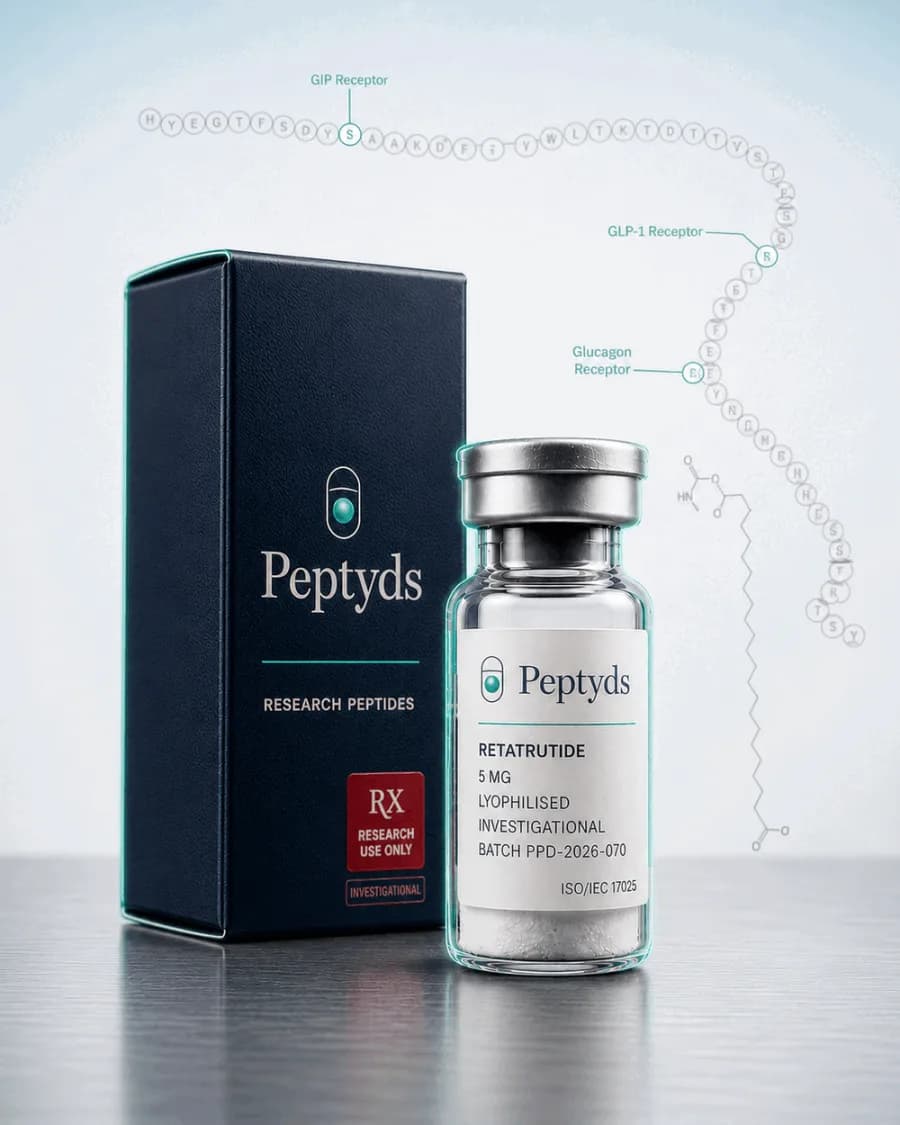
Retatrutide
Retatrutide ist ein synthetisches Peptid als dreifacher Rezeptoragonist, hergestellt als Agonist der GIP-, GLP-1- und Glukagon-Rezeptoren und untersucht in der metabolischen Forschung von Eli Lilly (Phase 2/3) auf seine Rolle bei der kombinierten Aktivierung von GIP-, GLP-1- und Glukagon-Rezeptoren.
Ein dreifach wirkendes Agonist-Peptid für die GIP-, GLP-1- und Glukagon-Rezeptoren — untersucht in fortgeschrittenen Kontexten der Stoffwechsel- und Gewichtsregulation.
For Research Use Only — Not for Human Consumption.
Investigational compound — no approved therapeutic indication.
Sold strictly for in vitro laboratory research.
- Verfügbarkeit
- Delivered in 3–7 days (EU)
- Lagerung
- Store 2–8 °C. Reconstitute before use.
- Versand aus
- European fulfilment centre, tracked express
Laborbeleg, pro Charge
- Unabhängig getestet, pro Charge
- Analysezertifikat verfügbar
- Reinheit und Identität dokumentiert
Forschung zu dreifachen Rezeptoragonisten.
Retatrutide (CAS 2381089-83-2) vereint die Aktivierung der GIP-, GLP-1- und Glukagon-Rezeptoren in einer einzigen Sequenz. Klinische Studien der Phase 2 haben deutliche Reduktionen des Körpergewichts und Verbesserungen metabolischer Marker berichtet. Formel C223H341N57O64S, MW 4858,60 g/mol. Strenge ärztliche Anleitung erforderlich.
- — Jastreboff et al. — Phase-2-Studie zu Retatrutide: dosisabhängige Endpunkte zur Gewichtsabnahme
- — Coskun et al. — GIP/GLP-1/Glukagon-Triagonismus und Marker des Energieverbrauchs
Nur Forschungskontext. Keine medizinische Beratung. Ziehen Sie vor der Anwendung eine qualifizierte medizinische Fachperson hinzu.
- 10 mg lyophilisiertes Pulver pro Vial
- Vor der Anwendung mit bakteriostatischem Wasser rekonstituieren
- Lyophilisiert bei 2–8 °C lichtgeschützt lagern
- Nach der Rekonstitution kühl lagern und innerhalb von 28 Tagen verwenden
- Ein Vial Retatrutide, 10 mg, lyophilisiert
- Originalitätsverschluss mit Chargennummer
- Karte zu Lagerung und ärztlicher Beratung
What the research reports about this molecule.
Classic parameters from peer-reviewed literature. Not human dosing guidance — read alongside the PubMed references on /learn.
- Sequence
- Dreifacher GIP-/GLP-1-/Glukagon-Rezeptor-Agonist
- Mechanism
- Aktiviert GIP-, GLP-1- und Glukagon-Rezeptoren
- Research domain
- Stoffwechsel, Gewichtsregulation (Eli Lilly Phase 2/3)
- Reconstitution
- Bakteriostatisches Wasser, USP
- Storage
- Langzeitlagerung bei -20 °C lyophilisiert; -80 °C für > 12 Monate; rekonstituiert bei 2–8 °C
Klare, gezielte Schritte — kein starres Protokoll.
Dies sind Hinweise zur praktischen Handhabung. Entscheidungen zur Dosierung treffen Sie gemeinsam mit Ihrer Ärztin oder Ihrem Arzt.
- 1
Unter ärztlicher Anleitung rekonstituieren — eine Dosistitration ausgehend von einer niedrigen Startdosis ist zwingend
- 2
Nach Anweisung subkutan verabreichen; dem vorgegebenen Dosissteigerungsplan folgen
- 3
Rekonstituiertes Vial kühl lagern; innerhalb von 28 Tagen verwenden
Anwendungsleitfaden
Forschungsprotokoll lesen
Präzise Anweisungen zu Rekonstitution, Dosierung und Handhabung.
Rekonstitutionsrechner
Nur zu ForschungszweckenSpritze
Peptid im Vial
Bakteriostatisches Wasser
Konzentration5 mg/mL
Zieldosis
Spritze aufziehen bis
5
Einheiten · 0.05 mL
Konzentration
5
mg/mL
Dosen pro Vial
40
Dosen
U-50 2.5 · U-40 2 Einheiten
Nur zur Berechnung für die Laborforschung. Keine medizinische Beratung und keine Dosierungsempfehlung, nicht zur Anwendung am Menschen oder am Tier.
Andere mit Fokus Gewicht & Stoffwechsel vergleichen auch
- RetatrutideDiese SeiteGrößen: 10 mg · 60 mgPreis / mg: €4.32 / mg
- SemaglutideGrößen: 5 mg · 10 mgPreis / mg: €5.00 / mg
- TesamorelinGrößen: 5 mg · 10 mgPreis / mg: €6.90 / mg
- CJC-1295 No DAC + IpamorelinGrößen: 10 mg + 10 mgPreis / mg: €7.50 / mg
Each release is matched with quality documentation through a documented verification path. Identity, purity, and composition test results sit on the product page before you buy.
Every batch is verified by an ISO/IEC 17025-accredited laboratory before release. Identity, purity, and documentation travel with the product — not behind a form.
Sensitive peptides ship in insulated cold packaging with gel packs sized for a 48-hour transit window, tracked door to door.
Alles, was Sie vor Ihrer Bestellung wissen sollten.
Versand, Lagerung, Qualität und wann eine ärztliche Konsultation nötig ist — auf den Punkt gebracht.
What proof of quality comes with my order?
Every batch ships with a batch code printed on the vial. The matching independent lab report — showing identity, purity, and composition — is linked on the product page and stays on your order page after purchase.
Should I speak to a clinician before using a peptide?
We recommend it — especially if you are pregnant, nursing, managing a medical condition, or combining peptides with prescribed medication. Our product pages are educational. They are not medical advice and they do not replace a conversation with a qualified practitioner.
When will my order ship and arrive?
Orders placed before 14:00 CET Monday–Friday ship the same business day from our European fulfilment centre in The Hague, Netherlands. Standard tracked EU delivery arrives in 2–4 business days; express options are available at checkout.
What does "research only" actually mean on a peptide label?
Research-only means the compound has not been approved by the EMA or any national medicines authority for medical use, and is sold solely for in-vitro and laboratory research. It is not a supplement, a cosmetic, or a medicine, and it carries no claims for human consumption.
Is retatrutide approved or available as a medicine?
No. Retatrutide is a triple agonist of GLP-1, GIP, and glucagon receptors developed by Eli Lilly and currently in Phase 3 trials (TRIUMPH programme). It is not approved by the EMA or FDA, so it cannot be prescribed. Phase 2 data showed up to ~24 percent body-weight reduction at 48 weeks.
What are the most common side effects of GLP-1 peptides specifically?
Across SUSTAIN, SURPASS, SURMOUNT, and TRIUMPH trials, the dominant adverse events for semaglutide, tirzepatide, and retatrutide are gastrointestinal: nausea, vomiting, diarrhoea, constipation, and abdominal discomfort, usually mild-to-moderate and concentrated during dose titration.
What's the difference between a prescription peptide and a research peptide?
A prescription peptide (e.g. Wegovy, Mounjaro, Vyleesi, Zadaxin in the relevant jurisdictions) has been through EMA or national-authority review, carries an authorised indication, and is dispensed by a pharmacy against a script. A research peptide is a reference-grade compound sold for laboratory use only.
How do I reconstitute a lyophilised peptide vial?
Bring both the lyophilised vial and the bacteriostatic water to room temperature, equalise pressure with a sterile vented needle, then inject the solvent slowly down the side of the vial. Swirl gently — never shake — until clear, and refrigerate at 2–8 °C.
How much bacteriostatic water should I add to my peptide vial?
The calculation is peptide mass (mg) ÷ desired concentration (mg/mL) = volume of bacteriostatic water in mL. For example, a 5 mg vial at 1 mg/mL needs 5 mL; at 2 mg/mL, 2.5 mL. Every Peptyds product page carries a suggested reconstitution volume tuned to the vial size.
How long does a reconstituted peptide stay stable in the fridge?
Most lyophilised peptides reconstituted with bacteriostatic water remain stable for 28–30 days at 2–8 °C, protected from light. A handful of short, fragile sequences — Epithalon among them — drop to roughly 14 days. Never freeze a reconstituted vial.
What side effects are most commonly reported across peptide research?
Across published trials and case series, the most frequent reported events are injection-site reactions (redness, induration, transient discomfort), headache, mild nausea, and temporary fatigue. GLP-1 and dual-agonist class peptides add dose-dependent gastrointestinal effects.
Who should not use peptides?
Peptides are not appropriate for anyone who is pregnant, nursing, planning conception, under 18, managing active cancer, or on immunosuppressants — and competitive athletes governed by WADA must avoid every peptide on the prohibited list. Anyone with a personal or family history of melanoma should specifically avoid melanocortin-receptor agonists.