

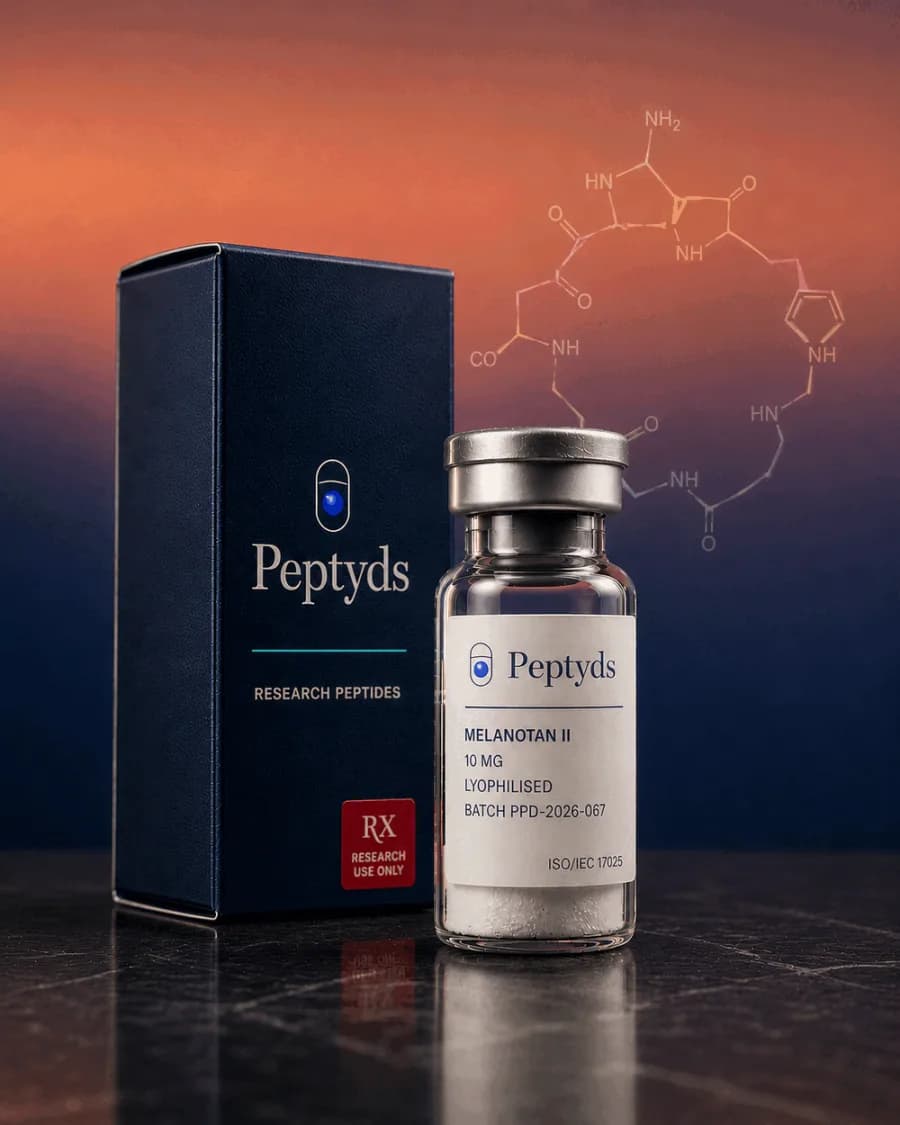
Melanotan II
Le Melanotan II est un heptapeptide cyclique synthétique de 7 acides aminés, synthétisé comme analogue de l'alpha-MSH et étudié dans la recherche sur le pigment et l'appétit pour son rôle dans l'activation non sélective des récepteurs des mélanocortines MC1R à MC5R.
Un agoniste des récepteurs des mélanocortines étudié pour ses effets sur la mélanogenèse, la fonction sexuelle et la régulation de l'appétit, via l'activation de la voie MC1R–MC4R.
For Research Use Only — Not for Human Consumption.
Sold strictly for in vitro laboratory research purposes.
En stock
Melanotan II est en rupture. Ceux-ci sont en stock.
Des composés différents, rapprochés par objectif de recherche commun et coût par mg comparable. Ils ne se substituent pas l'un à l'autre — lisez la recherche sur chaque page avant de commander.
- Melanotan IRecherche mélanogenèse et photoprotectionMême objectif · €3.90 / mgà partir de €39
- GHK-CuRecherche remodelage dermique et synthèseMême objectif · €0.78 / mgà partir de €39
Me prévenir au retour de ce lot
- Disponibilité
- Delivered in 3–7 days (EU)
- Conservation
- Store 2–8 °C. Reconstitute before use.
- Expédié depuis
- European fulfilment centre, tracked express
Preuve de laboratoire, par lot
- Testé de façon indépendante, par lot
- Certificat d'analyse disponible
- Pureté et identité documentées
Recherche mélanogenèse et pigment.
Le Melanotan II (CAS 121062-08-6) est un analogue lactame cyclique de l'alpha-MSH qui active de façon non sélective les récepteurs MC1R à MC4R. La recherche a examiné ses effets sur la production de mélanine, la libido et la suppression de l'appétit. Formule C50H69N15O9, MM 1024,18 g/mol. À utiliser uniquement sous encadrement clinique.
- — King et al. — effets du Melanotan-II sur l'excitation sexuelle dans des essais humains
- — Hadley et Dorr — agonisme de MC1R et voies de synthèse de la mélanine
Contexte de recherche uniquement. Ne constitue pas un avis médical. Consultez un professionnel de santé qualifié avant tout usage.
- 10 mg de poudre lyophilisée par flacon
- Reconstituer avec de l'eau bactériostatique avant usage
- Conserver lyophilisé à 2–8 °C, à l'abri de la lumière
- Une fois reconstitué, réfrigérer et utiliser sous 30 jours
- Un flacon de Melanotan II lyophilisé de 10 mg
- Bouchon inviolable avec étiquette codée par lot
- Carte de conservation et de consultation clinique
What the research reports about this molecule.
Classic parameters from peer-reviewed literature. Not human dosing guidance — read alongside the PubMed references on /learn.
- Sequence
- Heptapeptide cyclique synthétique (7 acides aminés)
- Molecular weight
- 1024 Da
- Mechanism
- Agoniste non sélectif des récepteurs des mélanocortines MC1R à MC5R
- Research domain
- Recherche pigment et appétit
- Reconstitution
- Eau bactériostatique, USP
- Storage
- Long terme : lyophilisé à -20 °C ; -80 °C au-delà de 12 mois ; reconstitué à 2-8 °C, ≤ 4 semaines
Des étapes simples et réfléchies — pas un protocole.
Ce sont des notes de manipulation pratiques. Les décisions de dosage restent entre vous et votre médecin.
- 1
Reconstituer avec 2 mL d'eau bactériostatique — agiter doucement par rotation
- 2
Administrer par voie sous-cutanée selon les indications de votre clinicien
- 3
Réfrigérer le flacon reconstitué ; utiliser sous 30 jours
Guide d'utilisation
Lire le protocole de recherche
Instructions concises de reconstitution, de dosage et de manipulation.
Calculateur de reconstitution
Réservé à la rechercheSeringue
Peptide dans le flacon
Eau bactériostatique
Concentration5 mg/mL
Dose visée
Remplir jusqu'à
5
unités · 0.05 mL
Concentration
5
mg/mL
Doses par flacon
40
doses
U-50 2.5 · U-40 2 unités
Calcul réservé à la recherche en laboratoire. Ne constitue ni un avis médical ni une recommandation de dosage, et n'est destiné ni à l'usage humain ni à l'usage vétérinaire.
Ceux qui étudient Peau et anti-âge comparent aussi
- Melanotan IICette pageFormats: 10 mgPrix / mg: €3.90 / mg
- GHK-CuFormats: 10 mg · 20 mg · 50 mgPrix / mg: €0.78 / mg
- Melanotan IFormats: 10 mgPrix / mg: €3.90 / mg
- KPVFormats: 5 mg · 10 mgPrix / mg: €7.50 / mg
Each release is matched with quality documentation through a documented verification path. Identity, purity, and composition test results sit on the product page before you buy.
Every batch is verified by an ISO/IEC 17025-accredited laboratory before release. Identity, purity, and documentation travel with the product — not behind a form.
Sensitive peptides ship in insulated cold packaging with gel packs sized for a 48-hour transit window, tracked door to door.
Tout ce qui mérite d'être demandé avant de commander.
Livraison, conservation, qualité et quand parler à un médecin — sans détour.
What proof of quality comes with my order?
Every batch ships with a batch code printed on the vial. The matching independent lab report — showing identity, purity, and composition — is linked on the product page and stays on your order page after purchase.
Should I speak to a clinician before using a peptide?
We recommend it — especially if you are pregnant, nursing, managing a medical condition, or combining peptides with prescribed medication. Our product pages are educational. They are not medical advice and they do not replace a conversation with a qualified practitioner.
When will my order ship and arrive?
Orders placed before 14:00 CET Monday–Friday ship the same business day from our European fulfilment centre in The Hague, Netherlands. Standard tracked EU delivery arrives in 2–4 business days; express options are available at checkout.
What does "research only" actually mean on a peptide label?
Research-only means the compound has not been approved by the EMA or any national medicines authority for medical use, and is sold solely for in-vitro and laboratory research. It is not a supplement, a cosmetic, or a medicine, and it carries no claims for human consumption.
Why is Melanotan II considered high-risk?
Melanotan II is not approved by the EMA, FDA, MHRA, or TGA, and regulators have issued consumer warnings citing unregulated supply chains and changes to existing moles. Case reports have described new or rapidly evolving naevi and isolated melanoma cases temporally linked to use, though causation is not established.
Are peptides safe long-term?
Honestly: it depends on the molecule. EMA-approved peptide drugs (semaglutide, tirzepatide, tesamorelin, thymalfasin in some jurisdictions) have multi-year safety datasets. Unapproved research peptides — BPC-157, TB-500, Melanotan II, Epithalon — have limited or no long-term human data.
What's the difference between a prescription peptide and a research peptide?
A prescription peptide (e.g. Wegovy, Mounjaro, Vyleesi, Zadaxin in the relevant jurisdictions) has been through EMA or national-authority review, carries an authorised indication, and is dispensed by a pharmacy against a script. A research peptide is a reference-grade compound sold for laboratory use only.
How do I reconstitute a lyophilised peptide vial?
Bring both the lyophilised vial and the bacteriostatic water to room temperature, equalise pressure with a sterile vented needle, then inject the solvent slowly down the side of the vial. Swirl gently — never shake — until clear, and refrigerate at 2–8 °C.
How much bacteriostatic water should I add to my peptide vial?
The calculation is peptide mass (mg) ÷ desired concentration (mg/mL) = volume of bacteriostatic water in mL. For example, a 5 mg vial at 1 mg/mL needs 5 mL; at 2 mg/mL, 2.5 mL. Every Peptyds product page carries a suggested reconstitution volume tuned to the vial size.
How long does a reconstituted peptide stay stable in the fridge?
Most lyophilised peptides reconstituted with bacteriostatic water remain stable for 28–30 days at 2–8 °C, protected from light. A handful of short, fragile sequences — Epithalon among them — drop to roughly 14 days. Never freeze a reconstituted vial.
What side effects are most commonly reported across peptide research?
Across published trials and case series, the most frequent reported events are injection-site reactions (redness, induration, transient discomfort), headache, mild nausea, and temporary fatigue. GLP-1 and dual-agonist class peptides add dose-dependent gastrointestinal effects.
Who should not use peptides?
Peptides are not appropriate for anyone who is pregnant, nursing, planning conception, under 18, managing active cancer, or on immunosuppressants — and competitive athletes governed by WADA must avoid every peptide on the prohibited list. Anyone with a personal or family history of melanoma should specifically avoid melanocortin-receptor agonists.