

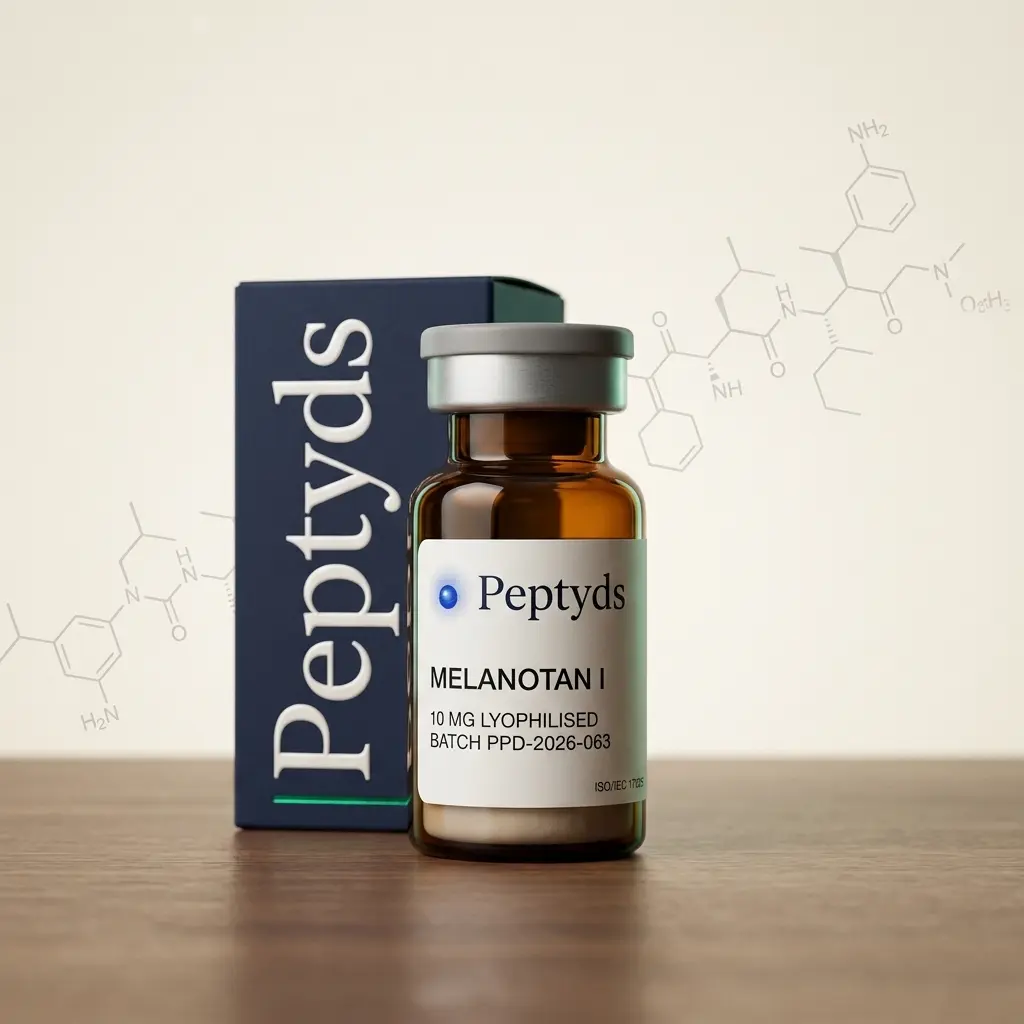
Melanotan I
Melanotan I (Afamelanotyd) to syntetyczny analog hormonu stymulującego melanocyty (α-MSH). Działa jako nieselektywny agonista receptorów melanokortynowych (MC1R, MC3R, MC4R, MC5R) i jest szeroko badany pod kątem indukowania produkcji eumelaniny oraz fotoprotekcji.
Badania nad melanogenezą i fotoprotekcją.
For Research Use Only — Not for Human Consumption.
Sold strictly for in vitro laboratory research purposes.
- Dostępność
- Delivered in 3–7 days (EU)
- Przechowywanie
- Store 2–8 °C. Reconstitute before use.
- Wysyłka z
- EU Fulfilment Centre
Dowód laboratoryjny, seria po serii
- Badane niezależnie, seria po serii
- Certyfikat analizy dostępny
- Czystość i tożsamość udokumentowane
Badania nad melanogenezą i fotoprotekcją.
Melanotan I (CAS 75921-69-6) to liniowy tridekapeptyd, analog endogennego α-MSH, zaprojektowany z dłuższym okresem półtrwania niż jego naturalny odpowiednik. Badania skupiły się przede wszystkim na pobudzaniu MC1R w celu stymulacji melanogenezy bez ekspozycji na UV, co daje odmienny profil bezpieczeństwa w porównaniu z cyklicznym Melanotan II. Wzór C78H111N21O19, masa cząsteczkowa 1646,8 g/mol.
- — Dorr i wsp. (1996) — bezpieczeństwo i skuteczność afamelanotydu (Melanotan I) w indukowaniu melanogenezy.
- — Fitzgerald i wsp. (2006) — fotoprotekcja i szlaki melanogenezy aktywowane przez analogi alpha-MSH.
- — Hadley i wsp. (1998) — projekt i ocena Melanotan I jako środka chroniącego przed promieniowaniem UV.
- — Barnetson i wsp. (2006) — badania kliniczne nad pobudzaniem MC1R w naprawie skóry.
Wyłącznie kontekst badawczy. To nie jest porada lekarska. Przed zastosowaniem skonsultuj się z wykwalifikowanym lekarzem.
- 10 mg liofilizowanego proszku w fiolce
- Przed użyciem rozpuść w wodzie bakteriostatycznej
- Liofilizat przechowuj w 2–8 °C, chroń przed światłem
- Po rozpuszczeniu trzymaj w lodówce i zużyj w ciągu 30 dni
- Jedna fiolka 10 mg liofilizowanego Melanotan I
- Zakrętka z plombą i etykieta z numerem serii
- Karta przechowywania z instrukcją rekonstytucji
What the research reports about this molecule.
Classic parameters from peer-reviewed literature. Not human dosing guidance — read alongside the PubMed references on /learn.
- Sequence
- Ac-Ser-Tyr-Ser-Nle-Glu-His-D-Phe-Arg-Trp-Gly-Lys-Pro-Val-NH2
- Molecular weight
- 1646.8 Da
- Mechanism
- Pobudzanie MC1R
- Research domain
- Dermatologia i melanogeneza
- Reconstitution
- Woda bakteriostatyczna, USP
- Storage
- Długoterminowo -20 °C w postaci liofilizatu; po rekonstytucji 2–8 °C
Proste, przemyślane kroki — nie protokół.
To praktyczne uwagi o obchodzeniu się z produktem. Decyzje o dawkowaniu zostają między tobą a twoim lekarzem.
- 1
Rozpuść w wodzie bakteriostatycznej — obracaj fiolką, nie wstrząsaj
- 2
Nabierz dawkę uzgodnioną z lekarzem, używając strzykawki z cienką igłą
- 3
Zrekonstytuowaną fiolkę przechowuj w lodówce, zużyj w ciągu 30 dni
Przewodnik użycia
Przeczytaj protokół badawczy
Zwięzła instrukcja rekonstytucji, dawkowania i obchodzenia się z produktem.
Kalkulator rekonstytucji
Wyłącznie do celów badawczychStrzykawka
Peptyd w fiolce
Woda bakteriostatyczna
Stężenie5 mg/mL
Dawka docelowa
Nabierz do
5
jednostek · 0.05 mL
Stężenie
5
mg/mL
Dawek z fiolki
40
dawek
U-50 2.5 · U-40 2 jednostek
Wyłącznie do obliczeń na potrzeby badań laboratoryjnych. To nie jest porada lekarska ani dawkowanie, i nie służy do zastosowań u ludzi ani u zwierząt.
Inni badający Skóra i przeciwstarzeniowe porównują też
- Melanotan ITa stronaRozmiary: 10 mgCena / mg: €3.90 / mg
- GHK-CuRozmiary: 10 mg · 20 mg · 50 mgCena / mg: €0.78 / mg
- KPVRozmiary: 5 mg · 10 mgCena / mg: €7.50 / mg
- Melanotan IIRozmiary: 10 mgCena / mg: €3.90 / mg
Each release is matched with quality documentation through a documented verification path. Identity, purity, and composition test results sit on the product page before you buy.
Every batch is verified by an ISO/IEC 17025-accredited laboratory before release. Identity, purity, and documentation travel with the product — not behind a form.
Sensitive peptides ship in insulated cold packaging with gel packs sized for a 48-hour transit window, tracked door to door.
Wszystko, o co warto zapytać przed zamówieniem.
Wysyłka, przechowywanie, jakość i moment, w którym warto porozmawiać z lekarzem — bez owijania w bawełnę.
What proof of quality comes with my order?
Every batch ships with a batch code printed on the vial. The matching independent lab report — showing identity, purity, and composition — is linked on the product page and stays on your order page after purchase.
How should I store my order when it arrives?
Sensitive peptides ship cold. Move them to a fridge on arrival (2–8 °C) unless the product page states otherwise. Lyophilised vials can tolerate short transit at ambient temperature but should not be left unrefrigerated for extended periods once delivered.
When will my order ship and arrive?
Orders placed before 14:00 CET Monday–Friday ship the same business day from our European fulfilment centre in The Hague, Netherlands. Standard tracked EU delivery arrives in 2–4 business days; express options are available at checkout.
What happens after I place an order?
You will receive an order confirmation, then a dispatch email with tracking once the package leaves our fulfilment centre. Your order page keeps the batch code, lab report, and storage guidance in one place for later reference.
How do I reconstitute a lyophilised peptide vial?
Bring both the lyophilised vial and the bacteriostatic water to room temperature, equalise pressure with a sterile vented needle, then inject the solvent slowly down the side of the vial. Swirl gently — never shake — until clear, and refrigerate at 2–8 °C.
How much bacteriostatic water should I add to my peptide vial?
The calculation is peptide mass (mg) ÷ desired concentration (mg/mL) = volume of bacteriostatic water in mL. For example, a 5 mg vial at 1 mg/mL needs 5 mL; at 2 mg/mL, 2.5 mL. Every Peptyds product page carries a suggested reconstitution volume tuned to the vial size.
How long does a reconstituted peptide stay stable in the fridge?
Most lyophilised peptides reconstituted with bacteriostatic water remain stable for 28–30 days at 2–8 °C, protected from light. A handful of short, fragile sequences — Epithalon among them — drop to roughly 14 days. Never freeze a reconstituted vial.
What side effects are most commonly reported across peptide research?
Across published trials and case series, the most frequent reported events are injection-site reactions (redness, induration, transient discomfort), headache, mild nausea, and temporary fatigue. GLP-1 and dual-agonist class peptides add dose-dependent gastrointestinal effects.
Who should not use peptides?
Peptides are not appropriate for anyone who is pregnant, nursing, planning conception, under 18, managing active cancer, or on immunosuppressants — and competitive athletes governed by WADA must avoid every peptide on the prohibited list. Anyone with a personal or family history of melanoma should specifically avoid melanocortin-receptor agonists.
Should I speak to a clinician before using a peptide?
We recommend it — especially if you are pregnant, nursing, managing a medical condition, or combining peptides with prescribed medication. Our product pages are educational. They are not medical advice and they do not replace a conversation with a qualified practitioner.