

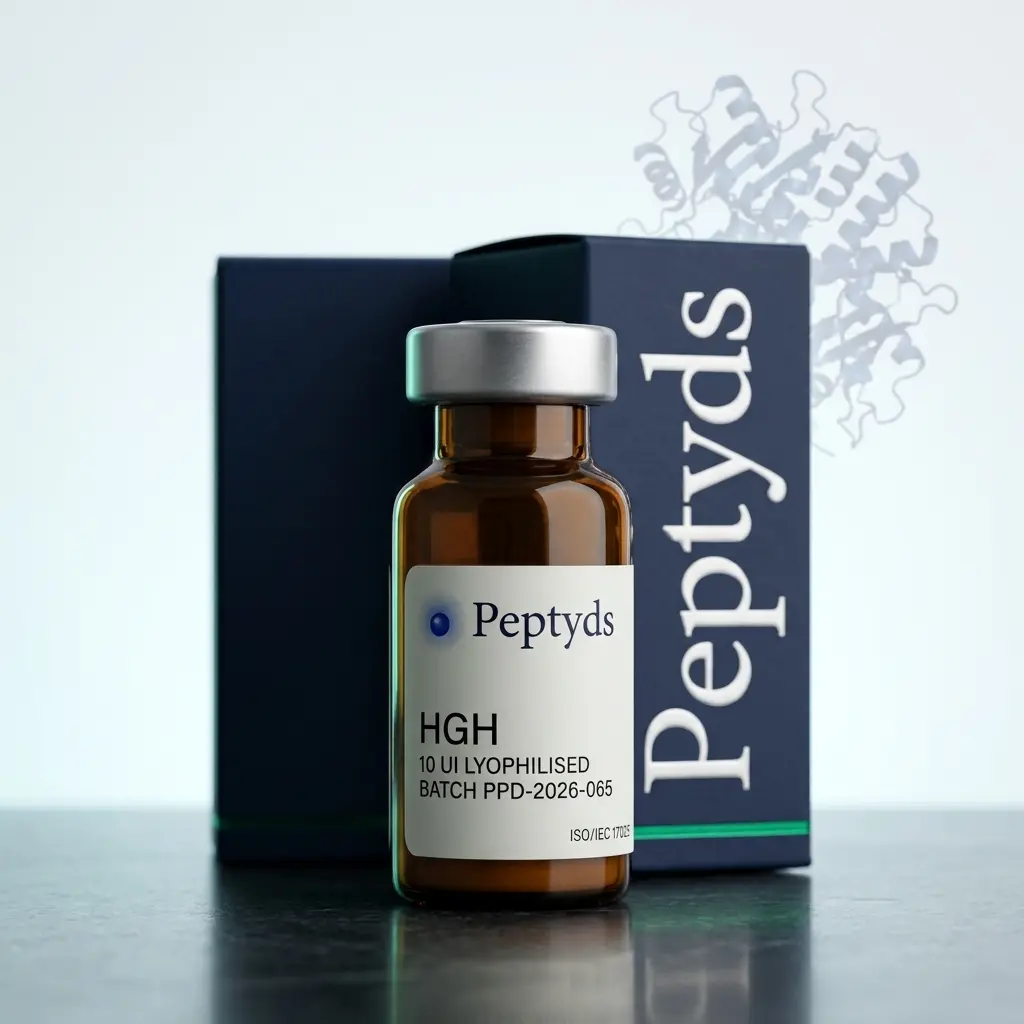
HGH
La hormona de crecimiento humana (HGH) es un polipéptido recombinante de 191 aminoácidos idéntico a la hormona hipofisaria natural. Es la señal fundacional para la estimulación de IGF-1, la reproducción celular, la lipólisis y la regeneración sistémica de los tejidos.
Investigación en endocrinología y regeneración celular.
For Research Use Only — Not for Human Consumption.
Sold strictly for in vitro laboratory research purposes.
Listed under the WADA 2026 Prohibited List.
Not for use by competitive athletes in sanctioned sports.
- Disponibilidad
- Delivered in 3–7 days (EU)
- Conservación
- Store 2–8 °C. Reconstitute before use.
- Se envía desde
- EU Fulfilment Centre
Prueba de laboratorio, por lote
- Analizado de forma independiente, por lote
- Certificado de análisis disponible
- Pureza e identidad documentadas
Investigación en endocrinología y regeneración celular.
La HGH recombinante (CAS 12629-01-5) es un polipéptido monocatenario estructuralmente complejo con dos puentes disulfuro. La investigación estudia su agonismo del receptor de GH, la estimulación posterior de IGF-1 hepática y su profundo impacto en la homeostasis metabólica, la acumulación de tejido magro y la densidad mineral ósea. MW ~22.125 Da.
- — Baumann et al. (1991) — proteínas de unión a la hormona de crecimiento e interacciones con el receptor en circulación.
- — Veldhuis et al. (2001) — regulación neuroendocrina de la secreción de GH y descenso asociado a la edad.
- — Salomon et al. (1989) — efectos del tratamiento con hormona de crecimiento humana recombinante en la composición corporal y el metabolismo.
- — Rudman et al. (1990) — efectos de la hormona de crecimiento humana en hombres mayores de 60 años.
Solo contexto de investigación. No es consejo médico. Consulta a un profesional sanitario cualificado antes de usarlo.
- 10ui de polvo liofilizado por vial
- Reconstituir con agua bacteriostática antes de usar
- Conservar liofilizado a 2–8 °C, protegido de la luz
- Una vez reconstituido, refrigerar y usar en 21 días
- Un vial de HGH liofilizado de 10ui
- Tapón con precinto de seguridad y etiqueta con código de lote
- Tarjeta de conservación con pautas de reconstitución
What the research reports about this molecule.
Classic parameters from peer-reviewed literature. Not human dosing guidance — read alongside the PubMed references on /learn.
- Sequence
- Polipéptido monocatenario de 191 aminoácidos
- Molecular weight
- 22125 Da
- Mechanism
- Agonista del receptor de hormona de crecimiento, estimulador de IGF-1
- Research domain
- Endocrinología, regeneración celular
- Reconstitution
- Agua bacteriostática, USP
- Storage
- Largo plazo -20 °C liofilizado; reconstituido 2–8 °C
Pasos simples y deliberados — no un protocolo.
Estas son notas prácticas de manejo. Las decisiones de dosis quedan entre tu médico y tú.
- 1
Reconstituye con agua bacteriostática — remueve con suavidad, no agites (molécula frágil)
- 2
Extrae la dosis acordada con tu médico con una jeringa de calibre fino
- 3
Guarda el vial reconstituido en la nevera y úsalo en 30 días
Guía de uso
Lee el protocolo de investigación
Instrucciones breves de reconstitución, dosificación y manejo.
Calculadora de reconstitución
Solo para investigaciónJeringa
Péptido en el vial
Agua bacteriostática
Concentración2.5 mg/mL
Dosis objetivo
Carga la jeringa hasta
10
unidades · 0.1 mL
Concentración
2.5
mg/mL
Dosis por vial
20
dosis
U-50 5 · U-40 4 unidades
Solo para cálculo de investigación de laboratorio. No es consejo médico ni de dosificación, y no es para uso humano ni veterinario.
Quienes investigan Recuperación también comparan
Each release is matched with quality documentation through a documented verification path. Identity, purity, and composition test results sit on the product page before you buy.
Every batch is verified by an ISO/IEC 17025-accredited laboratory before release. Identity, purity, and documentation travel with the product — not behind a form.
Sensitive peptides ship in insulated cold packaging with gel packs sized for a 48-hour transit window, tracked door to door.
Todo lo que vale la pena preguntar antes de pedir.
Envío, conservación, calidad y cuándo hablar con un médico — sin rodeos.
What proof of quality comes with my order?
Every batch ships with a batch code printed on the vial. The matching independent lab report — showing identity, purity, and composition — is linked on the product page and stays on your order page after purchase.
How should I store my order when it arrives?
Sensitive peptides ship cold. Move them to a fridge on arrival (2–8 °C) unless the product page states otherwise. Lyophilised vials can tolerate short transit at ambient temperature but should not be left unrefrigerated for extended periods once delivered.
When will my order ship and arrive?
Orders placed before 14:00 CET Monday–Friday ship the same business day from our European fulfilment centre in The Hague, Netherlands. Standard tracked EU delivery arrives in 2–4 business days; express options are available at checkout.
What happens after I place an order?
You will receive an order confirmation, then a dispatch email with tracking once the package leaves our fulfilment centre. Your order page keeps the batch code, lab report, and storage guidance in one place for later reference.
How do I reconstitute a lyophilised peptide vial?
Bring both the lyophilised vial and the bacteriostatic water to room temperature, equalise pressure with a sterile vented needle, then inject the solvent slowly down the side of the vial. Swirl gently — never shake — until clear, and refrigerate at 2–8 °C.
How much bacteriostatic water should I add to my peptide vial?
The calculation is peptide mass (mg) ÷ desired concentration (mg/mL) = volume of bacteriostatic water in mL. For example, a 5 mg vial at 1 mg/mL needs 5 mL; at 2 mg/mL, 2.5 mL. Every Peptyds product page carries a suggested reconstitution volume tuned to the vial size.
How long does a reconstituted peptide stay stable in the fridge?
Most lyophilised peptides reconstituted with bacteriostatic water remain stable for 28–30 days at 2–8 °C, protected from light. A handful of short, fragile sequences — Epithalon among them — drop to roughly 14 days. Never freeze a reconstituted vial.
What side effects are most commonly reported across peptide research?
Across published trials and case series, the most frequent reported events are injection-site reactions (redness, induration, transient discomfort), headache, mild nausea, and temporary fatigue. GLP-1 and dual-agonist class peptides add dose-dependent gastrointestinal effects.
Who should not use peptides?
Peptides are not appropriate for anyone who is pregnant, nursing, planning conception, under 18, managing active cancer, or on immunosuppressants — and competitive athletes governed by WADA must avoid every peptide on the prohibited list. Anyone with a personal or family history of melanoma should specifically avoid melanocortin-receptor agonists.
Should I speak to a clinician before using a peptide?
We recommend it — especially if you are pregnant, nursing, managing a medical condition, or combining peptides with prescribed medication. Our product pages are educational. They are not medical advice and they do not replace a conversation with a qualified practitioner.